

 Email Us: info@lupinepublishers.com
 Call Us: +1 (914) 407-6109
57 West 57th Street, 3rd floor, New York - NY 10019, USA
Call Us: +1 (914) 407-6109
57 West 57th Street, 3rd floor, New York - NY 10019, USA


Lupine Publishers Group
Lupine Publishers
ISSN: 2637-4706
Research Article(ISSN: 2637-4706) 
Once-Weekly Insulin Icodec: A Useful Addition for Diabetes Therapy Volume 4 - Issue 2
Received: September 21, 2023; Published:September 29, 2023
Corresponding author:Department of Medicine, Olive View-UCLA Medical Center, David-Geffen UCLA Medical School, USA
DOI: 10.32474/DDIPIJ.2023.04.000183
 Abstract
 PDF
PDFAbstract
Insulin icodec is a long-acting basal insulin analog under development that can be administered once weekly. The main purpose of this article is to provide an appraisal on insulin icodec based on available data published in a series of phase 3 clinical trials collectively called the ONWARDS Program. In 4 of the 5 published ONWARDS trials, reductions in glycated hemoglobin (HbA1c) levels were slightly superior with insulin icodec compared with once-daily insulin glargine or degludec with a mean difference of 0.19-0.38 percentage points. In the 5th trial, insulin icodec was not inferior to insulin degludec in decreasing HbA1c values. Data analysis of continuous glucose monitoring (CGM) showed greater or similar time spent in range (TIR) with insulin icodec versus insulin glargine or degludec. Incidence of level 1 hypoglycemia [blood glucose (BG) levels 54-69 mg/dl] was higher with insulin icodec compared with insulin glargine or degludec with estimated rate ratio (ERR) ranging from 1.25 to 1.88. Patient satisfaction and compliance were greater with insulin icodec compared with insulin glargine or degludec. In 2 of the 5 ONWARDS published trials, incidence of combined level 2 hypoglycemia (clinically significant hypoglycemia with BG < 54 mg/dl) and level 3 hypoglycemia (severe hypoglycemia with cognitive impairment requiring external assistance) was significantly higher (by 71-89%) with insulin icodec vs insulin glargine or degludec. Preliminary data in patients with type 1 diabetes showed approximately doubling rates of combined level 2 or 3 hypoglycemia with insulin icodec [(19.9 hypoglycemic events per person-year-exposure (PYE)] versus insulin degludec (10.3 hypoglycemic events per PYE). When analyzed separately, no significant increase in level 3 hypoglycemia or nocturnal hypoglycemia was found in association with use of insulin icodec. Time spent below range (TBR) in CGM was similar between insulin icodec and insulin glargine or degludec. There was tendency toward more weight gain with insulin icodec compared with glargine or degludec. In one trial, weight gain was significantly greater with insulin icodec versus degludec, with an estimated treatment difference (ETD) of 1.7 kg. Allergic reactions were not increased with use of insulin icodec. In conclusion, insulin icodec may be a convenient basal insulin that is administered once weekly. It is at least as effective as insulin glargine or degludec. Yet, it is associated with increased incidence of levels 1 and 2 hypoglycemia.
Keywords:insulin; icodec; glargine; degludec; hypoglycemia; glycated hemoglobin.
Introduction
The once-weekly insulin icodec was engineered in an attempt to improve adherence to basal insulin intake. The half-life of insulin icodec is 196 hours (8.1 days) making it suitable for once-weekly administration [1]. Insulin icodec reaches a steady state after 3-4 weeks, then exhibits an evenly distributed glucose-lowering activity throughout the week [1]. The long duration of action of insulin icodec is attributed to 2 main factors. First, binding to albumin through addition of a C20 fatty acid-containing side chain to form an albumin-binding depot from which icodec is slowly released in the circulation. Second, 3 amino acid substitutions that decreases affinity of icodec to insulin receptors leading to its decreased rate of clearance. Normally, insulin clearance occurs primarily through internalization following binding of insulin to its receptors at cell surface [1]. Thus, reduced binding of insulin icodec to insulin receptors will lead to its reduced clearance and further prolongation of its action [1]. Importantly, the reduced affinity of icodec to insulin receptor does not compromise its potency but slows its action [1]. The concentration of formulation of insulin icodec is 7 times higher than that of the standard insulin U100 formulation. It follows that the volume of insulin icodec administered once weekly is similar to other basal insulin dosing volumes given once daily [1]. To support its approval, insulin icodec is being evaluated in a program called ONWARDS. The latter consists of 6 phase 3 clinical trials that directly compare insulin icodec with the once-daily insulin analogues glargine and degludec [2]. The idea of this program is to assess efficacy and safety of insulin icodec in different clinical situations in patients with diabetes. Five of these 6 trials have been recently published and summarized in table 1 [3-7]. The main objective of this article is to review the advantages and limitations of insulin icodec based on results of the ONWARDS program.
Overview Of the Onwards Trials
There are several common features in trials of the ONWARDS Program. All included studies were randomized, multinational and treat-to target phase 3a clinical trials [3-7]. All trials were open label except ONWARDS 3 trial, which was double masked [5]. The primary endpoint was the change in HbA1c levels from baseline to the end of the study. The target of fasting self-measured BG was 80- 130 mg/dl. To achieve that target, doses of insulin icodec, glargine and degludec were adjusted weekly based on 3 pre-breakfast BG readings (measured on 2 days prior to and on the day of the weekly titration [3]. Thus, if the mean of the 3 BG values are > 130 mg/dl, insulin icodec dose is increased by 20 units weekly and doses of glargine or degludec are increased by 3 units daily. On the other hand, if the lowest of the 3 fasting BG values is < 80 mg/dl, doses of insulin icodec are decreased by 20 units/week and those of glargine or degludec by 3 units per day [3]. In ONWARDS trials, the initial dose of insulin icodec was equal to 7 times the dose of daily glargine or degludec. Accordingly, in insulin-naïve patients (ONWARDS 1, 3 and 5), insulin icodec was started at 70 units once weekly while glargine or degludec was started at 10 units once daily [3-7]. In patients already receiving basal insulin such as in ONWARDS 2 and 4 trials, the first insulin icodec dose was increased by 50% to accelerate reaching its steady state [4-6]. ONWARDS 1 trial is the longest-term trial of the ONWARDS Program lasting 78 weeks followed by 5-week follow-up period for safety monitoring) [3]. The latter study compared insulin icodec with insulin glargine in patients with type 2 diabetes who were insulin naïve [3]. ONWARDS 2 trial compared insulin icodec and degludec in patients with type 2 diabetes already treated with a basal insulin [4]. ONWARDS 3 trial compared insulin icodec with insulin degludec in insulin-naïve patients [5]. ONWARDS 4 trial was the only ONWARDS trial that compared insulin icodec with insulin glargine in patients already receiving basal-bolus or meal-time short-acting insulin [6]. Hence, this trial included patients with advanced type 2 diabetes with mean duration of approximately 17 years (table 1) [6]. ONWARDS 5 trial, the largest (N=1,085), compared insulin icodec titrated with a dosing guide app with degludec, glargine U100, or glargine U300 titrated per standard practice in insulin naïve patients under real practice conditions [7]. ONWARDS 6 trial, planned for 52 weeks and dedicated for patients with type 1 diabetes, has not been published yet. However, preliminary results at 26 weeks were published [8].
Effects of Insulin ICODEC on Glycemic Control
In ONWARDS 1, 2, 3, and 5 insulin icodec was shown to be slightly but statistically superior to both glargine glargine and degludec in lowering HbA1c levels, with estimated treatment difference (ETD) of approximately 0.19 to 0.38 percentage points (Table 1) [3-5,7]. In ONWARDS 4, insulin icodec was not superior in efficacy than degludec but was non-inferior neither (Table 1) [6]. In the 5 trials, the mean reduction in HbA1c levels by insulin icodec was approximately 1.5 percentage points compared with baseline [3-7]. Inspection of time curves of HbA1c values of insulin icodec revealed that reductions in HbA1c values were evident 10- 13 weeks following its initiation, then reached a trough at week 26 followed by a plateau [3-7]. Similar trajectory was observed with insulin glargine and degludec [3-7]. Data from CGM was used for a duration of 4 weeks in ONWARDS 1 and 2 trials to identify the diurnal pattern of BG [3,4]. Overall, no significant differences in time spent in range (70-180 mg/dl) was identified between icodec groups and glargine or degludec groups [3,4]. Meanwhile, in ONWARDS 1 trial, the percentage of time spent with BG levels above the range (ie. > 180 mg/dl) was approximately 1 hour less with insulin icodec than with insulin glargine [3]. Clearly, insulin efficacy depends on its doses. There was no consistent pattern in terms of difference in insulin doses between insulin icodec and comparator insulin (Table 1).
Patient Satisfaction with Insulin ICODEC
Patient satisfaction with insulin icodec versus degludec was evaluated in ONWARDS 2 and 5 trial using the “Diabetes Treatment Satisfaction Questionnaire” (DTSQ) with higher score indicating greater satisfaction [4]. In ONWARDS 2, at week 26, the DTSQ score was slightly but significantly higher in patients randomized to insulin icodec 4.22 versus insulin degludec 2.96, ETD 1.25 (95% CI, 0.41 to 2.10, P=0.003) (Table 1) [4]. In ONWARDS 5, the corresponding ETD was smaller, but still statistically significant; ETR 0.78 (95% CI, 0.10 to 1.47) (Table 1) [7]. Compliance with insulin therapy, assessed by the Treatment Related Impact Measure for Diabetes [TRIMP-D] compliance domain score, was significantly higher with insulin icodec vs once-daily insulin analogues in ONWARDS 5 trial, ETD 3.04 (95% CI, 1.28 to 4.81) [7].
Safety of insulin icodec
Hypoglycemia
Given the long duration of action of insulin icodec, there is a major concern about increased risk of prolonged hypoglycemia, slow recovery and recurrence of hypoglycemic episodes. In a short-term (7 weeks) cross-over trial including selected patients with type 2 diabetes (n=43, mean age 56 years) without co-morbidities, Pieber et al. [9] compared the frequency and severity of hypoglycemia in patients randomized to insulin icodec versus glargine. These authors induced hypoglycemia to a target plasma glucose levels of 54 mg/dl by doubling and tripling the doses of insulin icodec and glargine. Overall, they observed no significant differences between insulin icodec and glargine in the proportions of patients who developed hypoglycemia, hypoglycemic symptoms, time to recovery, and in the extent of rise of insulin counterregulatory hormones in response to hypoglycemia [9]. Despite these preliminary reassuring findings, results of clinical trials including higher number of patients followed for longer duration clearly showed increased risk of hypoglycemia with insulin icodec versus either insulin glargine or degludec. Thus, in ONWARDS 1 trial, at week 83, the rates of combined clinically significant (level 2) or severe hypoglycemia (level 3) were significantly greater with insulin icodec compared with glargine, 0.30 and 0.15 hypoglycemic events per PYE, respectively, ERR 1.71 (95% CI, 1.06 to 2.76) [3]. Furthermore, the difference in these rates between insulin icodec and glargine widened with duration of use [3]. Rates of level 1 hypoglycemic events were also higher with insulin icodec versus glargine, 3.02 events per PYE versus 1.39 events per PEY at 83 weeks [3]. In ONWARDS 3 trial, combined level 2 and 3 hypoglycemia from baseline to week 26 was approximately 3-fold higher with insulin icodec versus degludec; ERR 3.12 (95% 1.30 to 7.51, P=0.01) [5]. Furthermore, in ONWARS 2, 3 and 5 trials, there was increased risk of hypoglycemia (level 1, and combined level 2 and 3) with insulin icodec compared with once-daily insulin analogues (table 1) [4,5,7]. As mentioned earlier, ONWARDS 4 trial was the only study that compared insulin icodec with insulin glargine on a background of pre-meal bolus insulin aspart [6]. Again, the latter trial showed increased risk of level 1 hypoglycemia with insulin icodec versus glargine, ERR 1.25 (95% CI, 1.03 to 1.52, P=0.025) (Table 1) [6]. Analyzed separately, frequencies of level 3 hypoglycemia and nocturnal hypoglycemia were not increased with insulin icodec in the ONWARDS 1,2,3-5 trials [3-7]. In type 1 diabetes, preliminary results of ONWARDS 6 trial showed that rates of level 2 and 3 hypoglycemia with insulin icodec were approximately double the rates with degludec at 26 weeks, 19.9 versus 10.3 events per PYE [8]. Meanwhile, the use of CGM for 4 weeks during the ONWARDS 1 and 2 trials revealed similar time spent under BG levels of 54 mg/ dl in patients receiving insulin icodec versus glargine or degludec [3,4]. Thus, taken together, in type 2 diabetes, risk of level 1 and 2 hypoglycemia seems to be increased with icodec versus glargine or degludec, whereas risk of level 3 or nocturnal hypoglycemia is not increased.
Weight gain
There was a trend towards more weight gain associated with use of insulin icodec versus glargine or degludec in ONWARDS 1, 3, 4 and 5 trials (Table 1). In ONWARDS 2 trial, patients randomized to insulin icodec had a mean weight gain of 1.4 kg, whereas those randomized to insulin degludec had 0.3 kg weight loss, ETD 1.7 kg (95% CI, 0.76 to 2.63, P=0.0004) (Table 1) [4].
Advantages of insulin icodec
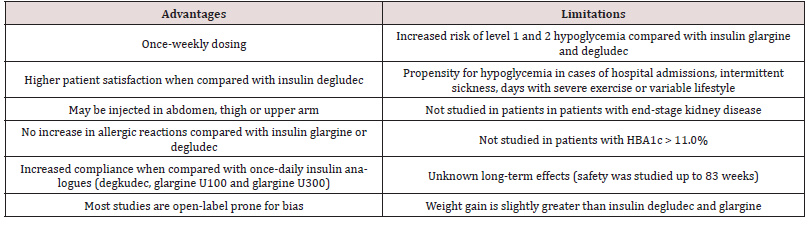
The major advantage of insulin icodec is the convenience and simplicity of its administration once weekly avoiding 6 extra injections per week compared with traditional basal insulins. In addition, if necessary, the day of administration may be changed by up to 3 days ensuring a minimum of 4 days between injections [6,7]. Moreover, a single dose-study showed that pharmacokinetics and pharmacodynamics of icodec did not change significantly whether injected in the thigh, abdomen or upper arm [10]. Thus, as expected, patient satisfaction was higher with insulin icodec compared to one-daily insulin analogues. In terms of efficacy, insulin icodec proved to be at least as effective, if not slightly more effective, as once-daily insulin glargine and degludec. However, the mean difference in HbA1c levels of 0.19-0.38 percentage points between insulin icodec and glargine or degludec is unlikely to have major clinical consequences. It is reassuring that available evidence do not suggest that insulin icodec is more immunogenic than other basal insulins as reflected by the low number of allergic and injection site reactions that are generally similar to insulin glargine and degludec [3-7].
Limitations of insulin icodec
The main limitation of insulin icodec is the increase incidence of level 1 and 2 hypoglycemia as detailed above. When expressed in absolute terms, this high risk of hypoglycemia can be substantial as illustrated by the difference in rates of combined level 2 and 3 hypoglycemia in patients with type 1 diabetes between insulin icodec and insulin degludec, 19.9 events per PYE and 10.4 events per PYE, respectively [8]. In fact, in the latter study, the absolute difference in hypoglycemic episodes between insulin icodec and degludec is sufficiently high to question the safety of use of insulin icodec in patients with type 1 diabetes. Unfortunately, insulin icodec was not studied in patients with end-stage kidney disease and those with baseline HbA1c levels > 11.0% because these patients were excluded from the ONWARDS 1-4 trials [3-6]. ONWARDS 5 trial had broader inclusion criteria but ranges of renal function and HbA1c levels at baseline were not mentioned [7]. Other limitations of insulin icodec include tendency to cause more weight gain than insulin degludec or glargine. Moreover, insulin icodec may not be suitable for use in the hospital setting where rapid variations in BG levels are expected. In addition, patients already on insulin icodec before hospital admission should be monitored closely for hypoglycemia for 7 days from the day of last icodec injection. It should be emphasized that all available trials of insulin icodec are sponsored by the manufacturer and all ONWARDS trials, except one, are open label (Table 1) [3-7]. Hence, these studies might be open to multiple bias in favor of insulin icodec. Advantages and limitations of insulin icodec are summarized in Table 2.
Table 1:Summary of phase 3a trials of once-weekly insulin icodec.
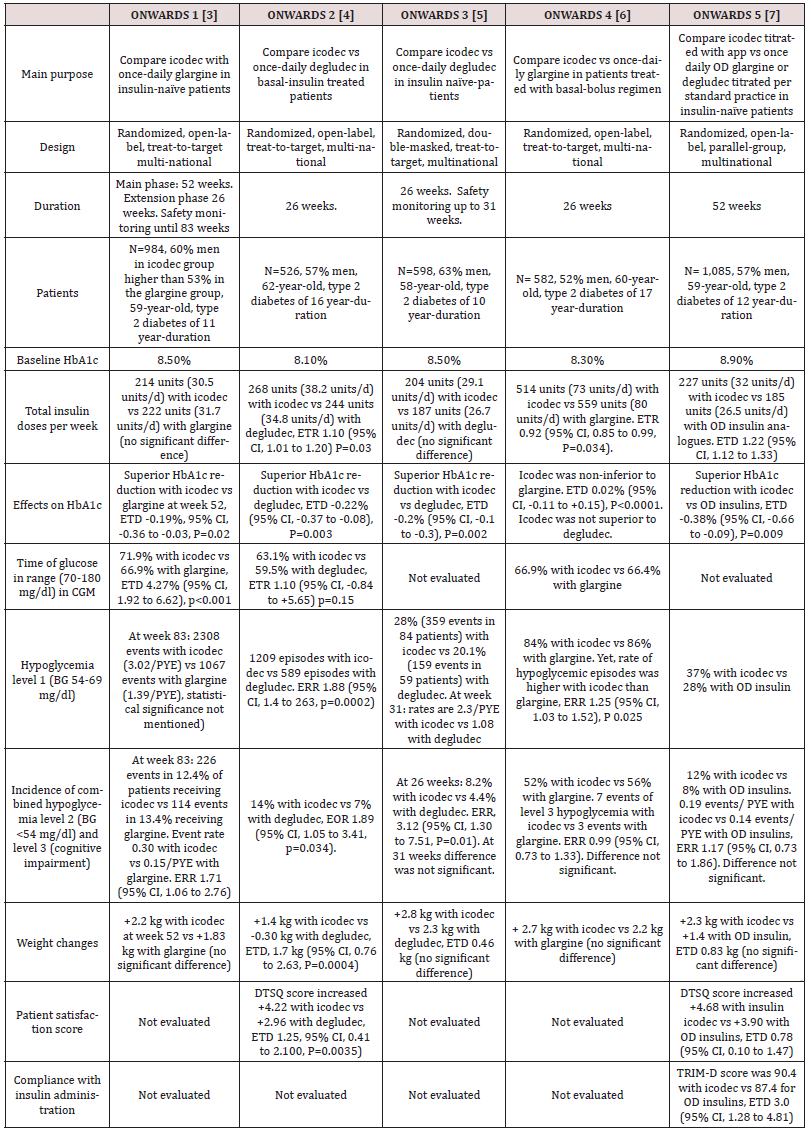
*The primary outcome in all trials was reduction of HbA1c with insulin icodec versus comparator. Values are means.
Abbreviations in the table: OD: once daily, ETD: estimated treatment difference, ERR: estimated rate ratio, HbA1c: glycated hemoglobin, CGM: continuous glucose monitoring, PYE: hypoglycemic event per person-year of exposure. DTSQ: Diabetes Treatment Satisfaction Questionnaire. TRIM-D: Treatment Related Impact Measure for Diabetes compliance domain score.
Table 2:Advantages and limitations of insulin icodec.
Conclusions and future directions
Insulin icodec is a welcome addition to insulin therapy representing a new class of long-acting basal insulin analogs that can be administered once-weekly. Available evidence suggests that insulin icodec may have similar or slightly higher efficacy than once-daily insulin glargine or degludec. However, the use of insulin icodec may be associated with increased risk of level 1 and level 2 hypoglycemia. The latter may be due to its prolonged duration of action and possibly aggressive dose titration. In fact, the titration schedule of the ONWARDS trials was based on an earlier study by Lingvay et al [11]. This study showed that insulin icodec dose adjustment by ±20 units weekly to attain the fasting BG target of 80-130 mg/dl achieved the best balance between efficacy and hypoglycemia compared with 2 other more aggressive titration regimens [11]. It is possible that less aggressive titration of insulin icodec might result in less frequency of hypoglycemia, e.g., an increase of its dose by 10 units per week instead of 20 units. The combination of once-weekly icodec with once weekly glucagon-like peptide-1 receptor agonist (GLP-1 RA) in one single formulation may be an attractive treatment strategy that potentially lowers icodec doses and therefore incidence of hypoglycemia. In addition, the weight loss-inducing effect of the GLP-1 may help attenuate or even override the weight gain induced by insulin icodec. In fact, multiple phase 3 clinical trials are underway to compare the combination of insulin icodec plus semaglutide (called icosema) with each component alone and with glargine in patients with type 2 diabetes [12-14]. Although data derived from the ONWARDS trials was useful in demonstrating the short-term efficacy and safety profile of insulin icodec, well-designed studies are needed to establish its long-term effects on cardiovascular events and mortality.
Conflict of interest
The author does not have a conflict of interest to declare.
References
- Nishimura E, Pridal L, Glendorf T, Hansen BF, Hubálek F, et al. (2021) Molecular and pharmacological characterization of insulin icodec: a new basal insulin analog designed for once-weekly dosing. BMJ Open Diabetes Res Care 9(1): 002301-002301.
- Philis Tsimikas A, Bajaj HS, Begtrup K, Cailleteau R, Gowda A, et al. (2023) Rationale and design of the phase 3a development programme (ONWARDS 1-6 trials) investigating once-weekly insulin icodec in diabetes. Diabetes Obes Metab 25(2): 331-341.
- Rosenstock J, Bain SC, Gowda A, Jódar E, Liang B, (2023) ONWARDS 1 Trial Investigators. Weekly Icodec versus Daily Glargine U100 in Type 2 Diabetes without Previous Insulin. N Engl J Med 389(4): 297-308.
- Philis Tsimikas A, Asong M, Franek E, Jia T, Rosenstock J, et al. (2023) Switching to once-weekly insulin icodec versus once-daily insulin degludec in individuals with basal insulin-treated type 2 diabetes (ONWARDS 2): a phase 3a, randomised, open label, multicentre, treat-to-target trial. Lancet Diabetes Endocrinol 11(6): 414-425.
- Lingvay I, Asong M, Desouza C, Gourdy P, Kar S, et al. (2023) Once-Weekly Insulin Icodec vs Once-Daily Insulin Degludec in Adults with Insulin-Naive Type 2 Diabetes: The ONWARDS 3 Randomized Clinical Trial. JAMA 330(3): 228-237.
- Mathieu C, Ásbjörnsdóttir B, Bajaj HS, Lane W, Matos ALSA, et al. (2023) Switching to once-weekly insulin icodec versus once-daily insulin glargine U100 in individuals with basal-bolus insulin-treated type 2 diabetes (ONWARDS 4): a phase 3a, randomised, open-label, multicentre, treat-to-target, non-inferiority trial. Lancet 401(10392): 1929-1940.
- Pieber TR, Arfelt KN, Cailleteau R, Hart M, Kar S, et al. (2023) Hypoglycaemia frequency and physiological response after double or triple doses of once-weekly insulin icodec vs once-daily insulin glargine U100 in type 2 diabetes: a randomised crossover trial. Diabetologia 66(8): 1413-1430.
- Bajaj HS, Goldenberg RM (2023) Insulin Icodec Weekly: A Basal Insulin Analogue for Type 2 Diabetes. Touch REV Endocrinol 19(1): 4-6.
- Pieber TR, Arfelt KN, Cailleteau R, Hart M, Kar S, et al. (2023) Hypoglycaemia frequency and physiological response after double or triple doses of once-weekly insulin icodec vs once-daily insulin glargine U100 in type 2 diabetes: a randomised crossover trial. Diabetologia 66(8): 1413-1430.
- Plum-Mörschel L, Andersen LR, Hansen S, Hövelmann U, Krawietz P, (2023) Pharmacokinetic and Pharmacodynamic Characteristics of Insulin Icodec After Subcutaneous Administration in the Thigh, Abdomen or Upper Arm in Individuals with Type 2 Diabetes Mellitus. Clin Drug Investig 43(2): 119-127.
- Lingvay I, Buse JB, Franek E, Hansen MV, Koefoed MM, et al. (2021) A Randomized, Open-Label Comparison of Once-Weekly Insulin Icodec Titration Strategies Versus Once-Daily Insulin Glargine U100. Diabetes Care. 44(7): 1595-1603.
- A research study to see how well the new weekly medicine IcoSema controls blood sugar level in people with type 2 diabetes compared with weekly insulin icodec (COMBINE 2). NCT 05352815.
- A research study to see how well the new weekly medicine IcoSema controls blood sugar level in people with type 2 diabetes compared with weekly semaglutide (COMBINE 2). NCT05259033.
- A research study to see how well the new weekly medicine IcoSema controls blood sugar level in people with type 2 diabetes compared to insulin glargine taken daily with insulin as part. NCT05013229. COMBINE 3.


-

Mark E Smith
Bio chemistry
University of Texas Medical Branch, USA -

Lawrence A Presley
Department of Criminal Justice
Liberty University, USA -

Thomas W Miller
Department of Psychiatry
University of Kentucky, USA -

Gjumrakch Aliev
Department of Medicine
Gally International Biomedical Research & Consulting LLC, USA -

Christopher Bryant
Department of Urbanisation and Agricultural
Montreal university, USA -

Robert William Frare
Oral & Maxillofacial Pathology
New York University, USA -

Rudolph Modesto Navari
Gastroenterology and Hepatology
University of Alabama, UK -

Andrew Hague
Department of Medicine
Universities of Bradford, UK -

George Gregory Buttigieg
Maltese College of Obstetrics and Gynaecology, Europe -

Chen-Hsiung Yeh
Oncology
Circulogene Theranostics, England -
.png)
Emilio Bucio-Carrillo
Radiation Chemistry
National University of Mexico, USA -
.jpg)
Casey J Grenier
Analytical Chemistry
Wentworth Institute of Technology, USA -

Hany Atalah
Minimally Invasive Surgery
Mercer University school of Medicine, USA -

Abu-Hussein Muhamad
Pediatric Dentistry
University of Athens , Greece