

 Email Us: info@lupinepublishers.com
 Call Us: +1 (914) 407-6109
57 West 57th Street, 3rd floor, New York - NY 10019, USA
Call Us: +1 (914) 407-6109
57 West 57th Street, 3rd floor, New York - NY 10019, USA


Lupine Publishers Group
Lupine Publishers
ISSN: 2644-1217
Research ArticleOpen Access
Quality of Life in Children With Sickle Cell Anemia Volume 4 - Issue 5
Received: June 30, 2023 Published:July 14, 2023
*Corresponding author: Aguiar C, Pediatrician (Título de Especialização em Pediatria), área de concentración em Gastropediatra pela UNIFESP; Mestre em Neurociências pelo Instituto de Psicologia da USP; PhD in Neuroscience at the Instituto de Psicologia da USP; Medica perita da Commissão de Assuntos de Assistance à Saúde (CAAS) do Governo do Estado de São Paulo; preceptora do Curso de Psiquiatria da Infância e Adolescência pela Santa Casa de Misericórdia do Rio de Janeiro- Medcurso, Brazil
DOI: 10.32474/OAJCAM.2023.04.000197
 Abstract
 PDF
PDFAbstract
Introduction: Sickle Cell Anemia (SCA) is the most common genetic disease in Brazil and in the world and manifests itself mainly in the black population. In addition to anemia and other clinical manifestations, painful crises occur due to secondary ischemia, which can lead to loss of Quality of Life (QoL), defined as “how the patient feels” instead of “how the health technician, based on his clinical measurements, believes he should feel”.
Objective: To verify the Quality of Life of children with Sickle Cell Anemia.
Method: A population affected by the disease was evaluated, consisting of 30 children aged between 4 and 11 years, from a pediatric hematology service, located in the city of São Paulo. The control group was composed by 30 children without any condition, from private and public schools in the same city. The two groups were assessed using a QoL scale (AUQEI). The variables had a normal distribution verified through the Normality test (Kolmogorov-Smirnov). To compare information with the numerical measurement level, Spearman’s correlation coefficient (non-parametric), t-student and Mann-Whitney tests were used.
Results: Differences in the socioeconomic profile of the studied children did not alter the results obtained and no significant differences were observed between the QoL of the studied populations.
Conclusions: The results obtained do not differ from those observed by other authors in the study of QoL in patients with chronic diseases. Quality of Life did not change due to painful phenomena.
Keywords: Sickle Cell Anemia; Quality of Life; Pain; Anxiety
Introduction
Sickle cell anemia (SCA) is a monogenic hereditary disease in which glutamate is replaced by valine, resulting in abnormal hemoglobin (HbS) that crystallizes when releasing its oxygen, leaving the red blood cell in a sickle shape [1]. In a situation of deoxygenation, this hemoglobin suffers polymerization of its molecules, which leads to the sickling of the red blood cell, which acquires the shape of a sickle. This alteration causes hemolytic anemia with a shortened red cells half-life and reduced plasticity, which causes it to become entangled with other sickled red blood cells and leads to agglomeration and blockage of blood flow (vasoocclusion) to the tissues, causing tissue damage and hypoxia [2].
The main clinical manifestations of Sickle Cell Disease are chronic anemia caused by the destruction of sickled red blood cells, which causes pallor of the skin and mucous membranes, fatigue, drowsiness, tachycardia and heart murmurs. Hemolysis can also occur acutely, causing a sharp drop in the hemoglobin level, requiring urgent medical intervention. Painful crises are extremely frequent due to ischemia secondary to obstruction of blood flow by sickled red blood cells with regional hypoxia and an inflammatory process that lead to intense pain in different parts of the body, including bones, with dactylitis being the first painful manifestation [3-6]. Painful crises are triggered by exposure to cold and sudden changes in temperature, infections, dehydration, menstrual periods, pregnancy, stress and splenic sequestration in which a massive amount of sickled blood is trapped in the spleen, triggering pallor, prostration, splenomegaly, abdominal pain, dehydration, hypovolemia and shock.
The concept of Quality of Life has a subjective basis and has only been considered since the 20th century, thinking about “how the patient feels” instead of “how the health technician, based on his clinical measurements, believes he should feel”. Thus, QoL can be defined as: “an individual’s perception of their position in life in the context of their culture and value system in which they live; and in relation to their goals, expectations and standards, and may still be influenced by the individual’s physical health, psychological state, level of independence, social relationships, environmental factors and personal beliefs” [7].
Considering sick children and adolescents, the perception of well-being can mean:
“how close your wishes and hopes are to what is actually happening. It also reflects your outlook, both for yourself and for others [...] it is very subject to change, being influenced by everyday events and chronic problems” [8]. Consequently, the relevance of this study consists in providing theoretical and empirical contributions in the field of Health Psychology, considering the concept of QoL, which enables subsidies to be provided for the planning and intervention of the teams that work with this population.
Objective
Due to the characteristics described so far, the objective of this study was to verify the quality of life of children with Sickle Cell Anemia.
Methods
Thirty children of both sexes, with Sickle Cell Anemia, aged between 4 and 11 years, from a reference outpatient clinic in Pediatric Hematology at a children’s hospital in the State of São Paulo. All of them were screened at birth using the Guthrie Test, which when positive for Sickle Cell Anemia, led to referral to a Basic Health Unit or to a hematology service, where the diagnosis was confirmed through hemoglobin electrophoresis. For the constitution of the control group, 30 other children were evaluated with the same characteristics of the experimental group, but without Sickle Cell Anemia or any other chronic disease, coming from private and public schools in the city of São Paulo.
The study therefore used a convenience sample
For the analysis of both groups, we used instruments with the objective of evaluating the socioeconomic level (Pelotas Scale) and Quality of Life (AUQEI) of both groups. The application of all scales was done individually by the researcher.
The Pelotas Social Class Assessment [9], defines social classes as Bourgeoisie (B), New Petty Bourgeoisie (NPB), Traditional Petty Bourgeoisie (PBT), Typical Proletariat (PT), Non-Typical (or Atypical) Proletariat (PNT) and Subproletariat (SUBPRO ).
The Autoquestionnaire Qualité de Vie Enfant was developed by Manificat et al.[10] translated and validated in Brazil by Assumpção, Kuczynski, Sprovieri and Aranha [11]. Across 26 questions, it explores family and social relationships, activities, health, bodily functions and separation. It is based on the point of view of the child’s own satisfaction and uses the support of images of 4 faces that express different emotional states: very unhappy, unhappy, happy and very happy. It is composed of four domains (autonomy, leisure, function and family) obtaining a single score, that results from the final sum of the scores assigned to the items.
In order to verify whether or not the studied groups were part of a normal curve, a Normality test was performed on numerical variables to determine the type of test to be used (non-parametric or parametric). For this purpose, the Kolmogorov-Smirnov Normality test was applied. In the comparative analyzis between the Normal x Sickle Cell groups for the numerical variables of the study, the nonparametric Mann-Whitney tests or the parametric Student t-tests were used. Comparisons between the Normal x Sickle Cell groups for the study’s categorical variables were performed using the Chi-square test. The project was evaluated by the Research Ethics Committee and was approved on Brazil Platform in accordance with Opinion No. 4,983,385. According to the proposed methodology, we obtained the following results (Table 1).
Results
Significant (p<0.05) for Age and AUQEI that do not adhere to normality and require the use of non-parametric tests (Table 2).
There was a significant difference between the groups in terms of Age in the sense of greater age in the Normal group. There was no significant difference between the groups regarding the numerical variable of the study (QoL) (Table 3).
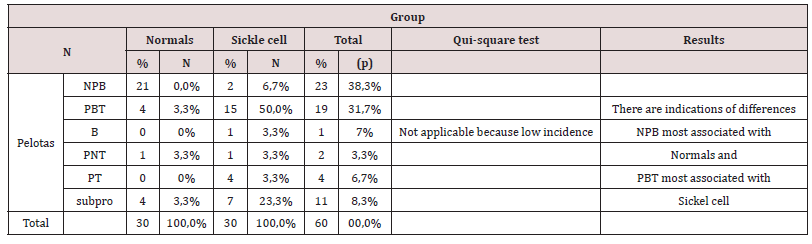
There was no significant difference in gender distribution between the study groups. It was not possible to apply the Chisquare due to the low incidence in some categories. However, there are indications that NPB is more associated with Normal and PBT is more associated with Sickle Cell (Table 4).
Table 1: Verification of the distribution of the studied groups regarding normality. Source: Prepared by the researcher.

Table 2: Comparison between ages and their relationship with the studied category. Source: Prepared by the researcher.
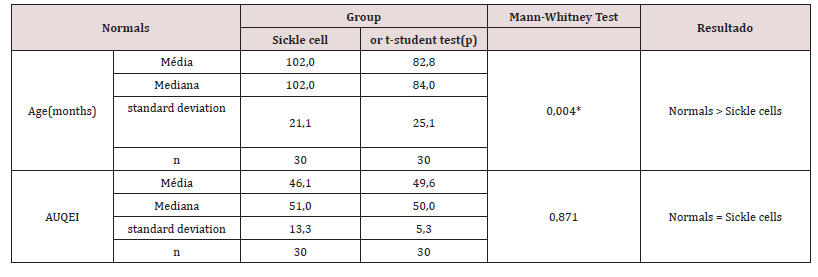
Table 3: Comparison between the normal and sickle cell groups when considering the gender category. Source: Prepared by the researcher.

Table 4: Comparison between the normal and sickle cell groups when considering the social class category.
Discussion
Chronic disease impairs the development of the individual, especially when it starts in childhood [6,12,13] and the negative effects of the disease are present throughout life14. The duration of the disease is not the main criterion and the disease will be classified as chronic if it causes at least one of the following consequences:
a. Function or activity limitations, compromising social relationships;
b. Dependence on medication, special diet, medical technology, specific devices and personal assistance;
c. Need for special medical, psychological or educational care, or even different accommodations at home and at school.
Psychic damage resulting from chronic illness in children is frequent, especially the development of anxiety, as clinical complications cause changes in the development of self-image and social skills, mainly due to school absence with a decrease in interaction in school and social activities, as well to the low school performance generally present [12,14,15].
From the 2010 census of the Brazilian Institute of Geography and Statistics [16]. and considering the child population as a whole, we observed that 31% had some chronic disease,14 with Sickle Cell Anemia being the most prevalent genetic disease [17] Thus, the study of the repercussions on the child’s psyche and QoL becomes fundamental, mainly due to the countless painful events that demand urgent medical treatment that impacts the life of the bearer and the whole family.
This study aimed to evaluate the quality of life in children and adolescents with sickle cell anemia. All participants were able to fully understand and respond to the questionnaires, none of which were excluded for being unable to respond to the questionnaires.
Considering sex, no difference was observed between the groups, guaranteeing their uniformity, although it must be considered that Sickle Cell Anemia is a monogenic hereditary disease not linked to sex.1 Regarding age, we observed a significant difference between the older groups in the normal group. However, no significant difference was observed between the groups with regard to the numerical variable of the study, that is, Quality of Life. This difference did not affect the results obtained, not showing relevance within the population we studied, which seems clear to us because it is made up of children between 4 and 11 years of age, still in the preoperative period and concrete operations, in which the Anticipatory mental images, although present in the group in concrete operations, do not allow a vision of the future to be structured with all its possibilities and limitations.
Considering social class, we observed that the group corresponding to the New Petty Bourgeoisie, due to the location of data collection, was related to the normal population, while the group corresponding to the Traditional Petty Bourgeoisie was associated with patients with Sickle Cell Anemia, also due to the fact that the sample is collected in a public hospital. These sociocultural differences between the two populations studied did not significantly alter the results obtained.
The interviews with the children in the experimental group were carried out at the hematology outpatient clinic of the Hospital Infantil Darcy Vargas, before or after the periodic consultation with the hematologist, with the child out of the pain period and, therefore, they were not subjected to acute stressors related to disease and were monitored by their mothers, except for two, which points to the importance of mothers in caring for people with chronic diseases. There were no objections to interviews with people showing availability and explaining that they liked an interview “beyond the illness”.
A child with SCA, like any chronic disease, is a serious family stressor due to frequent painful crises and the high risk of death, an ever-present risk, which leads to the establishment of overprotective relationships, usually on the part of the mother, which burdens her with caring for this child, which is added to the whole routine of the house and/or her work [18] Thus, in our sample, only seven mothers performed some paid activity, with the vast majority saying that it was impossible, due to “being right here in the hospital with him”.
Care for the sick child becomes the focus of family attention, causing less care or less attention dedicated to the other siblings because, when one of the children has a chronic illness only the child who is sick receives the attention of the parents. Therefore, he/she is often unable to perceive all the damages of being sick, which minimizes his damage and improves his resilience and quality of life. This is consistent with data obtained in other studies that refer to a worsening of QoL in the siblings of patients with chronic conditions, as opposed to that of the patients themselves [19].
When we consider the variable studied in the normal population, there were no significant differences regarding Quality of Life.
Regarding patients with Sickle Cell Anemia, when considering the QoL categories, no significant correlations were observed either. If we take into account that Sickle Cell Anemia causes a great impairment in global functioning, the strategies for coping with the disease are an important parameter in the assessment of social functioning [12,20] and this adjustment is an indication of the psychological state [21]. This observation, referring to the maintenance of quality of life in patients with chronic pathologies, had already been observed by Kuczynski [22].
However, contrary to what we observed in our study, other authors report that the population with SCA presents great evidence of depressive symptoms, even when somatic symptoms are controlled, being correlated with low self-esteem and tending to increase with age [23,24] a fact not observed by Assumpção [25] who studied adolescents with cerebral palsy and reported only symptoms resulting from post-traumatic stress that disappeared sometime later.
A recent study [26] with 40 adolescents with SCA investigated the prevalence of psychiatric problems collected through the Children’s Interview for Psychiatric Syndromes (ChIPS) and showed that 50% of the sample had psychiatric problems ‒ 12.5% with depressive symptoms, a rate considered high when compared to the index found in adolescents without the disease (4% to 8%), which was also not observed in our study.
There is also a predominance of internalizing behaviors such as depression and anxiety [12,27-29] resulting from the negative impact that the disease has on children, which was also not noticed in our study, since the QoL of both the groups showed.
Also, the high presence of anxiety symptoms, narrated by some authors, could be related to the unpredictability of the disease, [30] since there is a daily coexistence with the risk of crisis and death. This is aggravated in children due to the lower cognitive resources they have to deal with the situation, which would increase the feeling of helplessness and loss of control [12,23] with worse QoL. On the other hand, the unpredictability of the future is lower, because due to its heteronomy, the child feels safer from the support systems coming from health care and from his family.
The literature also considers that children with SCA have a derogatory self-image as a result of physical differences (short stature, sexual immaturity), which causes models of withdrawn behavior, preventing them from performing pleasant and typical activities of the phase [23,24], which also affects QoL. Our results do not reveal the same condition in the same way as other authors31 who do not refer, through the perception of the child who has a chronic pathology, signs of malaise that impair their quality of life.
It seems to us that a positive adaptation to the disease is necessary, and it must begin with an early diagnosis and adherence to treatment with different therapeutic interventions aimed at reducing the negative impact on the quality of life of the child and his family. This early diagnosis and specific interventions can enable the reduction of physical damage and the development of strategies to be adopted in the face of stressors. These are important factors in the reduction of psychological symptoms with reflections on QoL, which presented rates similar to those of the population without any pathology.
Our results do not alter the need to invest in outpatient assessment and intervention programs with the aim of expanding the repertoire of cognitive skills and coping strategies for these children and their parents, to qualify them to deal with the adverse situations resulting from Sickle Cell Anemmia.
Conclusion
When considering the results obtained, we can conclude that in the assessment of QoL in children and adolescents with Sickle Cell Anemia and its relationship with anxiety and painful symptoms, it was observed that:
a. The differences observed in the socioeconomic profile of the studied children do not seem to significantly change the results obtained, and do not influence the QoL of the affected children;
b. No significant differences were observed between the QoL of children and adolescents with and without Sickle Cell Anemia;
c. The memory of pain does not negatively interfere with the QoL of children and adolescents with Sickle Cell Anemia;
d. Significant anxious symptomatology was not observed in the experimental group studied when compared to the control group.
These conclusions do not differ from those observed by other authors in the study of Quality of Life in patients with chronic diseases [19,22,31,32] However, given the limitations of the present study, mainly represented by the sample size, further studies must continue to be carried out. with the aim of knowing other chronic diseases in their evolution so that better defined and organized support systems can be structured.
References
- Silverthorn DU (2017) Fisiologia Humana: uma Abordagem integrada. 7. ed. Porto Alegre: Artmed.
- Zago MA, Pinto, AC S (2007) Fisiopatologia das doenças falciformes: da mutação genética à insuficiência de múltiplos órgã Revista Brasileira de Hematologia e Hematoterapia 29(3): p. 207-214.
- Platt OS (2000) The acute chest syndrome of sickle cell disease. New England Journal of Medicine, v. 342(25): p. 1904-1947.
- Gladwin MT, Vichinsky E (2008) Pulmonary complications of sickle cell disease. New England Journal of Medicine 359(21) p. 2254-2265.
- Platt OS, Brambilla DJ, Rosse WF, Milner, PF Castro O (1994) Mortality in sickle cell disease. Life expectancy and risk factors for early death. New England Journal of Medicine 330(32): 1639-1644.
- Thompson Junior RJ Gustafson KE (1996) Adaption to Chronic Childhood Illness. Washington: American Psychological Association.
- Assumpção JR FB, kuczynski, E (2010) Qualidade de vida na infância e na adolescência: orientações para pediatras e profissionais da saúde mental. Porto Alegre: Artmed.
- Hinds PS (1990) Quality of life in children and adolescents with cancer. Seminars in Oncology Nursing, 4(6): 285-291.
- Lombardi C, Bronfman M, Facchini, LA, Victora CG, Barros, F et al. (1988) Operacionalização do conceito de classe social em estudos epidemioló Revista de Saúde Pública 22(4): 253-265.
- Manificat S, Dazord A, Cochat P, Nicolas J (1997) Evaluatión de la qualité de vie de l'enfant: validation d'un questionaire, premiers ré Archives de Pédiatrie 4(12): 1238-1246.
- Assumpção JR FB, Kuczynski E Sprovieri MH, Aranha E MG (2000) Escala de avaliação de qualidade de vida: (AUQEI - Autoquestionnaire Qualité de Vie Enfant Imagé) validade e confiabilidade de uma escala para qualidade de vida em crianças de 4 a 12 anos. Arquivos de Neuro-Psiquiatria 58(1): 119-127.
- Immelt S (2006) Psychological ajustment in young children with chronic medical conditions. Journal of Pediatric Nursing 21(5): 362-377.
- Silva M GN (2001) Doenças crônicas na infância: Conceito, prevalência e repercussões emocionais. Revista de Pediatria 2(2): 29-32.
- Allen PJ (2010) The primary care provider and children with chronic conditions. In: Allen, PJ, Vessey J A, Schapiro N (eds.). Primary care of a child with a chronic condition. 5th St. Louis Elsevier p. 3-21.
- Eiser C, More, RA (2001) review of measure of quality of life for children with chronic illness. Archives of Disease in Childhood 84(3): 205-211.
- Instituto Brasileiro De Geografia E Estatística ‒ IBGE. Censo 2010. 2011. Disponível em:
- Brasil (2008) Ministério da Saú Manual de Educação em Saúde. v. 1. Autocuidado em doença falciforme. Ministério da Saúde. Brasília.
- Guimarães TM R, Miranda WL, Tavares MMF O (2009) cotidiano das famílias de crianças e adolescentes portadores de anemia falciforme. Revista Brasileira de Hematologia e Hematoterapia 31: 9-14.
- Marciano ARF (2004) Qualidade de Vida em irmãos de autistas. 2004. Dissertação (Mestrado em Psiquiatria) ‒ Departamento de Psiquiatria, Faculdade de Medicina, Universidade de São Paulo, São Paulo.
- Linebarger JS, Sahler OJ, Egan KA(2009) Coping with death. Pediatrics in Review 30(9): 350-355.
- Hurtig AL, White, LS (1986) Psychosocial adjustment in children and adolescents with sickle cell disease. Journal of Pediatric Psychologic 11(3): 411-427.
- Kuczynski E (2002) Avaliação da qualidade de vida em crianças e adolescentes sadios e portadores de doenças crônicas e/ou incapacitantes. 2002. Tese (Doutorado em Psiquiatria) ‒ Faculdade de Medicina, Universidade de São Paulo, São Paulo.
- Benton TD, Ifeagwu JA, Smith-Whitley K (2007) Anxiety and depression in children and adolescents with sickle cell disease. Child and Adolescents Disorders 9: 114-121.
- Hurtig AL, Koepke D, Park KB (1989) Relation between severity of chronic illness and adjustment in children and adolescents with sickle cell disease. Journal of Pediatric Psychologic 14(1): 117-132.
- Assumpção EL, Paulo (1999) Estudo de sintomatologia depressiva entre adolescentes com lesão medular. 1999. Dissertação (Mestrado em Distúrbios do Desenvolvimento) ‒ Universidade Mackenzie, Sã
- Benton TD, Boyd R, Ifeagwu JA, Feldtmose E, Smith-Whitley K (2011) Psychiatric diagnosis in adolescents with sickle cell disease: A preliminary report. Current Psychiatry Reports 13(2): 111-115.
- Eiser C (1992) Psychological consequences of chronic disease in children. International Review of Health Psychology 1: 145-165.
- Friedman D, Holmbeck GN, Jandasek B, Zukerman J, Abad M (2004) Parent functioning in families of preadolescents with spina bifida: Longitudinal implications for child adjustment. Journal of Family Psychology 18(4): 609-619.
- Hijmans CT, Grootenhuis MA, Oosterlaan J, Last BF, Heijboer H, et al.(2009) Behavioral and emotional problems in children with sickle cell disease and healthy siblings: Multiple informants, multiple measures. Pediatric Blood Cancer 53: 1277-1283.
- Casey RL, Brown, RT (2003) Psychological aspects of hematologic diseases. Child and Adolescent Psychiatric Clinics of North America 12(3): 567-584.
- Bernal MP (2010) Qualidade de Vida e autismo de alto funcionamento: percepção da criança, família e educador. Tese (Doutorado em Psicologia Clínica)- Instituto de Psicologia, Universidade de São Paulo, São Paulo.
- Rocha PRG (2019) Avaliação do impacto da osteocondromatose múltipla hereditária na qualidade de vida infanto juvenil. 2019. Tese (Mestrado em Ciências Aplicadas ao Sistema Musculoesquelético) – Instituto Nacional de Traumatologia e Ortopedia Jamil Haddad, Rio de Janeiro.


-

Mark E Smith
Bio chemistry
University of Texas Medical Branch, USA -

Lawrence A Presley
Department of Criminal Justice
Liberty University, USA -

Thomas W Miller
Department of Psychiatry
University of Kentucky, USA -

Gjumrakch Aliev
Department of Medicine
Gally International Biomedical Research & Consulting LLC, USA -

Christopher Bryant
Department of Urbanisation and Agricultural
Montreal university, USA -

Robert William Frare
Oral & Maxillofacial Pathology
New York University, USA -

Rudolph Modesto Navari
Gastroenterology and Hepatology
University of Alabama, UK -

Andrew Hague
Department of Medicine
Universities of Bradford, UK -

George Gregory Buttigieg
Maltese College of Obstetrics and Gynaecology, Europe -

Chen-Hsiung Yeh
Oncology
Circulogene Theranostics, England -
.png)
Emilio Bucio-Carrillo
Radiation Chemistry
National University of Mexico, USA -
.jpg)
Casey J Grenier
Analytical Chemistry
Wentworth Institute of Technology, USA -

Hany Atalah
Minimally Invasive Surgery
Mercer University school of Medicine, USA -

Abu-Hussein Muhamad
Pediatric Dentistry
University of Athens , Greece