

 Email Us: info@lupinepublishers.com
 Call Us: +1 (914) 407-6109
57 West 57th Street, 3rd floor, New York - NY 10019, USA
Call Us: +1 (914) 407-6109
57 West 57th Street, 3rd floor, New York - NY 10019, USA


Lupine Publishers Group
Lupine Publishers
ISSN: 2641-1709
Research Article(ISSN: 2690-5752) 
Relationships of The Inferior Laryngeal Nerve (Iln) : A Report of 30 Thyroidectomies Volume 10 - Issue 3
Received: November 29, 2023; Published: January 04, 2024
Corresponding author: Mame Sanou Diouf, ENT department, Idrissa Pouye general hospital (HOGIP), Senegal
DOI: 10.32474/JAAS.2024.10.000339
 Abstract
 PDF
PDFAbstract
Objective: To study the relationships of the right and left inferior laryngeal nerves in the anterior cervical region and their variations induced by thyroid pathology. Patients, material and methods: The study concerned 30 patients who underwent thyroidectomy in the ENT department of HOGIP from June 1st, 2018, to June 30, 2019. A chart review was performed and then completed by intraoperative observation. The parameters studied were age, sex, operative indication, type of thyroidectomy, relationships of the ILN with the branches of the inferior thyroid artery (ITA), the thyroid lobes, the parathyroid glands as well as the inferior laryngeal artery (ILA).
Results: The mean age was 42 years, with extremes of 23 and 74 years. There were 29 women and one man. Multinodular goiter was the operative indication in 18 cases. Twenty-three patients had undergone total thyroidectomy, 6 patients left lobo isthmectomy and 1 patient right lobo isthmectomy. A total of 53 ILNs were studied. These included 29 left ILNs and 24 right ILNs. No case of non-recurrent ILN was identified. The recurrent nerve crossed the branches of the ITA in 70.8% of cases on the right and 78.57% of cases on the left. It was attached to the posterior surface of the right thyroid lobe in 10 cases (41.7%) and that of the left thyroid lobe in 11 cases (38%). The upper parathyroid was attached to the recurrent nerve in 8 cases on the right and in 4 cases on the left. The inferior parathyroid was attached to the recurrent nerve in 4 cases on the right and in 4 cases on the left.
Conclusion: In our context, where intraoperative monitoring is non-existent, the ITA is the best landmark for identifying the recurrent nerve using a lateral approach. The predominance of multinodular goiter as an operative indication in this series favored the attachment of the ILN to the posterior face of the thyroid lobe. The ILA is an almost constant companion of the ILN, and trauma due to misrecognition is a risk factor for post-thyroidectomy recurrent paralysis, due to untimely haemostasias near the ILN. The inferior parathyroid can be useful for identifying the recurrent nerve using an inferior approach.
Keywords: Relationships, Inferior laryngeal nerve, Thyroidectomy
Introduction
The inferior laryngeal nerve or recurrent nerve is a collateral branch of the tenth pair of cranial nerves [1]. It is essentially the motor for the larynx, with the exception of the crico-thyroid muscle, secondarily sensitive and is involved in breathing, phonation and swallowing [2]. This makes post-thyroidectomy recurrent paralysis a serious iatrogenic complication, which can impair these functions and thus be life-threatening, or cause significant psychological, social and professional repercussions [3]. The recurrent nerve has important visceral and vascular-nervous connections in the neck, making it essential to systematically search for and monitor it during thyroid surgery [4, 5]. According to Goldenberg and Randolph, the recurrent nerve can be located during thyroidectomy using three approaches: a lateral approach in which the ILN is found at the level of the retracted middle thyroid lobe, an inferior approach in which it is identified towards the thoracic inlet, and an upper approach in which the recurrent nerve is found at its laryngeal entry point [6, 1]. Despite the many anatomical studies and methods employed to protect the ILN during thyroidectomy, recurrent trauma has always been and remains a hot topic [7, 8] and the most frequent cause of medico-legal complaints after thyroid surgery [9]. This requires a good knowledge of the anatomical relationships of the recurrent nerve in the cervical region in order to minimize the morbidity associated with thyroid surgery. The aim of this study was to investigate the relationships of the right and left ILN in the anterior cervical region, taking into account the dissection difficulties inherent in neck morphology or induced by thyroid pathology indicating the surgical procedure [10].
Materials and Methods
This is a descriptive, cross-sectional observational study conducted in the ENT and cervicofacial surgery department of the HOGIP from June 1st, 2018, to June 30, 2019, i.e. a period of 12months. Was included in the study any patient who presented a multinodular goiter , a thyroid nodule or Graves’ disease and needed to benefit from thyroidectomy. All patients had to be operated on by the investigator himself, to avoid bias due to inter-individual variability. Age, sex, operative indication and type of thyroidectomy were studied. With regard to the ILN, we studied the relationships with the branches of the ITA, the thyroid lobes and parathyroid glands, as well as the ILA.
All patients had undergone preoperative and postoperative indirect laryngoscopy or nasofibroscopy to rule out recurrent paralysis. To locate the recurrent nerve, we opted for the lateral approach, using Chassaignac’s tubercle (transverse process of C6), below which the identified ITA facilitates identification of the ILN. The inferior approach was only used in voluminous goiters. After identification, the entire length of the ILN was exposed in the cervical region.
Results
A total of 30 patients were selected. The mean age was 42 years, with extremes of 23 and 74 years. Twenty-nine patients (96.7%) were female and one patient (3.3%) male, giving a sex ratio of 0.03. All patients underwent euthyroid surgery under general anesthesia with orotracheal intubation. Multinodular goiter was the operative indication in 18 cases (Table 1). Concerning the surgical procedure, 23 of the patients (77%) had undergone total thyroidectomy, left lobo isthmectomy was performed in 6 patients (20%) and 1 patient (3%) had undergone right lobo isthmectomy. A total of 53 ILNs were studied. There were 29 left ILNs (23 total thyroidectomies + 6 left lobo isthmectomies) and 24 right ILNs (23 total thyroidectomies + 1 right lobo isthmectomy).
Table 1. Distribution of patients according to surgical indication.

Relationship between ILN and ITA Branches
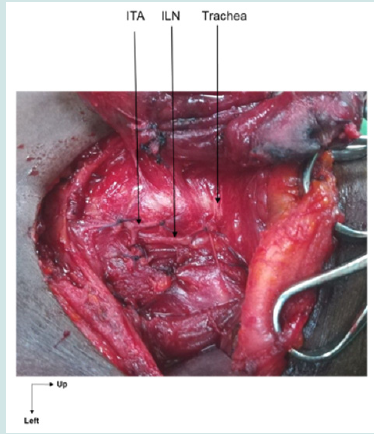
The recurrent nerve retro-crossed the ITA branches in 70.8% of cases on the right and 78.57% on the left, pre-crossed them in 20.8% of cases on the right and 14.29% on the left and passed between them in 8.3% of cases on the right and 7.14% on the left (Figures 1,2 and 3).
Figure 1: Left trifurcated ILN pre-crossing ITA branches.

Figure 2: Right ILN passing between ITA branches.
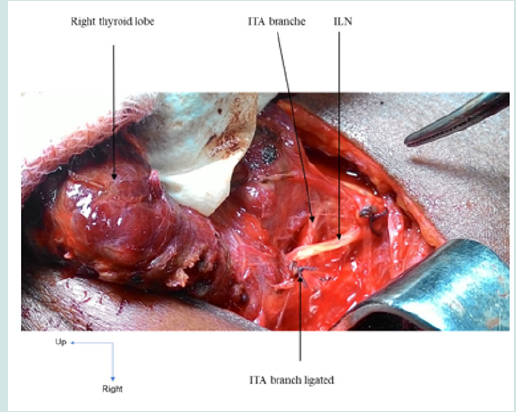
Figure 3: Left ILN retro-crossing ITA branches.
Relationship of the Recurrent Nerve to the Thyroid Lobe
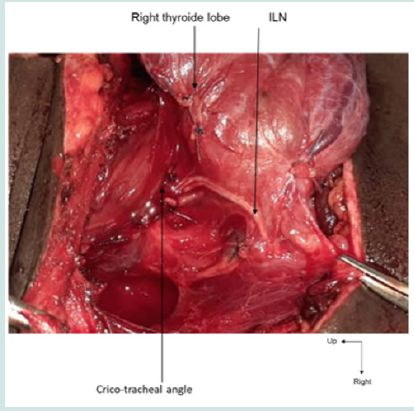
The ILN was attached to the posterior surface of the right thyroid lobe in 10 cases (41.7% of 24 right lobes), with no change in its course. It was attached to that of the left thyroid lobe in 11 cases (38% of 29 left lobes), with a modification of its course in 2 cases (Figure 4).
Figure 4: Right ILN attached to the posterior face of thyroid lobe.
Parathyroid Glands (Figure 5)
Figure 5: ILN and parathyroid glands.
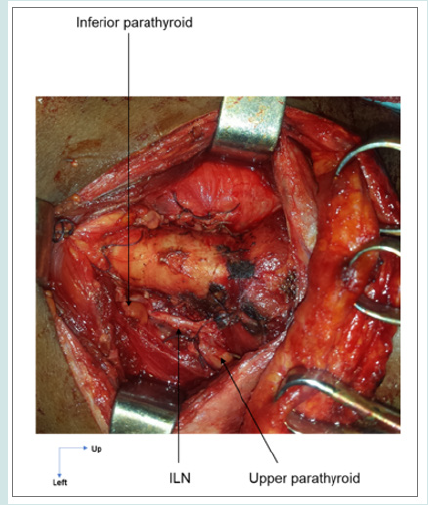
The superior parathyroid was seen in 22 patients on the right (N=24) and in all patients on the left (N=29). It was distanced from the ILN by an average of 0.91 cm on the right and 0.5 cm on the left, with identical extremes of 0 and 1 cm on both sides. It was adjacent to the recurrent nerve in 8 cases on the right and in 4 cases on the left. The inferior parathyroid was seen in 23 patients on the right (N=24) and in all patients on the left (N=29). It was distanced from the NLI by an average of 1.13 cm on the right and 1 cm on the left, with identical extremes of 0 and 2 cm on both sides. It abutted the recurrent nerve in 4 cases on the right and in 4 cases on the left.
Relationship of the ILN to the Inferior Laryngeal Artery
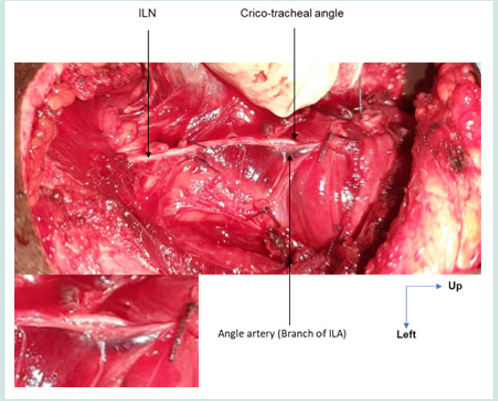
The inferior laryngeal artery was identified on the right in 21 cases, or 87.5% (N=24), and on the left in 26 cases, or 89.7% (N=29). In all these cases, it accompanied the recurrent nerve until it entered the cricotracheal angle (Figures 5,6 and 7).
Figure 6: ILA traveling with the ILN.
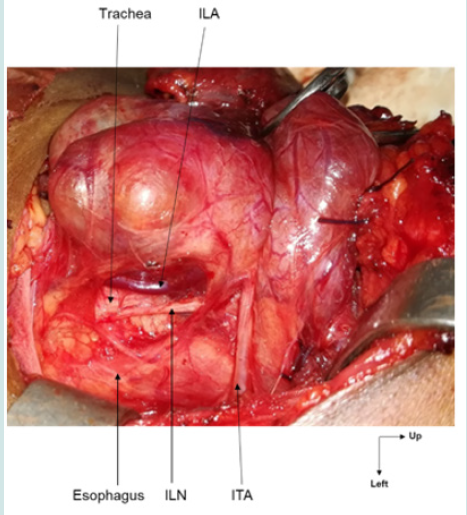
Figure 7: ILN and the angle artery (branch of the ALI).
Post-Operative Care
Post-operative management was straightforward. No patient developed postoperative paresis or recurrent paralysis.
Discussion
ILN and ITA relationships
In this series, on both the right and left, the retro arterial position of the recurrent nerve is the most frequent, followed by the pre-arterial position, while the proportion of ILNs passing between the branches of the ITA is lower. Most authors recognize 3 types of possible relationships between the ILN and the ITA: the recurrent can pass anteriorly (pre-cross), posteriorly (retro-cross) or between the branches of the ITA [4, 10, 11]. These results confirm as in our series, the greater frequency of the retro arterial position of the ILN independently of the side, reported by some authors [12, 5, 11]. Thus Pradeep [13], in a retrospective study of 584 ILNs, demonstrated that the recurrent nerve retro-crosses the branches of the ITA in 64.5% of cases, pre-crosses them in 25.5% and passes between them in 8.2%. In disagreement with the results of this series, Campos [4], in addition to noting the more frequent position of the recurrent nerve between the branches of the ITA, also specifies that their relationships are influenced by side. This side-dependent variability in ILN/ITA relationships was also evoked by Page [3], who found a pre-arterial recurrent nerve in around twothirds of cases (66.6%) on the right, and more consistently retro arterial on the left (90%). The predominance of the retro arterial route on the left noted by Flament [14] concurs with the results of this study. However, the proportion of ILN in pre-arterial position highlighted by Page [3] on the right is much higher than in many studies [11,13], including this series, where it was 20.8%. Thus, the pre-vascular position of the ILN or between the branches of the ITA has been identified by some authors as a risk factor for iatrogenic trauma, especially in the case of excessive traction of the thyroid lobe towards the midline, or of non-meticulous dissection [4, 12, 5].
Despite all this, the finding in this study that extra-laryngeal division of the ILN occurs in all patients at the level of the crossing with the ITA leads us to consider the latter as the best landmark for identification of the recurrent nerve by a lateral approach as well as preservation of its dividing branches. As Uludag [1] states, the ILN is generally identified by dissection around the ITA at the level of the middle part of the thyroid lobe. However, because of the many variations in this neurovascular relationship, often altered by pathological thyroid conditions [15], identification of ITA may facilitate that of ILN without guaranteeing its preservation.
Relationship of the ILN to the Thyroid Gland
The frequency with which the recurrent nerve accosts the posterior face of the thyroid lobe in our study (41.7% right, 38% left) is higher than Eltokhy’s [12] finding of 12.9% and may be explained by the predominance of multinodular goiter as an operative indication. Indeed, as thyroid nodules, especially lobar ones, increase in volume, they can cause the thyroid capsule to become attached to the ILN, with an increased risk of trauma when the thyroid lobe is exposed or excessively pulled [16].
Relationship between the NLI and the Parathyroid Glands
In the present study, the upper parathyroid glands are closer to the ILN ( average distance between 0.5 - 0.91cm ) than the lower parathyroids, which position is more variable (average distance between 1- 1.13 cm). Persky [17] in a prospective study of 103 consecutive thyroid lobectomies identified the superior parathyroid in 88.9% within 0.5 cm of the ILN and in 62.6% within 1 mm of it. By confirming the frequent presence of the superior parathyroid in the immediate vicinity of the recurrent nerve, these results make it a fairly reliable landmark for identifying the recurrent nerve, especially during a superior approach, in line with the data in the literature [18, 17]. The position of the lower parathyroids is more variable than that of the upper parathyroids [19], as shown by the standard deviation of 0.32 on the right and 3.037 on the left.
Nevertheless, in most cases they are quite close to ILN. The ILN’s relationship with the ILA In this series, the ILA was identified in 87.5% of cases on the right and 89.7% on the left, and in all cases accompanied the recurrent nerve until it entered the cricotracheal angle. The relationship between ILA and ILN has not been clarified in the literature.
Conclusion
The ITA is an important landmark for identifying the recurrent nerve using a lateral approach, especially in our context where monitoring is non-existent. Despite the greater frequency of the ILN’s retro arterial position, the surgeon must always bear in mind the inconstancy of these relationships, which can result in injury to a pre-arterial recurrent nerve or one between the branches of the ITA. The increase in volume of multinodular goiters or thyroid nodules, especially lobar ones, can lead to the thyroid capsule becoming attached to the ILN, with an increased risk of trauma when the thyroid lobe is exposed or excessively pulled [43]. The ILA is an almost constant companion to the ILN, and trauma due to misrecognition is a risk factor for post-thyroidectomy recurrent paralysis due to untimely hemostasis near the ILN. The inferior parathyroids can be useful for identifying the recurrent nerve using an inferior approach.
Conflict of Interest
The authors declare no conflict of interest.
References
- Uludağ M, Tanal M, İşgör A (2018) A Review of Methods for the Preservation of Laryngeal Nerves During Thyroidectomy. Med Bull Sisli Etfal Hosp 52 (2): 79-91.
- Cernea CR, Hojaij FC, De Carlucci D, Gotoda R and Plopper C, et al. (2009) Recurrent laryngeal nerve a plexus rather than a nerve? ArchOtolaryngol Head Neck Surg 135 (11): 1098-102.
- Page C, Foulon P, Strunski V (2003) The inferior laryngeal nerve: surgical and anatomic. considerations. Report of 251 thyroidectomies. Surg Radiol Anat 25: 188-91.
- Campos BA, Henriques PRF. (2000) Relationship between the recurrent laryngeal nerve and the inferior thyroid artery: a study in corpses. Rev Hosp Clín Fac Med S Paulo. ; 55(6) :195-200.
- Koumaré AK, Ongoiba N, Sissoko F, Berete S and Diop AT, et al. (2002)Nerf Laryngé Inférieur : anatomie et lésions opératoires. E-mémoires de l'Académie Nationale de Chirurgie 1(2) : 8-11.
- Goldenberg D, Randolph GW (2013) Intraoperative Complications: The ‘Classic’ Issues (The Recurrent Laryngeal Nerve (PART III). In Thyroid Surgery: Preventing and Managing Complications, First Edition John Wiley & Sons Ltd 119-27.
- Lubrano D, Levy-chazal N, Araya Y, Avisse C (2002) La recherche du nerf laryngé inférieur ou récurrent lors d’une lobectomie thyroïdienne. Ann Chir 127 : 68-72.
- Shindo ML, Wu JC, Park EE (2005) Surgical anatomy of the recurrent laryngeal nerve revisited. Otolaryngology–Head and Neck Surgery 133(4): 514-9.
- Beneragama T, Serpell JW (2006) Extralaryngeal bifurcation of the recurrent laryngeal nerve: a common variation. ANZ J Surg 76(10): 928-31.
- Echeverria Monares M (1970) Nerf récurrent et artère thyroïdienne inférieure. Travail du laboratoire d'Anatomie de la Faculté de Médecine de Paris.
- Makay O, Icoz G, Yilmaz M, Akyildiz M and Yetkin E, et al. (2008) The recurrent laryngeal nerve and the inferior thyroid artery-anatomical variations during surgery. Langenbecks Arch Surg 393(5): 681-5.
- Eltokhy AA (2015) A Tips and tricks to save recurrent laryngeal nerve during thyroid surgery. AAMJ 13(4): 83-8.
- Pradeep PV, Jayashree B, Harshita SS (2012) A Closer Look at Laryngeal Nerves during Thyroid Surgery: A Descriptive Study of 584 Nerves. Anatomy Research International.
- Flament JB, Flament JB, Delattre JF (1983) Les pièges anatomiques de la dissection du nerf récurrent. J Chir (Paris) 120 : 329-33.
- Ardito G, Revelli L, D’alatri L, Lerro V and Guidi ML, et al. (2004) Revised anatomy of the recurrent laryngeal nerves. The American Journal of Surgery 187(2): 249-53.
- Steinberg JL, Khane GJ, Fernandes CMC, NEL JP (1986) Anatomy of the recurrent laryngeal nerve: A redescription. The Journal of Laryngology and Otology 100(8): 919-27.
- Persky M, Fang Y, Myssiorek D (2014) Relationship of the recurrent laryngeal nerve to the superior parathyroid gland during thyroidectomy. The Journal of Laryngology & Otology 128: 368-71.
- Elsheikh E (2017) Superior parathyroid gland approach to the recurrent laryngeal nerve. Head & Neck 39(7): 1287-90.
- Mohamed M, Sheahan P (2014) Location of Parathyroid Glands during Thyroid Surgery: An Anatomical Study in a Surgical Series. Annals Thyroid Res 1(1): 13-16.


-

Mark E Smith
Bio chemistry
University of Texas Medical Branch, USA -

Lawrence A Presley
Department of Criminal Justice
Liberty University, USA -

Thomas W Miller
Department of Psychiatry
University of Kentucky, USA -

Gjumrakch Aliev
Department of Medicine
Gally International Biomedical Research & Consulting LLC, USA -

Christopher Bryant
Department of Urbanisation and Agricultural
Montreal university, USA -

Robert William Frare
Oral & Maxillofacial Pathology
New York University, USA -

Rudolph Modesto Navari
Gastroenterology and Hepatology
University of Alabama, UK -
Andrew Hague
Department of Medicine
Universities of Bradford, UK -

George Gregory Buttigieg
Maltese College of Obstetrics and Gynaecology, Europe -

Chen-Hsiung Yeh
Oncology
Circulogene Theranostics, England -
.png)
Emilio Bucio-Carrillo
Radiation Chemistry
National University of Mexico, USA -
.jpg)
Casey J Grenier
Analytical Chemistry
Wentworth Institute of Technology, USA -

Hany Atalah
Minimally Invasive Surgery
Mercer University school of Medicine, USA -

Abu-Hussein Muhamad
Pediatric Dentistry
University of Athens , Greece

New York - NY 10019, USA +1 (914) 407-6109 Fax - +1 (914) 465-7596 info@lupinepublishers.com