

 Email Us: info@lupinepublishers.com
 Call Us: +1 (914) 407-6109
57 West 57th Street, 3rd floor, New York - NY 10019, USA
Call Us: +1 (914) 407-6109
57 West 57th Street, 3rd floor, New York - NY 10019, USA


Lupine Publishers Group
Lupine Publishers
ISSN: 2641-1709
Short Communication(ISSN: 2690-5752) 
Battle´s Sign. More than a Manifestation of Head Trauma Volume 10 - Issue 2
Received: August 02, 2023; Published: August 25, 2023
Corresponding author: Hector R Diaz, Consulting Professor., Idalberto Revuelta University, Policlinic. Sagua la Grande, Villa Clara, Cuba
DOI: 10.32474/JAAS.2023.09.000334
 Abstract
 PDF
PDFShort Communication
Figure 1: The Battle´s sign.
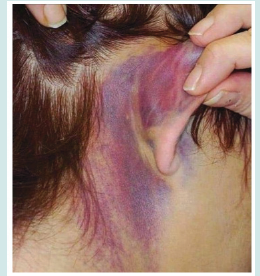
The Battle´s sign was initially described by William Henry Battle (1855-1936) it refers to retroauricular ecchymosis on the mastoid, which indicates a fracture of the median base of the skull [1]. This sign is noted as a bruising of the mastoid process as a consequence of extravasation of blood along the path of the posterior auricular artery (Figure 1). This sign typically appears one to three days after the traumatic injury occurs. On the other hand, this type of ecchymosis can also be produced by other non-traumatic causes.
The objective of this communication is to point out the fundamental non-traumatic causes that can produce ecchymosis in the retroauricular region. Causes of non-traumatic ecchymosis in the retroauricular region:
a) Connective tissue disorders (systemic lupus erythematosus; scleroderma; dermatomyositis; polymyositis; rheumatoid arthritis; Ehlers–Danlos syndrome; mixed connective tissue disease.
b) Coagulation disorders (hemophilia, Von Willebrand disease, clotting factor deficiencies, hypercoagulable states and deep venous thrombosis).
c) Hepatic diseases.
d) Chronic kidney disease.
e) Hypothyroidism.
f) Bone marrow disorders.
g) Drugs ( anticoagulants, platelet antiaggregant, steroids)
h) Infection diseases (N. meningitidis; varicella; scarlet fever; rubella; measles; dengue and other haemorrhagic fever).
Conclusion
Battle’s sign was described in the context of medical care for patients with head trauma as a manifestation of the presence of a fracture of the median base of the skull. However, this semi logical sign has been exceptionally observed in patients with pathological processes other than skull fracture.
References


-

Mark E Smith
Bio chemistry
University of Texas Medical Branch, USA -

Lawrence A Presley
Department of Criminal Justice
Liberty University, USA -

Thomas W Miller
Department of Psychiatry
University of Kentucky, USA -

Gjumrakch Aliev
Department of Medicine
Gally International Biomedical Research & Consulting LLC, USA -

Christopher Bryant
Department of Urbanisation and Agricultural
Montreal university, USA -

Robert William Frare
Oral & Maxillofacial Pathology
New York University, USA -

Rudolph Modesto Navari
Gastroenterology and Hepatology
University of Alabama, UK -
Andrew Hague
Department of Medicine
Universities of Bradford, UK -

George Gregory Buttigieg
Maltese College of Obstetrics and Gynaecology, Europe -

Chen-Hsiung Yeh
Oncology
Circulogene Theranostics, England -
.png)
Emilio Bucio-Carrillo
Radiation Chemistry
National University of Mexico, USA -
.jpg)
Casey J Grenier
Analytical Chemistry
Wentworth Institute of Technology, USA -

Hany Atalah
Minimally Invasive Surgery
Mercer University school of Medicine, USA -

Abu-Hussein Muhamad
Pediatric Dentistry
University of Athens , Greece