
 Email Us: info@lupinepublishers.com
 Call Us: +1 (914) 407-6109
57 West 57th Street, 3rd floor, New York - NY 10019, USA
Call Us: +1 (914) 407-6109
57 West 57th Street, 3rd floor, New York - NY 10019, USA


Lupine Publishers Group
Lupine Publishers
ISSN: 2690-5752
Research Article(ISSN: 2690-5752) 
The phyletic relationship between bipedal primates from Africa and from Dmanisi, Georgia (Europe) Volume 8 - Issue 4
Received:October 02, 2023; Published: October 13, 2023
Corresponding author: Sergey Vyrskiy, Russia. Orcid.org/0000-0002-5755-5897
DOI: 10.32474/JAAS.2022.06.000297
 Abstract
 PDF
PDFAbstract
The excavations in the Dmanisi site, East Georgia, the Caucasus, discovered stone tools along with fossils of bipedal primates in deposits of 1.85-1.77 mya. The stone tools are technologically similar to those of the Oldowan industry found in deposits of 3.0- 2.6 mya in the East African Rift System. The discovery suggests possible adaptive radiation of the species carrying the Oldowan industry from Africa to Europe. To check the assumption, this study uses the concept of an adaptive species which employs not a taxon as its basic phylogenetic (genealogical) unit, but a phyletic line interval formed by individuals featuring the same adaptability to the environment. When analysed for adaptability, the samples from the Dmanisi collection revealed that the individuals belong to two out of three African phyletic adaptive lines. First, it is the line of radicophagous individuals with the diet consisting primarily of cereal grains, roots and bulbs of field and coastal herbs. The second line is represented by the homo who had a large proportion of meat in their diet, and whose individuals mastered the manufacture of stone tools using the Oldowan technology. It might be claimed that individuals of the homo line appeared in Dmanisi as a result of adaptive radiation from the African continent, while radicophagous individuals from Dmanisi, although fully corresponding to the individuals of the African line, could have Asia as their common phyletic source.
Keywords:Bipedal Primates; Phyletic Relationship; Dmanisi; Adaptive Species Concept
Introduction
In Dmanisi, Georgia, stone tools were discovered in deposits of 1.85–1.77 mya along with fossils of bipedal primates [1]. These tools are found to be technologically similar to the Oldowan tools from the East African Rift System deposits of 3.0–2.6 mya [2, 3]. This discovery might suggest adaptive radiation of the species carrying the Oldowan technology from Africa to Europe. Verification of the phyletic relationship (also referred to as ‘genealogical’ by Ch.R. Darwin) between African and European bipedal primates from Dmanisi was based on the adaptive species concept with a phyletic line interval (and not a taxon) serving as the basic phylogenetic unit. The interval is formed by self-reproducing generations of individuals featuring the same adaptability to the environment [4]. A total of three adaptive phyletic lines were reconstructed on the African continent. First, it is the line of radicophagous individuals observed in the interval of 5.8–1.4 mya with their diet consisting primarily of cereal grains, roots and bulbs of field and coastal herbs. The second line is observed between 6.0 and 2.4 mya and is represented by omnivorous individuals – osteodontokeratic gatherer-scavengers with a large proportion of meat in their diet. And the third line was formed 3.0-2.6 mya when an omnivorous population inhabiting the East African Rift System learned to make stone Oldowan tools, which gave this population the advantage of extensive use of the environment. Thus, a new adaptive line was established. As fossils of bipedal primates found together with “stone tool” artifacts are routinely registered by researchers as belonging to the Homo genus, the phylogenetic name homo can be assigned to the new adaptive line. Spreading as a result of adaptive radiation and having an evolutionary advantage, this population gradually replaced the omnivorous maternal line and completely occupied the African continent by 2.4 mya. Genealogically (according to Ch.R. Darwin), this can be represented as a system of adaptive phyletic lines as shown in Figure 1.
Methods
In this work, we established the adaptability of the Dmanisi individuals using the diagnostic criteria developed to determine the functional adaptability of African bipedal primates. The criteria are presented as a table containing the metrics of fossils [5, Table 1].
Figure 1: Adaptive phyletic lines constructed for African bipedal primates from 6-1 mya deposits. Converted from Vyrskiy [4].
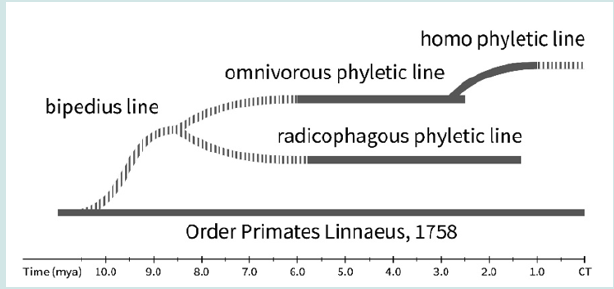
Table 1. Dietic differentiation of individuals belonging to the radicophagous and omnivorous (homo) adaptive lines.
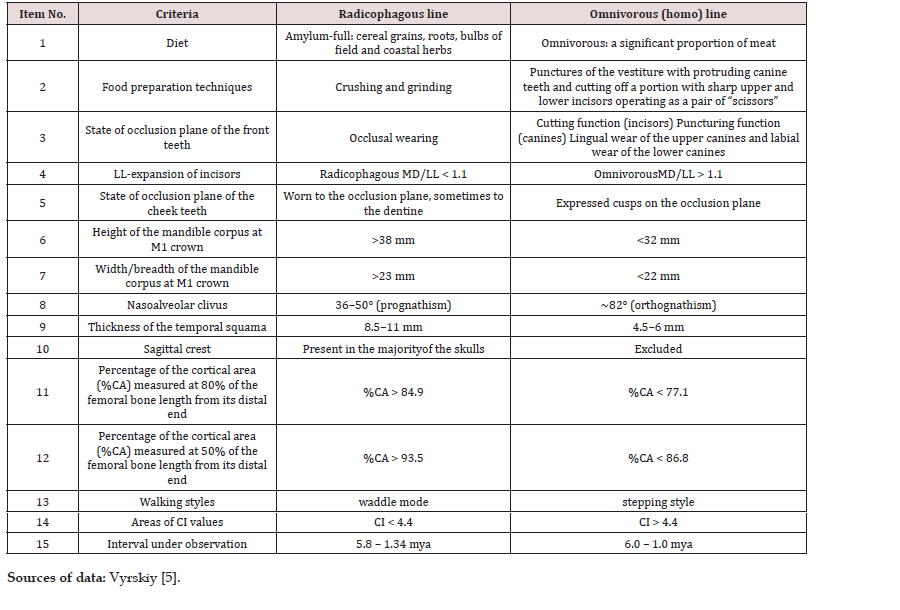
MD/LL, mesiodistal to labiolingual diameter ratio
%CA = [CA / TA] × 100
where TA = CA + MA; TA is the total periosteal area in cross section; CA is the cortical area; MA is the medullary area.
Cerebral index CI = (0.91 × ECV)2 / Pb
where ECV is the endocranial volume in cc; Pb is the body weight in g.
Dmanisi Collection Adaptability Analysis
This study applies the criteria presented in Table 1 and used earlier to diagnose the adaptability of African bipedal primates, to analyse the Dmanisi collection (Georgia). It must be noted that individuals belonging to any phyletic line demonstrate adaptive characteristics obtained from the maternal and more distant ancestral lines in addition to the main line-forming adaptation. For example, bipedal locomotion is characteristic of both the radicophagous and omnivorous lines, which suggests their origin from the same bipedal maternal species.
Mandible D211
Mandible D211 was excavated in 1991 and attributed to the original species Homo erectus L. Gabunia & A. Vekua [6]. The mandible has the corpus height at M1 crown of 24.7 mm, and the breadth of 18.4 mm [7], which, in accordance with Criteria 6 and 7 (Table 1), indicates the dietary adaptability typical of the omnivorous line. This might be also confirmed by the fact that the sample has all 16 teeth with a low degree of occlusal wearing, while canines and incisors feature a pointed shape required for the scissors-type cutting. Premolars are closer in shape to canines than to molars [8], which is also indicative of the method of food preparation generally used by omnivores (see Table 1, Criteria 2 and 3).
Yet another criterion is the dimensions of the incisors. For D211, Vekua et al. [9] gives the following dimensions:
RI1 - MD/LL = 5.9 mm / 5.8 mm = 1.02; LI1 - MD/LL = 6.2 mm / 5.9 mm = 1.05;
RI2 - MD/LL = 6.6 mm / 6.4 mm = 1.03; LI2 - MD/LL = 6.4 mm / 6.3mm = 1.02
All values almost fall into the half-interval of MD/LL > 1.1, which points at the omnivory of the individual (see Table 1, Criterion 4). However, some authors publish entirely different values, namely: RI1 MD/LL = 4.3 mm/6.2 mm = 0.7, and RI2 MD/LL = 4.6 mm/7.2 mm = 0.64 [8], which formally assigns the sample to the radicophagous adaptability (see Table 1, Criterion 4). At the same time, Van Arsdale notes that the measurement was made at the cervicoenamel junction of the dental neck. As authors sometimes fail to identify the location of measurement, Criterion 4 (Table 1) shall be used with caution.
a) Conclusion: By a combination of characteristics, the individual with Mandible D211 may be attributed to the omnivorous phyletic line.
Cranium D2282
Calvaria D2280 and cranium D2282 were excavated in 1999. Mandible D211 was combined with D2282 with the individuals of all specimens jointly named hominids and assigned to the original species Homo ex gr. ergaster L. Gabunia et al. [1]. In the maxilla of cranium D2282, slightly worn right P4-M2 and left M1 and M2 were preserved. Figures 23 and 24 [10] show distinct cusps on the occlusion plane, which clearly indicates the omnivorous nature. For individuals with radicophagous adaptability, the comparative study of samples of African bipedal primates [5] shows the highest value of ECV = 582 cm3, and thus the value of ECV = 650 cm3 for D2282 [1] confirms their omnivorous adaptability. However, it is also advisable to measure the thickness of the temporal squama which should not exceed 6.0 mm for omnivorous individuals.
a) Conclusion: The individual presented in the cranium D2282 collection can be attributed to the omnivorous phyletic line with a high degree of probability.
Calvaria D2280
The ECV value is 775 cm3 [1], which is significantly greater than any value reported for the African adaptive species radicophagous, and therefore sample D2280 calvaria can be tentatively assigned to the omnivorous lineage. The omnivorous nature of an individual can be further confirmed by the thickness of the temporal squama, which should not in this case exceed 6.0 mm (see Table 1, Criterion 9).
a) Conclusion: The individual featuring D2280 calvaria can be tentatively attributed to the omnivorous phyletic line.
Mandible D2600
The mandible was found in 2000 and designated as the holotype of H. georgicus sp. nov. L.Gabunia et al. [11]. It retained nearly all of the teeth that show exceptional occlusal wear, almost down to teeth display [8]. The teeth are very worn and even reaching the remarkably well-developed roots [7], which indicates radicophagous adaptability (see Table 1, Criteria 2, 3). The mandible has the corpus height at M1 crown of 41 mm, and the breadth of 21 mm, which confirms its radicophagous attribution (Table 1, Criteria 6,7).
Van Arsdale [8] demonstrates that MD/LL= 4.7 / 7.1 mm = 0.66 for the RI1 incisor; and MD/LL = 5.4 / 9.0 mm = 0.61 for RI2. Martinón-Torres et al. [10] indicate that MD/LL = 4.6 / 7.3 mm = 0.63 for the RI1 incisor, while MD/LL = 5.5 / 9.0 mm = 0.6 for RI2, and MD/LL = 5.2 / 7/9 mm = 0.66 for LI2. These data also confirm the adaptability of radicophagous type (Table 1, Criterion 4). However, it should be borne in mind that the incisors are so worn out that the measurements are actually taken at the dental neck and therefore the findings may be identical to the values obtained on the omnivorous samples measured in the same location. Essentially, the dietary status of an individual can be determined without making these measurements, namely by the food preparation method. Nevertheless, Criterion 4 (Table 1) shall not be completely disregarded as it proves useful in a number of cases for the analysis and attribution of scattered teeth.
a) Conclusion: The individual featuring the D2600 mandible can be attributed to the radicophagous phyletic line.
Cranium D2700
Cranium D2700 and associated mandible D2735 were found in 2001 and assigned to Homo erectus (=ergaster) by A. Vekua et al. [12]. The cranium bears four maxillary teeth, namely the right M1 and M2 and the left P4 and M2 [12], which have pronounced cusps on the occlusal plane [10], indicating that the individual was omnivorous. The ECV value of cranium D2700 was measured by different methods, hence the discrepancy in the results, i.e. 600 cm3 [13.14] and 645 cm3 [12]. This is just slightly higher than the upper limit of the ECV value required to attribute an individual as radicophagous, but given the previous criterion we will consider this to be a confirmation of the omnivorous adaptability. The adaptability of an individual can also be defined by the thickness of the temporal squama, which for the omnivorous should not exceed 6.0 mm (Table 1, Criterion 9).
a) Conclusion: Individual D2700 can be attributed to the omnivorous phyletic line.
Mandible D2735
The mandible contains eight teeth, i.e. P3, P4, M1 and M2 which are located on both sides [12]. The mandible shows the corpus height at M1 crown of 22.4/22.3 mm and the breadth of 21.0/20.7 mm when measured by Van Arsdale [8], and 22.5 mm and 19 mm respectively when determined by Rightmire et al. [14]. According to Criteria 6 and 7 (Table 1), the results are indicative of the omnivorous nature of the individual. The LI2 incisor (D3698) of this mandible has MD/LL = 8.1/7.6 mm = 1.07, and RI2 has MD/ LL = 8.1/7.4 = 1.09 [10]. Therefore, Criterion 4 also confirms its omnivory. This assumption is further upheld by the low degree of occlusal wear [7] and the pronounced cusps on the occlusal plane [15].
a) Conclusion: The individual with mandible D2735 can be attributed to the omnivorous phyletic line.
Cranium D3444 and mandible D3900
Cranium D3444 and its directly adjacent mandible D3900 were recovered during the 2003 excavation season [8]. Comparative computer-tomography-based lateral views of skulls D2700/ D2735 and D2282/D211 that are characterised by the established omnivorous adaptability, and skull D3444/D3900 showed almost completely matching contours [16], which indirectly confirms the omnivorous nature of the latter. The ECV of cranium D3444 is 625 cm3 [14]. This is slightly above the upper limit of the ECV value for radicophagous individuals, which, with a certain degree of caution, can be considered as confirmation of the omnivory. The omnivorous nature of this composite individual could also be potentially verified by the thickness of the temporal squama, which should not exceed 6.0 mm (Table 1, Criterion 9).
Sample D3444/D3900 exhibits a unique feature as all the maxillary and mandibular teeth were lost by the individual long before death, as evidenced by complete alveolar socket resorption and extensive remodeling of the alveolar process [16,8]. It means that the D3444/D3900 individual lived for a long time without eating food that required significant chewing [16,8]. It should be noted that there are no tools found in the deposits that could have allowed grinding plant starch-containing matter - cereal grains, root crops, or bulbs. Therefore, the D3444/D3900 individual could only have exploited meat as a food source. The stratum where the samples were discovered also contained stone artifacts and eight animal bones with stone tool cuts and percussion marks indicating carcass processing and meat-eating [16]. And this undoubtedly means that the D3444/D3900 individual could only grind meat food with stone tools, and therefore it belonged to the homo line, which is filial from omnivorous.
a) Conclusion: Composite individual D3444/D3900 undoubtedly belongs to the homo phyletic line.
Cranium D4500
Cranium D4500 was restored in 2005. The species status of the collection was defined as H. erectus ergaster georgicus, D. Lordkipanidze et al. [17], thus cancelling the previously assigned status. The dental arch is heavily worn down to the dentin, with only the LL diameters established for the incisors [14]. The crown morphology is only partially preserved, suggesting that the anterior dentition was used in paramasticatory activities such as gripping [17], which evidences the radicophagous adaptability. The ECV of skull (546 cm3) [17] falls within the range of values typical of radicophagous individuals, although an accidental small size of an adult omnivore should not be ruled out. The 42° inclination of the naso-alveolar clivus relative to the alveolar plane is also characteristic of radicophagous. The adaptability type can also be confirmed by the thickness of the temporal squama which should be at least 8.5 mm (Table 1, Criterion 9).
a) Conclusion: Cranium D4500 can be attributed to the radicophagous phyletic line.
Right femur D4167
a) The femoral head has a diameter of 40 mm [18], which allows us to predict body weight of an individual using the Femoral Head Diameter (FHD) tables proposed by McHenry [19]. However, for the convenience of computations, we applied an equation that represents the same data as a mathematical polynomial of the second order rather than selecting tabular data [5]. The only difference is the exclusion of arboreal primates from the FHD calculations as they did not use the femur as a support for obligate locomotion.
Pb = (FHD + 5.3)2/41.5 = (40 + 5.3)2/41.5 = 49.4 kg
where Pb is body weight.
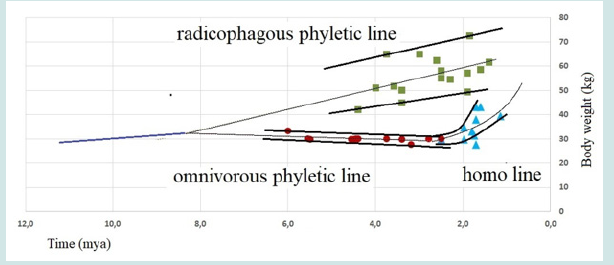
As shown by Vyrskiy [5], there are various weight ranges for groups of African bipedal primates featuring radicophagous, omnivorous and homo adaptability.
b) Some studies suggest that the stratigraphic proximity of skull D4500, mandible D2600 and femur D4167 in the deposit allows them to be identified as belonging to one individual. We have assigned samples D2600 and D4167 to the radicophagous line. Femur D4167 from deposits of 1.85 mya, with the estimated weight of the individual Pb = 49.4 kg, falls on the lower boundary of the radicophagous body weight range (Figure 2), which does not contradict the above-mentioned identification.
Figure 2: Weight ranges (Pb) for African bipedal primates from 6–1 mya deposits. Sources of data: Vyrskiy [5].
Let us consider the Cerebral Index (CI) of the D4500/D2600/ D4167 composite individual. In the review [5], the Roginsky encephalization index equation was taken as the basis for CI calculation with an adjustment for the endocranial cavity.
CI = (0.91 × ECV)2/Pb
Where Pb is the body weight of an individual, gr.
The study of the D4500 skull [17] established the value of ECV = 546 cm3, i.e. the CI of the D4500/D2600/D4167 composite individual with the body weight of 49.4 kg for femur D4167 may be calculated as:
However, according to Criterion 14 (Table 1), this value corresponds to the omnivorous type, which contradicts the previously established attribution of these samples. If we assume that the D4500 individual with ECV = 546 cm3 belongs to the radicophagous line, then the body weight should be at least 56 kg to obtain the corresponding value of CI < 4.4 (Table 1, Criterion 14). Also, for a D4167 individual with a body weight of 49.4 kg, ECV should not exceed 512 cm3 for a CI value to be < 4.4 (Table 1, Criterion 14). Thus, it might be concluded that the parts of the composite skeleton belong to different individuals although the constituent D4500, D2600, and D4167 samples present the same adaptive radicophagous line.
c) Lordkipanidze et al. [18] give the following values of cross-section dimensions of the femur measured in the middle of the D4167 femur bone: antero-posteriorly (a-p) diameter
= 26.5 mm and medio-laterally (m-l) diameter b = 22.2 mm. This allows us to predict the thickness of the cortex in the middle of the D4167 femur for the radicophagous affiliation of the individual.
Calculate the total periosteal area (TA) in the midshaft:
TA = S = π a b/4 = (3.14 × 26.5 × 22.2) /4 = 461.8 mm2
Assuming that the individual belongs to the radicophagous group, we calculated the medullary area (MA) corresponding to the percentage of the cortical area %CA = 93.5 (Table 1, Criterion 12).
%CA = [(TA - MA) / TA] × 100, whence
MA= TA × (1 - %CA / 100) = 461.8 × (1 - 93.5 / 100) = 461.8 × 0.065 = 30 mm2
If we assume that the medullary oval is similar to the total oval, then
a/b = am/bm = 26.5/22.2 = 1.194
where am and bm are the diameters of the medullary oval
whence am =1.194 × bm
then MA = 30 mm2 = π am bm/4 = 3.14 × 1,194×(bm)2 / 4, and
bm = √4×30/3.14×1.194 = √32 = 5,66 mm.
As a result, the predicted m-l cortex thickness will be (22.2 – 5.66) / 2 = 8.3 mm, with the a-p thickness being (26.5 – 1.194 × 5.66) / 2 = 9.9 mm.
If thickness measurements of the femoral cortex D4167 show values above the calculated ones, then the individual can be attributed to the radicophagous phyletic line.
Left femur D3160
For femoral shaft D3160, Lordkipanidze et al. [18] reported the (a-p) diameter a = 21.4 mm and (m-l) diameter b = 25.3 mm, measured at a distance of approximately 80% from the distal end of the bone. It has been assumed in a number of studies that cranium D2700, mandible D2735, both omnivorous, and left femur D3160 represent one individual. It allows us to predict the thickness of the D3160 femur cortex in case of its omnivorous attribution.
Calculate the total periosteal area (TA) at a distance of 80% from the distal end of the bone:
TA = π a b / 4 = (3.14 × 21.4 × 25.3) / 4 = 425 mm2
Then, the medullary area (MA) for the upper value of %CA = 77.1 (Table 1, Criterion 11) can be calculated from the following equation:
%CA = [(TA - MA) / TA] × 100, whence
MA = TA × (1 - %CA / 100) = 425 × [1 - (77.1 / 100)] = 97.3 mm2
If we assume that the medullary oval is similar to the total oval, then
a/b = am/bm = 21.4 / 25.3 = 0.846, whence am = 0.846 × bm
Calculate (a-p) and (m-l) diameters of the medullary oval as
MA = 97.3 mm2 = π am bm / 4 = (π ×0.846 × bm 2) / 4
whence bm = √ [97.3 мм2×4 / (π ×0.846)] = √ [97.3 мм2×4 /
2.66] = 12.09 mm;
am = 0.846 × bm= 10.2 mm.
Then, the (a-p) thickness of the femoral shaft cortex will be (21.4 - 10.2) / 2 = 5.6 mm, and the (m-l) thickness - (25.3 – 12.9) / 2 = 6.6 mm.
If measurements of the D3160 femoral cortex at a distance of 80% from the distal end show values below the ones indicated above, then the individual can be assigned to the omnivorous phyletic line.
Results
a. The study has established that cranium D4500, mandible D2600, and right femur D4167 belonged to individuals featuring radicophagous dietary adaptability. As posited in [5], the radicophagous adaptive line ended on the African continent approximately 1.34 mya, which does not contradict the age of the Dmanisi samples. To confirm the radicophagous attribution of right femur D4167, it is necessary to measure the femoral cortex thickness in the midshaft, and the value should be at least 9.9 mm for a-p and at least 8.3 mm for m-l. For cranium D4500, it is essential to measure the thickness of the temporal squama which has to be at least 8.5 mm. It is unfortunate that in most cases the task of measuring the temporal squama with sufficient accuracy is significantly impeded by matrix infilling of cracks.
b. The unique composite individual D3444 / D3900 undoubtedly belongs to the homo phyletic line.
c. Calvaria D2280, cranium D2282, mandible D211, cranium D2700, mandible D2735, and left femur D3160 display signs of omnivorous attribution. But as these individuals are found in the deposits together with the Oldowan tools, which is believed to be incompatible with the osteodontokeratic culture of the gatherer-scavenger, they must be attributed to the homo line. This conclusion is also confirmed by the D3444 / D3900 individual discovered in the same deposits and clearly belonging to the homo line. Also, Grimaud-Herve and Lordkipanidze [20] use a number of features, such as the asymmetry of the encephalic relief, to assign the D2280 and D2282 individuals to the Homo genus. It shall be noted that omnivorous samples disappeared from the African fossil record 2.5 mya, which does not contradict with the absence of this species in Dmanisi, Georgia.
Discussion
a. It is sometimes doubted whether the adaptive species concept shall be applied to construct the phylogeny of bipedal primates. It should be noted here that the most commonly used methods of comparative analysis of the fossils’ metrics display a limited degree of similarity between their individuals, and do not allow the reconstruction of the reproductive hierarchy (maternalfilial) for groups of individuals.
b. There is some ambiguity of the borderline values for the adaptability criteria presented in Table 1. First of all, fossils are often chipped, weathered, and posthumously damaged by predators or scavengers, making measurements difficult. Secondly, some studies fail to indicate the methods used to measure fossils, which might lead to a discrepancy between their findings and the values in the diagnostic table. For example, the measurement of the height and width of the mandible corpus at M1 level can be performed in at least two ways, and hence the 10% variation in the results. Finally, the diagnostic table was compiled on the basis of collections made before 2017, and therefore, as new data become available, the borderline values may be adjusted.
Conclusions
a. Bipedal primates of the Dmanisi collection, Georgia, from deposits of 1.85–1.77 mya display only two types of adaptability, namely radicophagous and homo, which are identical to the adaptability of the corresponding phyletic lines of the African continent.
b. If we take into account that the emergence of homo adaptability on the African continent in deposits of 3.0-2.6 mya is associated with the development of the Oldowan industry, it can be argued that individuals of the homo line from the Dmanisi collection appeared in Europe as a result of adaptive radiation and belong to the African phyletic branch.
c. Radicophagous individuals were found only in the lowest layers of the Dmanisi deposit. It can be assumed that they were the first to inhabit this area, and they left the site after the homo - more mobile and armed with tools - came from Africa. Therefore, it cannot be ruled out that radicophagous individuals appeared in Europe as a result of adaptive radiation from Asia.
d. The omnivorous adaptive species became extinct on the African continent around 2.5 mya and was not found in the Dmanisi collection either. This synchronism of evolutionary processes on the two continents confirms the common Afro- European habitat of bipedal primates during the period of 1.85–1.77 mya.
e. It is essential to note that if the measurements of samples suggested herein confirm the assumed adaptability of the respective individuals, then it also confirms the predictive value of the adaptive species concept.
Funding
The authors report there are no competing interests to declare. This work was performed unilaterally and independently. The author has no affiliations with or involvement in any organization or entity with any interest in the subject matter discussed in this manuscript. The research was not funded by any institute or grant.
References
- Gabunia L, A Vekua, D Lordkipanidze, CC Swisher 3rd, R Ferring, et al. (2000) Earliest Pleistocene hominid cranial remains from Dmanisi, Republic of Georgia: taxonomy, geological setting, and age. Science 288(5468): 1019-1025.
- Semaw S (2000) The World’s Oldest Stone Artefacts from Gona, Ethiopia: Their Implications for Understanding Stone Technology and Patterns of Human Evolution Between 2.6–1.5 Million Years Ago. J Archaeol Sci 27(12): 1197-1214.
- Plummer TW, JS Oliver, EM Finestone, PW Ditchfield, Laura C Bishop, et al. (2023) Expanded geographic distribution and dietary strategies of the earliest Oldowan hominins and Paranthropus. Science 379 (6632): 561-566.
- Vyrskiy S (2021) Reconstruction of African Bipedal Primates’ Phylogeny Based on the Adaptive Species Axiom. J Anthro & Archeo Sci 5(2): 604-618.
- Vyrskiy SV (2017) The system of species of African bipedal primates from 6.2–0.9 mya. East West Association for Advanced Studies and Higher Education GmbH. Vienna, Austria pp: 1-68.
- Gabunia L, A Vekua (1995) A Plio-Pleistocene hominid from Dmanisi, East Georgia, Caucasus. Nature 373(1): 509-512.
- Lordkipanidze D, A Vekua, PG Rightmire, A Margvelashvili (2007a) Hominid Fossils from Dmanisi and Their Place Among the Early Hominids. Bulletin of the Georgian National Academy of Sciences, Georgia.
- Van Arsdale AP (2006) Mandibular Variation in early Homo from Dmanisi, Georgia. A dissertation. the University of Michigan, Michigan.
- Vekua A, D Lordkipanidze, M Bukhsianidze (2011) The discovery of a mandible of the earliest Eurasian hominid. in Archaeology of Caucasus № Georgian National Museum, Tbilisi. ISSN 1512-3529.
- Martinón Torres M, JM Bermúdez de Castro, A Gómez Robles, A Margvelashvili, L Prado, et al. (2008) Dental remains from Dmanisi (Republic of Georgia): Morphological analysis and comparative study. Journal of Human Evolution 55(2): 249-273.
- Gabounia L, MA de Lumley, A Vekua, D Lordkipanidze, H de Lumley (2002) Découverte d’un nouvel hominidé à Dmanissi (Transcaucasie, Géorgie). CR Palevol 1(2002): 243–253.
- Vekua A, D Lordkipanidze, G Rightmire, J Agusti, R Ferring, et al. (2002) A new skull of early Homo from Dmanisi, Georgia. Science 297(5578): 85-89.
- Antón SC (2003) Natural History of Homo erectus. Yearbook of Physical Anthropology 122(S37): 126-170.
- Rightmire GP, MS Ponce de León, D Lordkipanidze, A Margvelashvili, CP Zollikofer (2017) Skull 5 from Dmanisi: descriptive anatomy, comparative studies, and evolutionary significance. Journal of Human Evolution 104(1): 50-79.
- Bermúdez de Castro JM, M Martinón Torres, MJ Sier, L Martín Francés (2014) On the Variability of the Dmanisi Mandibles. PLoS ONE 9(2): e88212-e88215.
- Lordkipanidze D, A Vekua, R Ferring, GP Rightmire, J Agusti, et al. (2005) The earliest toothless hominin skull. Nature 434(7034): 717-718.
- Lordkipanidze D, MSP de León, A Margvelashvili, Y Rak, GP Rightmire, et al. (2013) A Complete Skull from Dmanisi, Georgia, and the Evolutionary Biology of Early Homo. Science 342(6156): 326-331.
- Lordkipanidze D, T Jashashvili, A Vekua, MSP de León, Christoph PE Zollikofer, et al. (2007b) Postcranial evidence from early Homo from Dmanisi, Georgia. Nature 449(7160): 305-310.
- McHenry H (1992) Body size and proportions in early hominids. Am J Phys Anthropol 87(4): 407-431.
- Grimaud Herve D, D Lordkipanidze (2010) The Fossil Hominids’ Brain of Dmanisi: D 2280 and D 2282. Chapter 5. In The Human Brain Evolving: Paleoneurological Studies in Honor of Ralph L Holloway, Douglas Broadfield, Michael Yuan, Kathy Schick and Nicholas Toth, editors. (Stone Age Institute, Gosport IN 47433), Research institute in Indiana, United States.
Editorial Manager:
Email:
archaeology@lupinepublishers.com
archaeology@lupinepublisher.com

-

Mark E Smith
Bio chemistry
University of Texas Medical Branch, USA -

Lawrence A Presley
Department of Criminal Justice
Liberty University, USA -

Thomas W Miller
Department of Psychiatry
University of Kentucky, USA -

Gjumrakch Aliev
Department of Medicine
Gally International Biomedical Research & Consulting LLC, USA -

Christopher Bryant
Department of Urbanisation and Agricultural
Montreal university, USA -

Robert William Frare
Oral & Maxillofacial Pathology
New York University, USA -

Rudolph Modesto Navari
Gastroenterology and Hepatology
University of Alabama, UK -

Andrew Hague
Department of Medicine
Universities of Bradford, UK -

George Gregory Buttigieg
Maltese College of Obstetrics and Gynaecology, Europe -

Chen-Hsiung Yeh
Oncology
Circulogene Theranostics, England -
.png)
Emilio Bucio-Carrillo
Radiation Chemistry
National University of Mexico, USA -
.jpg)
Casey J Grenier
Analytical Chemistry
Wentworth Institute of Technology, USA -

Hany Atalah
Minimally Invasive Surgery
Mercer University school of Medicine, USA -

Abu-Hussein Muhamad
Pediatric Dentistry
University of Athens , Greece