
 Email Us: info@lupinepublishers.com
 Call Us: +1 (914) 407-6109
57 West 57th Street, 3rd floor, New York - NY 10019, USA


Lupine Publishers Group
Lupine Publishers
ISSN: 2690-5752
Short Communication(ISSN: 2690-5752) 
Reassessing the Terminal Canaanite Occupation at Jericho: Sultan IV or Sultan V? Volume 13 - Issue 1
Received:September 02, 2026; Published: September 29, 2026
Corresponding author: Bryan Windle, Trinity Southwest University, Albuquerque, United States
DOI: 10.32474/JAAS.2026.13.000405
Abstract
 Abstract
 PDF
Abstract
Despite more than a century of excavation, the stratum representing the terminal Canaanite occupation of Tell es-Sultan/Jericho during the Late Bronze Age remains disputed. Recent publications have renewed the debate over whether Sultan IV or Sultan V represents Jericho’s terminal Canaanite occupation, with Kennedy (2023) [1] defending the final phase of Stratum IV and Nigro (2023, 2024) [2,3] identifying Stratum V as the final Late Bronze Age settlement. To date, few studies have systematically compared the published archaeological evidence for Sultan IV and Sultan V while also evaluating ancient textual evidence relevant to the possible causes of the site’s Late Bronze Age destruction. Resolving this question clarifies the occupational history of Jericho and refines the chronology of the site’s Late Bronze Age settlement sequence. This article evaluates published excavation data from Sultan IV and Sultan V together with ceramic assemblages from contemporary Levantine sites, radiocarbon evidence, inscriptional finds, and architectural remains. The evidence supports identifying Nigro’s Sultan V as the terminal Canaanite occupation at Tell es-Sultan during the Late Bronze Age and suggests a plausible explanation for its destruction
Keywords: Jericho; Tell es-Sultan; City IV; City V; Middle Bronze Age; Late Bronze Age
Introduction
Tell es-Sultan/ancient Jericho preserves one of the longest continuous settlement histories in the southern Levant. Yet, despite more than a century of excavation, archaeologists and scholars continue to disagree over which stratum represents Jericho’s final Canaanite occupation during the Late Bronze Age. Resolving this issue is foundational to understanding the site’s characteristics and chronology in the Late Bronze Age.
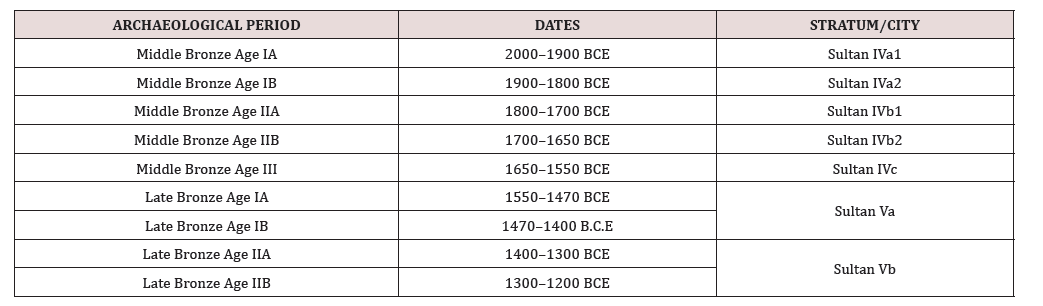
The debate persists because different excavators produced contradictory interpretations of the site’s stratigraphy. British archaeologist John Garstang (1948, xvi, 128) [4], who excavated Jericho in the 1930s, developed a site stratigraphy that included five strata, in addition to the Neolithic settlement. He concluded that the final Canaanite occupation, represented by his City IVii, came to an end in a fiery destruction ca. 1400–1385 BCE, at the hands of Joshua and the Israelites, as described in the Bible (Garstang 1948, 179) [4]. Kathleen Kenyon, who excavated from1952–58 [5], never provided site-wide stratigraphy for Jericho, choosing instead to date each trench and square independently. She concluded that the destruction of Garstang’s City IVii did not occur in the Late Bronze Age, but was the terminus of the Middle Bronze city, which she associated with the expulsion of the Hyksos from Egypt (Kenyon 1967, 275) [6]. The most recent excavations under the direction of Lorenzo Nigro et al. (1997–2000, 2009–2024) [3,7,8] indicate Kenyon’s date of the destruction of the final phase of City IV at the end of the Middle Bronze Age, ca. 1550 BCE is correct. Moreover, Nigro’s (Nigro 2016, 11; 2024, 48) [3,9] team harmonized the data from previous excavations with their own into an overall periodization of the site that clarifies the Middle and Late Bronze Age occupation of the site (See Table 1). According to their site stratigraphy, Stratum Va and Vb represent the Late Bronze occupation, not Stratum IVc, which they date to the Middle Bronze Age. These competing interpretations lead to fundamentally different reconstructions of Jericho’s occupational history.
Table 1. Middle and Late Bronze Age Stratigraphy of the Italian-Palestinian Expedition at Tell es-Sultan/ancient Jericho (Adapted from Nigro 2016, 11; 2024, 48) [9,3].
While each interpretation derives from relevant archaeological evidence, previous discussions have generally focused on defending one stratigraphic model or the other rather than systematically analyzing the published data for both Sultan IV and V and evaluating it using the same criteria before drawing a conclusion. Moreover, the archaeological evidence has rarely been considered alongside all of the pertinent ancient textual witnesses concerning the destruction of Late Bronze Jericho. This article addresses these deficiencies by reassessing the published evidence for Sultan IV and Sultan V within a single framework, including comparative ceramic assemblages, architectural remains, radiocarbon determinations, and inscriptional finds, while also considering ancient textual evidence relevant to the destruction of the site.
Methodology
This study undertook a comprehensive reassessment of the archaeological evidence relating to Sultan IV and V to determine which stratum represents the site’s terminal Canaanite settlement1 First, the author assembled an encompassing database of known Late Bronze Age archaeological material at Tell es-Sultan from museum collections, excavation archives, and published reports. To incorporate all relevant available data, the author contacted universities, museums, and research institutions housing material from previous excavations. Inventories and artifact lists provided by curators were systematically reviewed to identify ceramics and objects attributable to the Late Bronze Age. To verify the published descriptions and refine artifact identifications, the author conducted first-hand examinations of ceramic material from the Garstang and Kenyon excavations housed at the Rockefeller Museum (Jerusalem) and the Royal Ontario Museum (Toronto). Observations from these collections were incorporated into the analytical database. The resulting dataset was analyzed comparatively to determine whether the archaeological evidence more strongly supported assignment of the terminal Late Bronze occupation to the final phase of Sultan IV or to Sultan V.
Because no single category of evidence is sufficient to establish the chronology of the terminal occupation, conclusions were based on the convergence of multiple independent lines of archaeological evidence rather than on any single argument. The ceramic assemblages from both the final phase of Sultan IV and from Sultan V were compared with securely dated Late Bronze assemblages from contemporary Levantine sites in order to assess chronological correlations. Relevant architectural remains were evaluated to determine their association with Sultan IV or V and their implications for occupational history. Radiocarbon evidence from Stratum IV was considered to determine its reliability in providing a possible date (no radiocarbon data from Sultan V is available). Scarabs and other glyptic artifacts were assessed according to their archaeological contexts and accepted chronological ranges. The combined results from these independent lines of inquiry provided the basis for determining whether the final phase of Sultan IV or whether Sultan V represents Tell es-Sultan’s terminal Canaanite occupation during the Late Bronze Age.
1. Throughout this paper, the terminology from the most stratigraphic analysis by Nigro will be used, although the author will refer to City IV and City V, rather than Stratum IV and Stratum V. When referring to previous excavations, the references to particular strata will be updated to Nigro’s stratigraphy. Hence, Garstang’s City IVii is equivalent to Nigro’s Sultan IVc. Moreover, since City V was constructed in the LB I period and destroyed in the LB II period, the author will refer to City V wholistically, rather than City Va or City Vb.
Results
Evidence for Middle Bronze occupation of Stratum IVc.
Nigro’s research affirms Kenyon’s dating of the destruction of City IVc to the end of the Middle Bronze Age (Nigro 2016, 11–15; 2020, 201–202). Kennedy (2023, 8), like Bryant Wood (1990) [1,7,9,10], maintains that Kenyon dated the City IV to the Middle Bronze Age solely on the basis of an absence of Cypriot pottery, yet inexplicably published this type of pottery. Kennedy (2023 [1] states, “Although Kenyon argued for dating the destruction of Jericho IVc to around 1550 BC rather than slightly later in the 15th century BC due to an alleged absence of exotic wares such as Cypriot Bichrome and Chocolate on White, the excavation reports on Jericho tell a different story.” A careful reading of Kenyon, however, reveals her reasoning was more nuanced than the one-dimensional caricature presented by Kennedy and Wood. Kenyon presented a broader argument for dating City IV based on the stratigraphy of certain areas and the overall ceramic sequence rather than on the absence of a single imported pottery class. Nigro, who upholds Kenyon’s dating, does not use the absence of Cypriot pottery as the basis for his dating. His site-wide periodization assigns City IVc to the Middle Bronze Age on the basis of stratigraphic considerations, architectural relationships, ceramic sequence, and radiocarbon dating.
Radiocarbon samples from Jericho City IVc derived from charcoal and grain seeds have been analyzed on several occasions with mixed results. Kenyon and Holland (1983, 763) [11] published their initial radiocarbon results in Jericho V. One important sample (BM-1790), taken from Area H, Stage XII, phase l.i on Spring Hill initially yielded a date of 3080 ± 40 BP or 1410 BCE ± 40 years. This seemed to indicate that City IV was destroyed at the end of the LB I period. However, the laboratory at the British Museum had a problem with the calibration of their equipment from 1980- 1984, which yielded erroneous results that tended to date samples younger than they really were (Bowman et al. 1990, 59) [12]. The results of BM-1790 were revised to 3300 ± 110 BP, (Bowman et al. 1990, 59) [12], resulting in a date from the Middle Bronze Age.
In 1991 and 1992, eighteen further samples (twelve from charcoal and six from carbonized grain) obtained from Kenyon’s excavations at Tell es-Sultan/Jericho were analyzed. The results of the charcoal samples were surprisingly uniform, with all but one sample providing homogeneous data (Bruins and van der Plicht 1995, 214) [13]. That one sample was a part of a larger piece of charcoal that was split into three fractions and dated separately. The outlier (GrN-18538) tested at 3614 ± 20 BP, while the other two samples (GrN-18721 and GrN-18722) yielded dates similar to the other nine (3385 ± 20 BP and 3368 ± 17 BP, respectively). The grain samples also provided uniform dates (Bruins and van der Plicht 1995, 216) [13]. Due to the homogeneous nature of the radiocarbon dates, except for one outlier, an accurate average for each type of sample was obtained: the average of the grains was 3306 ± 7 BP, and the average of the charcoal was 3370 ± 6 BP. According to Bruins and van der Plicht (1995, 218–219) [13] “Calibration with the 1993 decadal curve of Stuiver and Becker, using the OxCal computer calibration, program, results in 1-a ranges of equal probability, 1601–1566 cal BCE and 1561–1524 cal BCE.”
Kennedy (2023, 14) [1] reports IntCal20 calibrations for only three of the eighteen published determinations published by Bruins and van der Plicht and argues that the resulting calendar dates are “significantly higher than the historical dates when compared to the proposed dates of destruction published by the various excavation teams.” However, rather than recalibrating the complete dataset, Kennedy selects only three samples representing the extremes: the oldest determination within the principal cluster (GrN-18368), the youngest determination (GrN-18539), and the acknowledged outlier (GrN-18538). He does not present recalibrated results for the remaining fifteen samples, a recalculated weighted mean, a combined probability distribution, or Bayesian chronological modelling. This contrasts with the original analysis of Bruins and van der Plicht, who evaluated the coherence of the short-lived grain samples, calculated weighted averages for statistically consistent samples, and interpreted the radiocarbon determinations within their archaeological contexts. While Kennedy uses the extreme samples to illustrate the range of possible calibrated dates, Bruins and van der Plicht addressed the more fundamental question of whether the radiocarbon measurements statistically represent the same archaeological event, and when this event occurred. Consequently, Kennedy’s recalibration demonstrates that individual determinations may calibrate slightly differently under IntCal20, but it does not establish that the conclusions drawn from the complete radiocarbon dataset by the original authors require revision.
In 2000, Marchetti and Nigro published four more radiocarbon samples (Marchetti and Nigro 2000, 329–332) [8]. One sample (Rome-1176) dated to 3330 ± 60 BP resulted in a calibrated date range of 1668–1506 BCE. The other sample (Rome-1775) dated to 3110 ± 60 BP, resulted in a calibrated date range of 1432–1262 BCE.
The radiocarbon dates published by Kenyon are suspect, given the known problems with the equipment at the British Museum laboratories, although they eventually pointed to a Middle Bronze date. The radiocarbon dates published by Marchetti and Nigro are also unhelpful, as one would seem to support a destruction around the end of the MB III (ca. 1550 BCE), and the other would support a destruction around the end of the LB I period (ca. 1440 BCE). However, the radiocarbon dates published by Bruins and van der Plicht seem to be the most accurate, given their uniformity. They indicate that Sultan City IVc was destroyed at the end of the MB III, sometime between 1550 and 1520 BCE (Nigro 2023, 600) [2]. The radiocarbon data analyzed to date appear to support the views of Kenyon, and Nigro, based on their interpretation of the ceramic sequence from Jericho, that City IVc was destroyed at the end of the Middle Bronze Age, sometime in the middle of the 16th century BCE2. Nigro contends, based on these radiocarbon dates, that Jericho City IVc was destroyed ca. 1530 BCE (Nigro 2024, 58) [3].
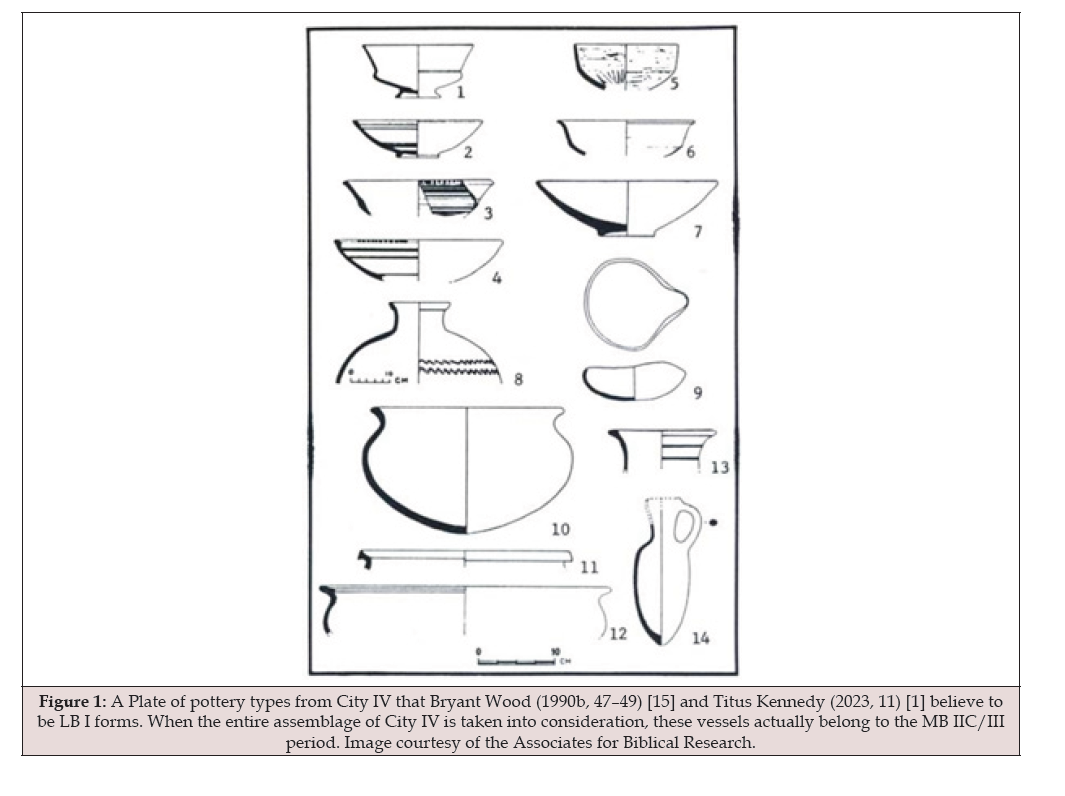
Some have argued that the Middle Bronze pottery published by Kenyon from City IVc has been misdated and actually dates to the Late Bronze Age (Wood 1990a, 50–52; 1990b, 47–49; Kennedy 2023, 8–11) [1,10,15]. In his 1990 article, Wood presented a plate of pottery from the final phases of City IV (Figure 1) that Kenyon had dated to the Middle Bronze Age, but which he believed was, in fact, LB I pottery. Kennedy (2023, 11) [1] uses the same plate and largely repeats Wood’s claims. While Wood provides comparable vessels dating to the LB I period as support, similar comparable vessels exist from the MB IIC/III period. This is not surprising given that “The material culture of the Late Bronze Age is a direct continuation of Middle Bronze Age traditions. Since there is no distinct cultural break, it can be difficult to distinguish between the pottery common to both periods” (Mullins and Yannai 2019, 151) [16].
Figure 1: A Plate of pottery types from City IV that Bryant Wood (1990b, 47–49) [15] and Titus Kennedy (2023, 11) [1] believe to be LB I forms. When the entire assemblage of City IV is taken into consideration, these vessels actually belong to the MB IIC/III period. Image courtesy of the Associates for Biblical Research.
2. Kutschera and Bietak, et al. (2012, 407–422) [14] propose that the volcanic eruption of Thera/Santorini occurred approximately 100 years earlier than the archaeological evidence from Tell el-Daba, Egypt supports. This suggests a possible carbon-14 offset in Egypt and the southern Levant in the 15th century BC, which may affect the radiocarbon dating of City IV. Surprisingly, the academic community has largely ignored his findings.
Wood (1990b, fig. 1) [15] noted a flaring carinated bowl, which he believed dated to the LB I. This vessel comes from Kenyon’s phase lii-liii (Kenyon and Holland 1982, Fig. 110:1) [17]. Kenyon published another similar flaring carinated bowl from phase lii-liii (Kenyon and Holland 1983, Fig. 191:13) [11]; this vessel belongs to the MB IIB-C (Bonfil 2019, 101) [18]. A similar flaring carinated bowl from Hazor provides another Middle Bronze Age parallel (Bonfil 2019, 101). Wood (1990b, fig. 9) [15,18] also highlighted an oil lamp, which he identifies as LB I. Kennedy (2023, 9) [1] repeats Wood’s claim, noting that lamps in a saucer form with slightly pinched spouts are typical of LB I. This type of lamp is found in early LB I contexts and is a continuation of a common MB IIC form. However, later in the LB I, at the time Wood and Kennedy place the destruction of City IV, the spouts of lamps became more severely pinched (Mullins and Yanni 2019, 168) [16]. A similar oil lamp from Yoqne‘am provides a Middle Bronze Age parallel (Bonfil 2019, 136, 113). Wood (1990b, fig. 9) [15,18] further notes a cooking pot he believes demonstrates that City IV dates to the Late Bronze Age. While open, globular cooking pots with everted rims are common in the LB I, they actually begin to appear towards the end of the MB IIB (Bonfil 2019, 84) [18]. A similar open, globular cooking pot with everted rim was discovered by the team at Beth Shean in Stratum R3, dating to the sixteenth century (Mazar and Mullins 2007, Pl 33.2) [19]. In fact, both the oil lamp and a cooking pot discussed above, which were published by Kenyon and Holland (1982, Fig. 197:2 and 198:10) [17], are listed as MB IIB-C exemplars in The Ancient Pottery of Israel and its Neighbors – Volume 3 (Bonfil 2019, 136, 113). Wood (1990b, fig. 14) [15,18] also presents a dipper juglet which he suggests is typical of the LB I. However, this form is transitional at best and could come from either the final phase of the Middle Bronze Age or the early phase of the Late Bronze Age; it has a slightly elongated body and pointed base, not the typical LB I dipper juglet that has a globular body with a high, narrow neck (Mullins and Yannai 2019, 165) [16].
As shown above, the vessels that Wood (and Kennedy) identify as having LB I parallels also have comparable examples from MB III contexts. Since many forms in the LB I carry on the tradition of their Middle Bronze counterparts, the forms listed on Wood’s plate could just as easily date from the MB III as LB I. Their position is even more problematic as they stretch these forms to the very end of the LB I, when many are more common early in the LB I. Rather than emphasizing a limited number of vessel forms that have LB I comparables, the ceramic assemblage should be evaluated in its entirety to determine whether City IVc is more appropriately dated to the MB III or LB I period.
Kenyon’s phase lii-liii represents City IVc, and the carefully selected forms noted by Wood and Kennedy derive from this phase. An analysis of the many other vessels published by Kenyon and Holland from this phase demonstrates that this stratum is clearly MB III. For example, the storage jars from phase lii-liii (Kenyon and Holland 1983, Fig. 202.2 and 203.4) have Middle Bronze Age parallels from Yoqne‘am (Bonfil 2019, Pl 1.3.19, #2) [18] and Beit Mirisim (Bonfil 2019, Pl. 1.3.17, #5) [18] respectively. A Type A.II.b bowl from this phase at Jericho (Kenyon and Holland 1983, Fig. 189.4) [11] has a parallel from Middle Bronze Age Hazor (Bonfil 2019, 90, pl. 1.2.1, #14). Kenyon and Holland (1983, Fig. 194.3) [11,18] published a pedestal vase from the final phase of City IV that has two burnished parallels from Beit Mirsim (Bonfil 2019, Pl. 1.3.8, #4 and #5) [18]. Similarly, a juglet from phase lii-liii at Jericho (Kenyon and Holland 1983, Fig. 196.4) [11] is comparable to a juglet from the Middle Bronze Age Stratum R-3 at Beth Shean (Mazar and Mullins 2007, Pl. 33.13) [19].
When considered as a whole, the ceramic assemblage recovered by Kenyon’s team from the final phase of City IVc is more consistent with a Middle Bronze III date than a Late Bronze I date. Although Wood and Kennedy identify LB I parallels for several vessel forms, these same forms also have well-attested MB III comparables. More importantly, the dating of City IVc should be based on the assemblage in its entirety rather than on selected vessel types. As demonstrated above, even a limited examination of additional vessels from phases lii–liii at Jericho reveals numerous Middle Bronze Age parallels from other sites. Taken together, the evidence indicates that City IVc belongs to the MB III period rather than the LB I period.
Evidence for Late Bronze occupation of Stratum V
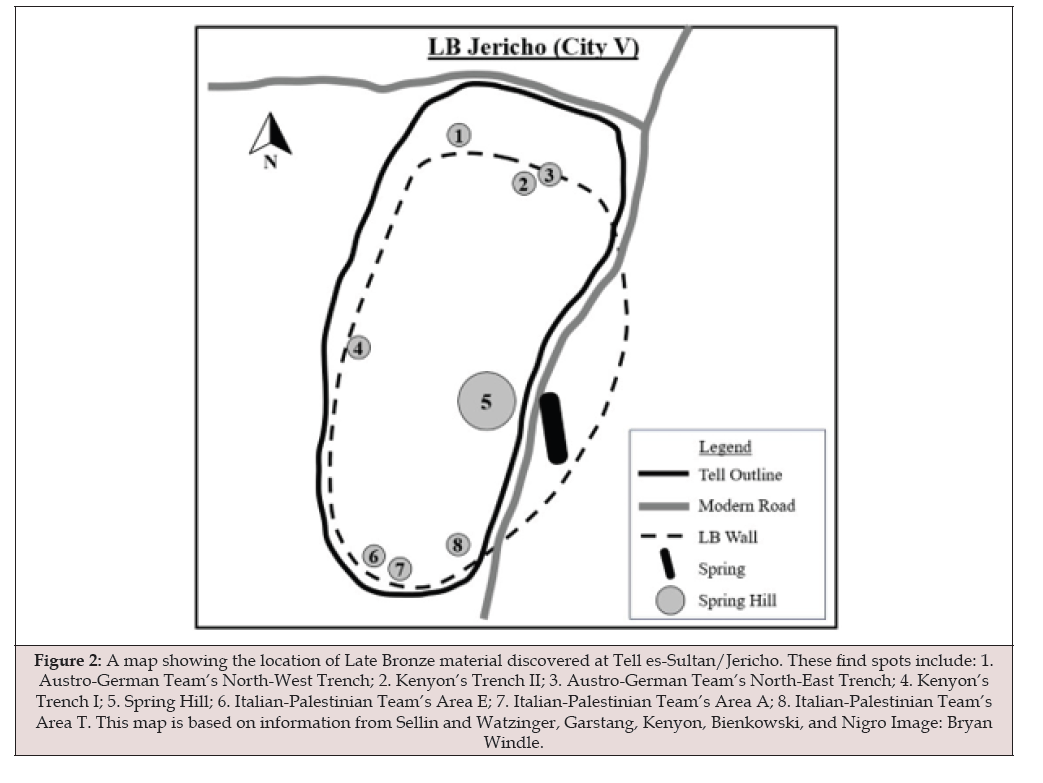
Every major excavation team unearthed Late Bronze pottery at Jericho, particularly on Spring Hill, the area on the eastern side of the tell overlooking Jericho’s spring (Figure 2). It was here that a succession of palaces and mansions were constructed: The Early Bronze palace was replaced by the Middle Bronze palace, which gave way to a smaller structure in the Late Bronze Age, referred to as the Middle Building by Garstang, or the Residency by Nigro.
Figure 2: A map showing the location of Late Bronze material discovered at Tell es-Sultan/Jericho. These find spots include: 1. Austro-German Team’s North-West Trench; 2. Kenyon’s Trench II; 3. Austro-German Team’s North-East Trench; 4. Kenyon’s Trench I; 5. Spring Hill; 6. Italian-Palestinian Team’s Area E; 7. Italian-Palestinian Team’s Area A; 8. Italian-Palestinian Team’s Area T. This map is based on information from Sellin and Watzinger, Garstang, Kenyon, Bienkowski, and Nigro Image: Bryan Windle.
Sellin and Watzinger (1913, 123–129) [20] published 15 diagnostic Late Bronze painted sherds, all of which came from Squares G5-6, H506 and I5-6 on Spring Hill in the area of the IA “Hilani3.” Garstang noted that Watzinger confirmed in written communication to him that the Late Bronze sherds discovered by the Austro-German team came from the upper layers of the “Lower Palace,” likely having come from their Late Bronze strata below the Iron Age “Hilani” Bienkowski 1986, 115, 116) [21]. Notes that Late Bronze sherds were also discovered in the dump piles from the German excavations to the north of the tell, possibly indicating occupation at the northern end of the tell. Garstang’s (1934, Pl. XXVII–XXXIX) [22] excavations unearthed over 200 Late Bronze painted sherds and five painted vessels from the area of Spring Hill, both in upper layers and foundation layers of the Middle Building, as well as some in the palace area and storerooms. Kenyon (1983, 463-464) [11] found six more Late Bronze painted sherds on Spring Hill in Squares H II, III, and V. Nigro has not published his final report on Jericho, but recently discussed a single sherd of a Cypriot White Slip II milk bowl (Nigro 2023, 612; 2024, 58) [2,3].
3. A “Hilani,” from the term Bit-hilani (Akkadian: meaning ‘house of pillars’), was a style of palace that became popular during the Iron Age. It appears to have originated in region of the Hittites and spread throughout the Southern Levant.
Dating pottery sherds from this area has proven difficult from a stratigraphic perspective because the Middle Building was covered by an erosional layer of burnt debris and ash (the so-called “streak” or “wash”) and was built into the destruction layer of the Middle Bronze Palace (Garstang 1934, 100–101) [22]. There is debate as to whether the pottery from Spring Hill came from the erosional layer or from rooms in the Middle Building themselves (see Bienkowski 1990 vs. Wood 1990b) [15,23]. Bienkowski argued that the painted pottery discovered by Garstang on the tell was not LB I Cypriot bichrome ware, but rather it was standard LB II painted ware that came from the rooms of the Middle Building, referring to the room numbers written on the pottery sherds (Bienkowski 1990, 46) [23]. Wood responded that the fabric of the sherds was finer and of better quality than the relatively poor LB II pottery, and must therefore date to the LB I. Wood also (1990b) [15] argued that pottery excavated by Garstang came from the erosional layers above or beneath the Middle Building, even though it was labeled with the room numbers of the Middle Building. The present author examined the bichrome pottery from Garstang’s Middle Building while at the Rockefeller Museum in Jerusalem and determined that its fabric is of similar quality to the regular, unpainted LB IIA pottery he excavated at Shiloh.
For his part, Garstang attributed the Late Bronze painted ware to the occupation of the Middle Building and initially dated these “monochrome or shaded duo chrome” (now known as bichrome) sherds to the LB I period. While he admitted that determining the stratigraphy of the Middle Building was problematic, Garstang (1934, 111) [22] did note that in room M III exhibited real, discernible stratification. Perhaps this is why he dated the Middle Building based on the painted pottery he found at differing levels, both in and below the erosional streak that covered the building.
Garstang (1948, 177–180) [4] later changed his mind about the date of the ceramics he unearthed in the Middle Building, based on a revision of the chronology of similar pottery from Beth Shean, and assigned them to the LB II period. The specific sherds in Garstang’s original report (Garstang 1934, plates XXX–XXXIX) [22] that caused him to change his mind are the very bichrome pottery sherds that Wood (1990b) and Kennedy (2023, 10) [1,15,] maintain are LB I and thus date City IVc to that period. Garstang came to believe these sherds dated to the LB II and concluded that the Middle Building was not part of City IVc (which he erroneously believed was the final Late Bronze city), but was used later by King Eglon4.
Three types of bichrome pottery exist in the southern Levant: (1) imported Cypriot Wheel made Bichrome, (2) Local Wheel made Bichrome that looks identical to the Cypriot ware but is made from local clay rather than Cypriot clay, and (3) Standard Canaanite ceramics with black and red decoration. The imported and local wheel made bichrome wares (#1 and 2) in the Jezreel Valley span MB III–LB I. The Standard Canaanite black and red decoration (#3) that predominates in LB I–IIA, almost disappearing in LB IIB, with red decoration only, tends to predominate in LB IIB into Iron I. (Robert Mullins 2024, Personal Communication). Common motifs in all three types of bichrome pottery include a zigzag line painted between two vertical, parallel lines, a crisscross “fishnet” pattern, alternating colored horizontal lines, and the use of metopes.
Comparative assemblages from other Late Bronze sites near Jericho further affirm that this pottery fits into the LB I-II range, and thus belongs to City V. The repertoire from Jericho is nearly identical to the assemblages at Tall el-Hammam, Shiloh, Shechem, Tel Batash, Beth Shean, and Tel Esur (See Table 2). All these sites were within 50 miles of Jericho.
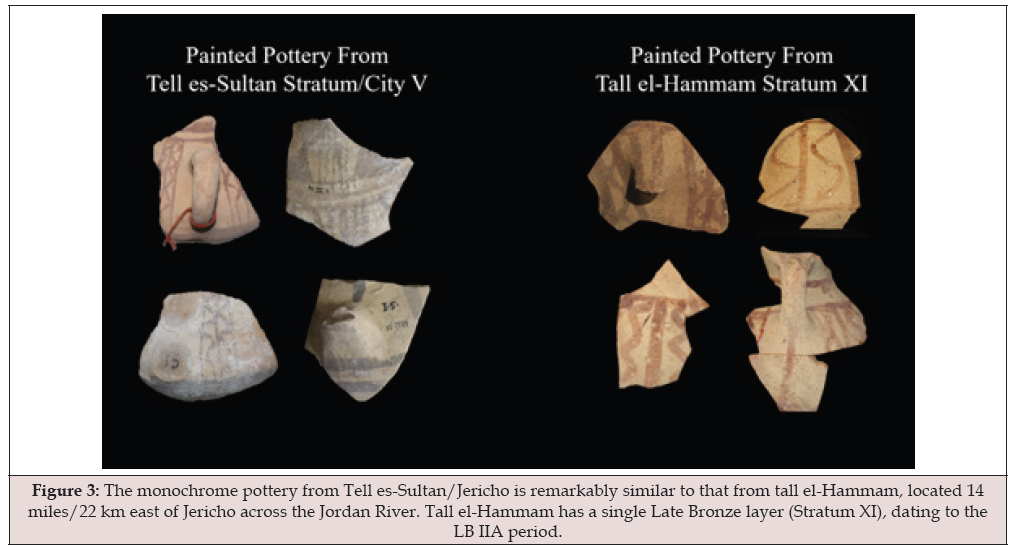
The closest of these comparables, tall el-Hammam, is a major Bronze Age site located 14 miles/22 km east of Jericho across the Jordan River. It has a single Late Bronze layer (Stratum XI), which consists of a freestanding building of five to seven rooms. The excavators discovered the remains of cedar beams, amulets, and scale pans, indicating it was a significant administrative building, possibly an Egyptian toll house (Gary Byers 2024, Personal Communication). Based on the pottery from this structure, as well as that from a nearby tomb, this stratum dates to the LB IIA period (Collins et al. 2016, 18) [25]. This author conducted an analysis of pottery assemblage from tall el-Hammam in January 2026 and concluded the painted monochrome sherds, particularly from amphorae, were nearly identical to those from Jericho that he studied at the Rockefeller Museum in Jerusalem and the Royal Ontario Museum in Toronto. This evidence indicates Jericho City V was likely occupied at the same time in the Late Bronze Age IIA period.
4. Nigro’s research (2020, 202) [7], indicates the Middle Building was used in the LB IIB, but also acknowledges a scarcity of thirteenthcentury archaeological material. This, combined with the fact that Nigro (2025, 242) [24] dates the destruction of the walls of City V to the fourteenth century, leads this author to believe that the unfortified City Vb may represent the Moabite occupation mentioned in Judges 3. Might Eglon, king of Moab, have repaired and reused the Middle Building as his winter residence?
Table 2. Comparative Assemblages in the southern Levant showing relative chronological correlations with Jericho City V.
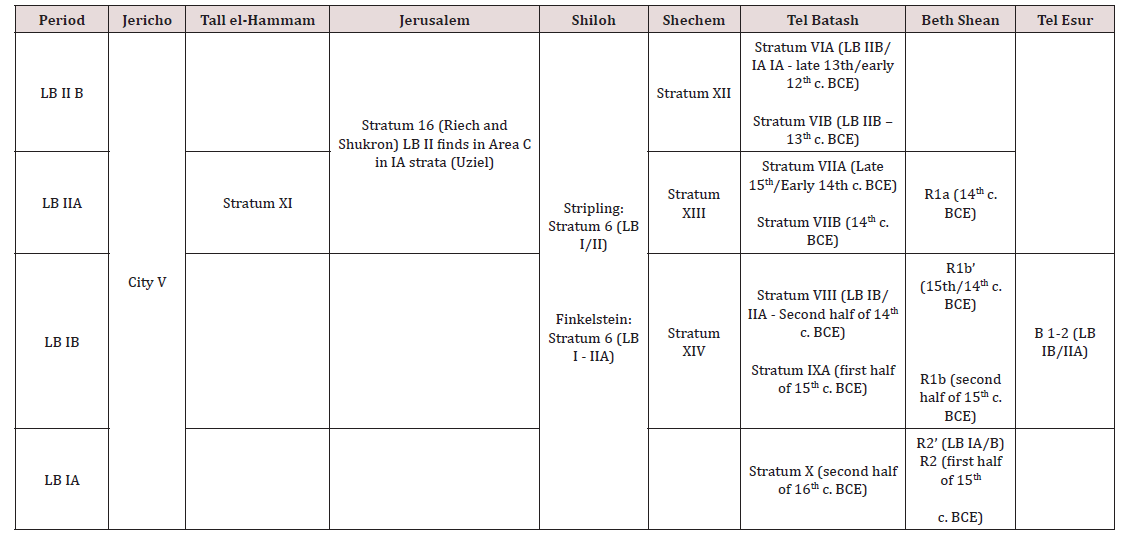
Shiloh is another nearby site, located 15 miles/24 km northwest of Jericho. Late Bronze remains from Stratum 6 have been discovered (Finkelstein 1993, 143, 148, 150) [26], including a Late Bronze favissa filled with painted LB IIA sherds and restorable cultic vessels. Finkelstein (1993, 8) [26] dated Stratum 6 to the LB I–IIA period (ca. 1550–1350 BCE). According to current dig director, Scott Stripling (Moore et al. 2026, 1703) [27], the typochronological ceramic assemblage analysis from the core favissa, along with the radiocarbon analysis of the animal bones, points toward an LB IIA terminus post quem for the favissa. This is important, as numerous pottery comparables exist between Shiloh and Jericho (see below), indicating Jericho Stratum V was primarily a Late Bronze Age IIA city. As part of the dig team at Shiloh, this author excavated numerous pieces of bichrome pottery from the favissa that are similar to the bichrome pottery from Jericho that he studied in person at the Rockefeller Museum.
The Bronze Age city of Shechem is located 25 miles/41 km northwest of Jericho between Mt. Gerizim and Mt. Ebal. Because of its vulnerable location, Shechem was fortified early in its history. It has significant Late Bronze strata in Field XIII: Stratum XII (LB IIB), Stratum XIII (LB IIA) and Stratum XIV (LB IB; see Duff 2015, 9) [28], with numerous comparable pottery forms (see below).
Tel Batash/biblical Timnah lies 32 miles/52 km west of Jericho and was occupied throughout the LBA: Stratum VIA (LB IIB/IA IA = late thirteenth/early twelfth century BCE), Stratum VIB (LB IIB = thirteenth century BCE), 37 Stratum VIIA (Late fifteenth/early fourteenth century BCE) Stratum VIIB (fourteenth century BCE), Stratum VIII (LB IB/IIA = Second half of fifteenth century BCE), Stratum IXA (first half of fifteenth century BCE), and Stratum X (second half of 16th century BCE; see Mazar and Panitz-Cohen 2019, 90).
Beth Shean is located 44 miles/70 km north of Jericho and 14 miles/22 km south of the Sea of Galilee. Area R has well-stratified Late Bronze layers: R1a (fourteenth century BCE), R1b’ (fifteenth/ fourteenth century BCE), R1b (second half of fifteenth century BCE), R2’ and R2 (first half of fifteenth century BCE; see Mazar and Mullins 2007, 12, 112–195) [19]. During the Late Bronze Age, Beth Shean was a significant Egyptian administrative center in the region.
Finally, Tel Esur (also known as Tel Assor or Tell el-Asawir) is 49 miles/79 km northwest of Jericho. It is a small site in the region of Sharon, lying along the Via Maris at the entrance to the Wadi Ara pass. It has a beautiful repertoire of painted Late Bronze pottery dating to the LB IB/IIA horizon (Shalvi et al. 2019, 116) [29], which matches the painted pottery from Jericho (see below).
Painted bichrome ware with similar motifs was discovered at Beth Shean in strata R1a (LB IIA/fourteenth century BCE) through R2 (LB IA/first half of fifteenth century BCE; Mazar and Mullins 2007, 470–583) [19]. Other examples of similar Late Bronze painted bichrome pottery have been found at nearby sites, such as in Stratum VI of Debris 407 (a favissa) at Shiloh; Finkelstein (1993,143-146) [26]. Late Bronze painted bichrome pottery has also been discovered in the LB IB/IIA Stratum VIII at Tel Batash (Mullins and Yannai 2019, 220–222) [16], and the B1–2 stratum at Tel Esur, which dates to the LB IB/IIA horizon (Shalvi et al. 2020, 2-5). Ceramicist Robert Mullins (2024, Personal Communication), who has studied the pottery Garstang published from Jericho, believes the bichrome pottery from the site is largely Standard Canaanite black and red ware that dates to the LB IIA period5.
In addition to the painted bichrome pottery, many painted monochrome sherds were discovered on the tell. Typically, these sherds are both drab ware and fine ware with red or brown painted decoration. Again, common metopes include a zigzag line painted between two vertical, parallel lines, and a criss-cross “fishnet” pattern. Similar monochrome sherds were discovered at nearby tall el-Hammam in the LB IIA Stratum XI (Gary Byers 2024, Personal Communication, Figure 3) and at Beth Shean in both LB IB and IIA contexts (Mazar and Mullins 2007, 519 and 529) [19], as well as at Shechem in both the LB IB and IIA periods (Duff 2015, Fig. 2.19.8 and Fig. 2.32.6) [28]. Moreover, at Beth Shean, monochrome red becomes increasingly popular in the LB II period, while bichrome red and black, especially popular in LB I, fades away by the LB IIB (Mazar and Mullins 2007, 395) [19].
Figure 3: The monochrome pottery from Tell es-Sultan/Jericho is remarkably similar to that from tall el-Hammam, located 14 miles/22 km east of Jericho across the Jordan River. Tall el-Hammam has a single Late Bronze layer (Stratum XI), dating to the LB IIA period.
Kenyon excavated a mendable Late Bronze dipper juglet, which she dated to the fourteenth BCE, lying on the floor of a home in square H III (Kenyon and Holland 1981, 371) [30]. The excavation report described it as, “Hard pink ware with very small white grits. Surface destroyed. Crushed but complete” (Kenyon and Holland 1983, 467) [11]. She further wrote, On the floor is a small mud oven, just like those still used by peasant women in Palestine today (Pl. 63B). Beside the oven, a single dipper juglet was lying on the floor. This juglet (Pl. 62 C) is the only Late Bronze Age vessel we have found in situ on the tell. Its date is fourteenth century, and fits in well with the more precisely datable finds in the tombs made by Professor Garstang…The evidence seems to me to be that the small fragment of a building which we have found is part of the kitchen of a Canaanite woman, who may have dropped the juglet beside the oven and fled at the sound of the trumpets of Joshua’s men.” (Kenyon 1957, 261, 263) [31].
5. The author is grateful to Dr. Robert Mullins for engaging with him about the pottery from Jericho. Mullins is one of the leading authorities on Late Bronze Age pottery in the Southern Levant. He co-authored “The Late Bronze Age I–II,” with Eli Yannai in The Ancient Pottery of Israel and Its Neighbors (Israel Exploration Society, 2019) and Excavations at Tel Beth-Shean 1989-1996, Volume II: The Middle and Late Bronze Age Strata in Area R (Israel Exploration Society, 2008), with project director Amihai Mazar of the Hebrew University of Jerusalem.
Dipper juglets in the Late Bronze Age became less elongated than their Middle Bronze counterparts, and had more rounded bottoms, rather than the more pointed bottoms of Middle Bronze dipper juglets. Kenyon’s dipper juglet had a trefoil, pinched mouth, a feature that began in the late LB I and continued into the LB II (Mullins and Yannai 2019, 165) [16].
In summary, the pottery from the tell clearly fits within the LB IB/IIA horizon, and the comparables from nearby tall el-Hammam and Shiloh indicate that Jericho was occupied primarily in the LB IIA period. This aligns with Kenyon’s dating of the dipper juglet from the domestic structure she excavated. Given that City IVc dates to the MB III period, as established above, this Late Bronze Age pottery is to be associated with City V.
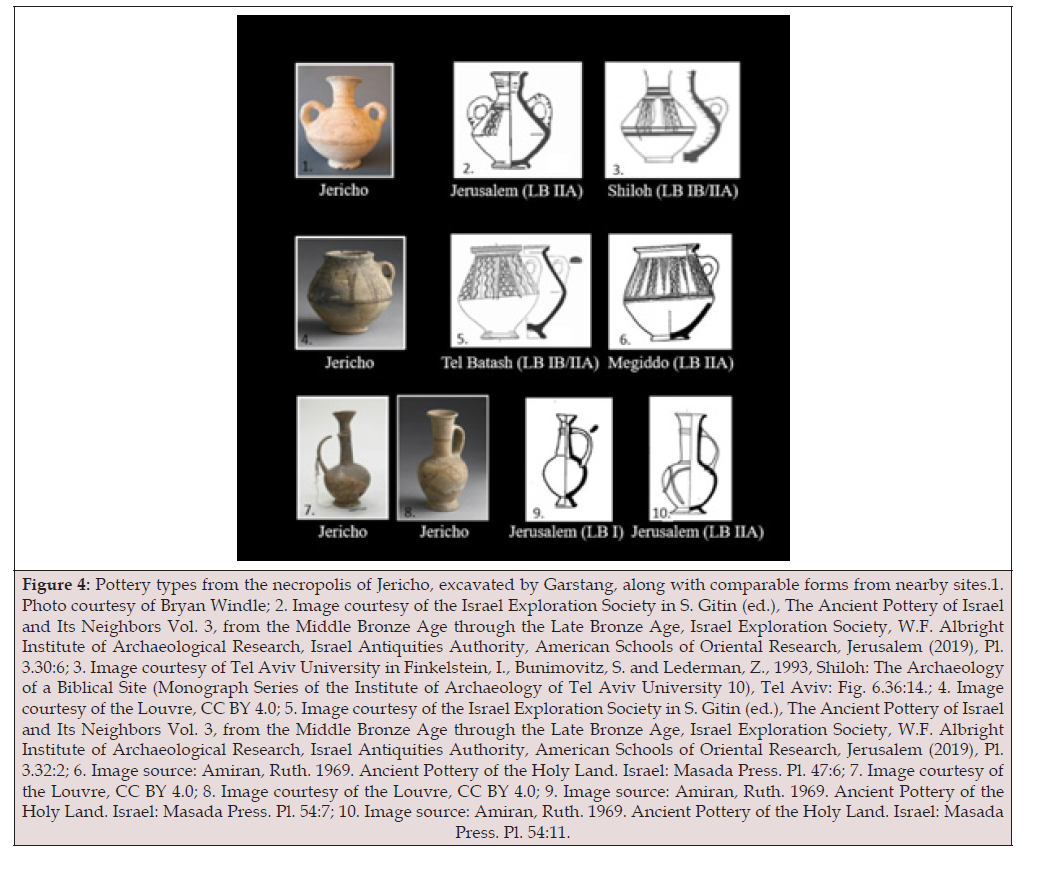
Beyond the painted pottery from the tell, Garstang also found distinctively Late Bronze vessels in Tombs 4, 5, and 13 (Figure 4). While constructed in the Middle Bronze Age, they were reused in the Late Bronze Age, indicating the site was occupied during this period. The vessels from these three tombs include distinctly Late Bronze forms, such as monochrome painted biconical amphorae, which were discovered in abundance in Tombs 4 and 5. Amphorae lack Middle Bronze antecedents in the southern Levant, and are usually regarded as a Late Bronze innovation (Mullins and Yannai 2019, 163) [16]. They appear in small, medium, and large sizes, and are often decorated with typical Late Bronze Age patterns above the point of carination. Comparable painted biconical amphorae have been found in an LB IIA tomb in Jerusalem (Mullins and Yannai 2019, Pl. 3.30.6) [16] and in Stratum 6 (LB IIA) at Shiloh (Buhl and Holm-Nielsen 1969, Pl. XXVI, 204; Finkelstein 1993, Fig. 6.36, 14) [26,32]. A larger, one-handled biconical jug was also discovered in Tomb 4. The coarse fabric and sloppy runs in the painted lattice work decoration indicate that it may be a local imitation and most likely dates to the LB IIA. Comparable one-handled biconical jugs were found in an LB IB/IIA context at Tel Batash (Panitz-Cohen, N., Mazar, et al. 2006, Pl 37:11) [33], and in an LB IIA context at Megiddo (Amiran 1969, Pl. 47, 6) [34].
Figure 4: Pottery types from the necropolis of Jericho, excavated by Garstang, along with comparable forms from nearby sites.1. Photo courtesy of Bryan Windle; 2. Image courtesy of the Israel Exploration Society in S. Gitin (ed.), The Ancient Pottery of Israel and Its Neighbors Vol. 3, from the Middle Bronze Age through the Late Bronze Age, Israel Exploration Society, W.F. Albright Institute of Archaeological Research, Israel Antiquities Authority, American Schools of Oriental Research, Jerusalem (2019), Pl. 3.30:6; 3. Image courtesy of Tel Aviv University in Finkelstein, I., Bunimovitz, S. and Lederman, Z., 1993, Shiloh: The Archaeology of a Biblical Site (Monograph Series of the Institute of Archaeology of Tel Aviv University 10), Tel Aviv: Fig. 6.36:14.; 4. Image courtesy of the Louvre, CC BY 4.0; 5. Image courtesy of the Israel Exploration Society in S. Gitin (ed.), The Ancient Pottery of Israel and Its Neighbors Vol. 3, from the Middle Bronze Age through the Late Bronze Age, Israel Exploration Society, W.F. Albright Institute of Archaeological Research, Israel Antiquities Authority, American Schools of Oriental Research, Jerusalem (2019), Pl. 3.32:2; 6. Image source: Amiran, Ruth. 1969. Ancient Pottery of the Holy Land. Israel: Masada Press. Pl. 47:6; 7. Image courtesy of the Louvre, CC BY 4.0; 8. Image courtesy of the Louvre, CC BY 4.0; 9. Image source: Amiran, Ruth. 1969. Ancient Pottery of the Holy Land. Israel: Masada Press. Pl. 54:7; 10. Image source: Amiran, Ruth. 1969. Ancient Pottery of the Holy Land. Israel: Masada Press. Pl. 54:11.
The tombs also contained numerous examples of Base Ring (BR) ware, which is both distinctive and diagnostic. It originated in Cyprus and comes in two forms: BR I ware, which first appeared in the LB I, and BR II ware, which generally dates to the LB II. In the southern Levant, BR I and BR II often occur concurrently, especially in the LB II period (Artzy 2019, 343) [35]. While BR I ware was introduced in the LB I period, most examples derive from LB IIA contexts in the southern Levant; imitation BR II ware also became popular during the LB IIA period (Bienkowsk 1986, 69-70) [21]. In his meticulous study of pottery from Jericho, Bienkowski recorded that Tomb 5 contained seven Cypriot BR I jugs and eight imitation BR II jugs, indicating the tomb was likely used in the LB II period (Bienkoski 1986, 69) [21]. While Garstang dated most of this tomb pottery to the LB I phase, Kenyon (1957, 261) [31]. believed it dated to the LB IIA period, writing that the tombs “were reused between about 1400 BCE and c. 1350–1325 B.C.” According to Nigro (2023, 607) [2], Tomb 5 contained vessels datable as early as 1450–1400 BCE, while Tombs 4 and 13 yielded vessels datable to 1375–1275 BCE. Thus, the pottery assemblage from Tombs 4, 5, and 13 indicates Jericho City V was occupied beginning in the mid-to-late fifteenth century BCE and into the fourteenth century BCE.
Similarly, the scarabs discovered in the necropolis of Jericho indicate the site was occupied during the LB IB/IIA horizon, associating them with City V. Garstang found scarabs of Thutmose III and Hatshepsut in Tomb 5 at level d-e, which he dated to the LB I (Garstang 1933, 27) [36]. A second scarab of Thutmose III derived from Tomb 11 dating from the Iron I period (Nigro 2013, 6) [37]. In Tomb 4, Garstang (1933, 22) [36] excavated two scarabs of Amenhotep III, the latest in the series of scarabs (Figure 5). Finding scarabs in funerary contexts is unsurprising as most scarabs from Late Bronze Age contexts in Canaan come from tombs where they were placed as burial gifts (Ben-Tor 2011, 204) [38]. Pharaohs like Thutmose III and Amenhotep III were popular and revered long after they died. Consequently, their scarabs were copied and collected for many years and are therefore not helpful in determining a terminus date, unless they are found in a stratum dating to the reign of said pharaoh. This was the case with the scarabs of Amenhotep III, which were discovered while sifting material from above the MB II level d, in the later material of the upper levels (Garstang 1933 23) [36]. Garstang (1933, 27) dated this level to the LB I, but more recent analysis dates this to the LB IIA based on the pottery associated with that level. Given that Amenhotep III reigned in the LB IIA period, and his scarabs came from an LB IIA context, the scarab can be used to date the occupation of Jericho to the LB IIA period.
Figure 5: The sequence of scarabs excavated by Garstang in the necropolis indicate the site was occupied from the LB IB period into the LB IIA period. The scarabs are as follows: 1. Scarab of Thutmose III from Tomb 5 (Photo courtesy of Gary Urie); 2. Scarab of Hatshepsut from Tomb 5 (Photo courtesy of Gary Urie); and 3. Scarab of Amenhotep III from Tomb 4 (Photo courtesy of Associates for Biblical Research).
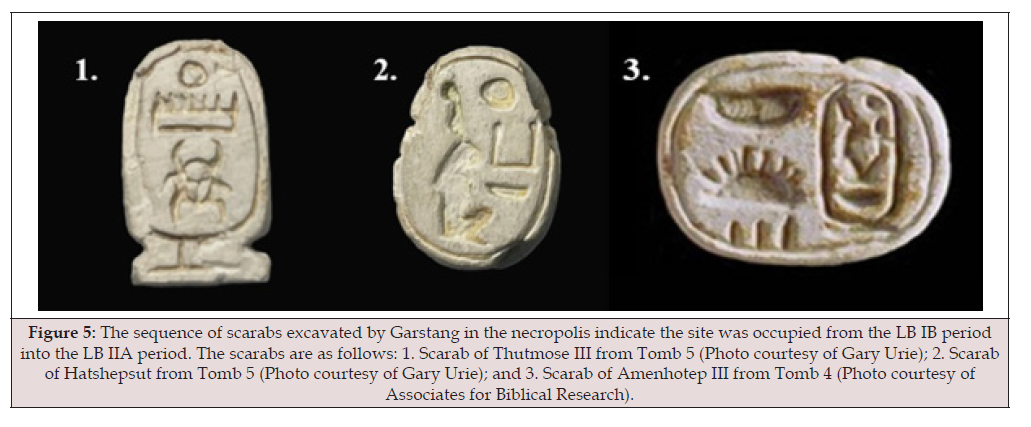
Hatshepsut’s scarab is also helpful for dating. Unlike popular pharaohs, like Thutmose III and Amenhotep III, Hatshepsut was despised, and her name was systematically erased from inscriptions in Egypt in antiquity (Tyldesley 1996, 114–115) [39]. Her scarabs are rare because they were not copied or kept as amulets. This likely makes the Hatshepsut scarab a good chronological indicator, as noted by Wood (1990b, 49) [15]. Thus, Hatshepsut’s scarab would imply some occupational evidence in the LB IB. Depending on whether one uses the high chronology or the low chronology, the sequence of Late Bronze Age scarabs discovered in the tombs at Jericho is as follows: Hatshepsut ca. 1504–1484 BCE, Thutmose III ca. 1504–1450 BCE, Amenhotep III ca. 1391–1354 BCE (Aling 2014, 15–16) [40] or Hatshepsut ca. 1473–1458 BCE, Thutmose III ca. 1479–1425 BCE, Amenhotep III ca. 1390–1352 BCE (Shaw 2003, 485) [41]. The scarab of Amenhotep III is vital to establishing a terminus ante quem for City V. Regardless of which Egyptian chronology one prefers, the series of scarabs indicates occupation at Jericho during the LB IB period into the LB IIA period.
In addition, during his excavations on the eastern side of the tell, just outside of the Middle Building, Garstang discovered a single cuneiform tablet that measured 5 cm × 4 cm. He described it as “most similar to the Tell el-Amarna tablets” and estimated that it most likely dated to the fourteenth century BCE (Garstang 1934, 116, 117) [22]. Nigro has variously dated Garstang’s tablet to the fourteenth century (Nigro 2020, 202) and the fifteenth century (Nigro 2024, 58) [7]. It is most accurate to simply date it to the LB IB/IIA horizon. The tablet was significantly damaged, and only a handful of signs are discernible, not enough to translate anything meaningful with certainty. One partial translation reads, “…older? S[o]n of Ta[g]atuka…” (Horowitz and Oshima 2006, 96) [42]. Even though the inscription cannot be meaningfully read, there are potentially important inferences that can be drawn from its discovery. First, it may imply that there was an archive during the Amarna period of the late fifteenth or fourteenth century BCE. Secondly, it may imply that Jericho was a city-state under Egyptian hegemony at this time. Nigro (2020, 202) [7] summarizes: “The discovery by Garstang of an administrative tablet dating from the same [Amarna] period…is a substantial piece of evidence in favor of the existence of a palace and a city during the fourteenth century BCE.”
Evidence for Late Bronze Fortification of City V
The nature of the Late Bronze fortification system of Jericho has been a matter of confusion and debate. Sellin and Watzinger (1913, 15) [20] labeled their fourth stratum Israelitische, believing it to be the city the Israelites lived in. Thus, they referred to the so-called “Great revetment wall” that they traced around almost three-quarters of the city as “Israelitische Boschüngsmauer” when, in fact, it belonged to the Middle Bronze Canaanite city (Burke 2008, 281) [43] Garstang believed he found the remains of the Late Bronze walls, but they were constructed in the Early Bronze Age (Kenyon 1957, 181; Kenyon and Holland 1981, 2) [6,30,31]. Kenyon (1967, 275) never produced a site-wide stratigraphy for Jericho, but suggested that the actual walls of City IVc, which Garstang believed belonged to the final Canaanite city, were destroyed near the end of the Middle Bronze Age. Some scholars, such as Bryant Wood (1990a, 50) [10], have argued that the fortification walls of City IVc were actually constructed at the end of the Middle Bronze Age, but fell in the LB I period, and that Kenyon misdated that stratum. Bienkowski, on the other hand, has argued that Late Bronze Jericho was unfortified, citing the lack of physical evidence and the widely held belief that cities in the Late Bronze Age were unfortified (Bienkowski 1986, 124) [21]6. In short, the nature of the Late Bronze fortification system at Jericho has been confusing and contradictory.
Nigro has harmonized the findings of the previous excavations and clarified the phases of the fortifications. Their new synthesis explains many of the discrepancies that existed between the results of the previous excavations (Burke 2008, 275) [43]. They clarified the fortifications of the Bronze Age city, particularly those belonging to the Middle Bronze Age. According to Nigro (2020, 1996) [7].
Four superimposed fortifications protected the MB city: a solid mudbrick wall with rectangular towers in MB I (1950–1800 BCE), two successive earthen ramparts with a limestone revetment crowned by a mudbrick wall in MB II (1800–1650 BCE), and a rubble rampart supported by triangular terrace-walls and a Cyclopean Wall at its foot in MB III (1650–1550 BCE).
Fiaccavento and Gallo (2020, 241) [44] note that the rampart protecting the MB III city was constructed over the remains of the MB II lower city at the southern end of the tell:
The area of the city was reduced in size, and part of the southern lower town was razed for the construction of a massive rubble rampart sustained by a huge retaining wall set within a foundation trench at its foot and a series of terrace walls on the slope and covered by a superficial revetment of crushed limestone.
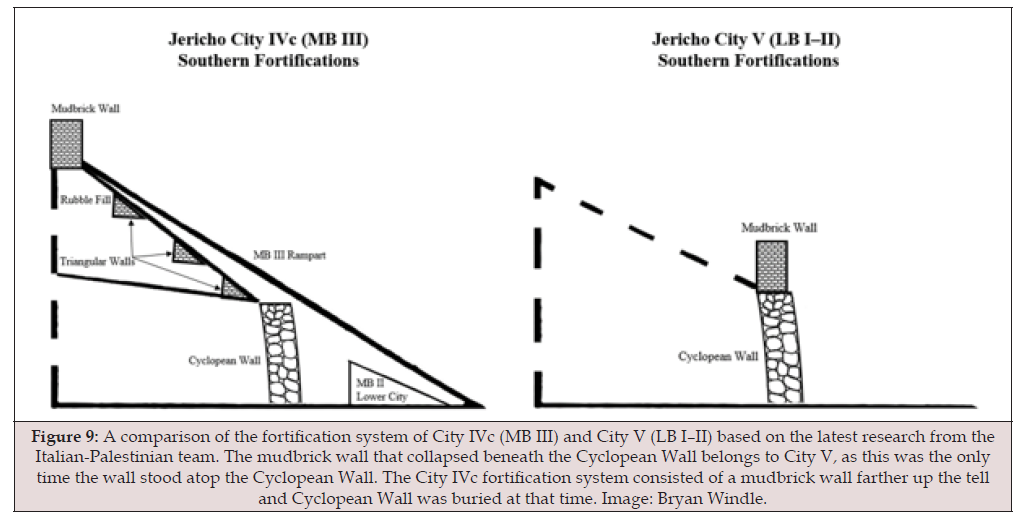
Thus, during the final phase of City IVc in the MB III period, the rubble rampart ran from the base of the tell, up over the Cyclopean wall, which was buried and unseen, continuing up the tell to the mudbrick wall.
6. Bienkowski cites a study by Rivka Gonen showing that only eight out of seventy-six known Late Bronze settlements were fortified as evidence that Jericho was likely unfortified. Gonen (1984, 70) explained this as “an outcome of the Egyptian policy in Canaan, intended to weaken the power of the semi-independent city-states and to prevent uprisings and revolt.” More recently, however, Abigail Leavitt (2025, 140) conducted a survey analyzing Late Bronze II sites in the central hill country, the area the Israelites initially settled during the conquest, and discovered that 40.3% were fortified, urban sites, 6.0% were cultic sites, 3.0% were enclosures, 22.4% were cemeteries, 19.4% were small ruins, 6.0% were medium ruins, and 3.0% were large ruins. She concluded that fortified, urban sites were by far the most common in the central hill country in the Late Bronze Age period. Similarly, David Hansen (2000, 184–185) completed a survey of thirty Late Bronze sites mentioned in the book of Joshua, nineteen of which are described in the biblical text as being fortified. Excavations have revealed evidence of fortifications (ie. mudbrick walls, revetment walls, ramparts, and/or gates,) at 84%, or sixteen out of nineteen of these sites.
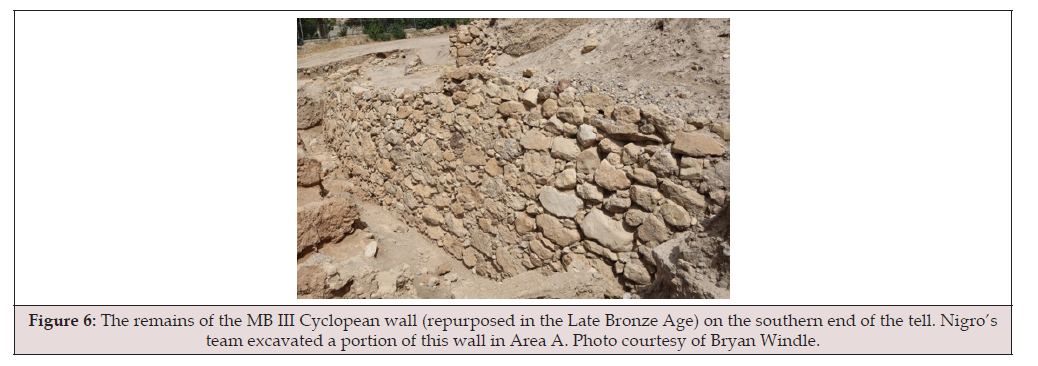
After the final Middle Bronze city (City IVc) was destroyed, it lay abandoned for at least a century before it was again resettled. Nigro (2023, 600) [2] believes Jericho City V was established ca. 1450 BCE, while Fiaccavento and Gallo (2020, 240) [44] believe it was closer to 1400 BCE. The citizens of Late Bronze Jericho reused the remains of the MB III fortifications, adding a new mudbrick wall on top of the surviving crest of the Cyclopean Wall (Nigro 2020, 202, Figure 6) [7]. Interestingly, this is precisely what Kenyon had suggested (1957, 262). It is also what Yigal Yadin (1982, 22) [45] noted: “In many cases the Late Bronze Age people did not actually build new fortifications but, rather, reused Middle Bronze fortifications, strengthening them where necessary. Interpreters often overlook this fact.”
Figure 6: The remains of the MB III Cyclopean wall (repurposed in the Late Bronze Age) on the southern end of the tell. Nigro’s team excavated a portion of this wall in Area A. Photo courtesy of Bryan Windle.
Remains of Late Bronze mudbrick walls atop the MB III Cyclopean wall have been identified by each of the excavation teams at Jericho, even if they were not always recognized as such (Figure 7). In his most recent article on Jericho in the Late Bronze Age, Nigro (2023, 601–605) [2] has identified the remains of the Late Bronze fortifications in photos from each of the previous excavation teams’ reports. For example, he notes that Sellin and Watzinger identified the mudbrick wall overlaying the MB III Cyclopean wall on the northern end of the tell and east of the spring, but they misidentified it as Israelite and dated it to the Iron Age. The caption accompanying the photo reads: “The LB II fortification wall on top of the MB III Cyclopean wall excavated by the Austro-German Expedition (after Sellin-Watzinger 1913, pl. 10)” (Nigro 2023, 602) [2,20].
Figure 7: The remains of a few courses of the mudbrick walls atop the Cyclopean Wall on the northern end of the tell can be seen in this photo from Garstang’s excavations. Nigro identified these mudbricks as the remains of the Late Bronze fortification system of Sultan V (2020, 202; 2023, 601). Photo courtesy of the PEF. Arrow added by Bryan Windle. After Nigro 2020, 2023.
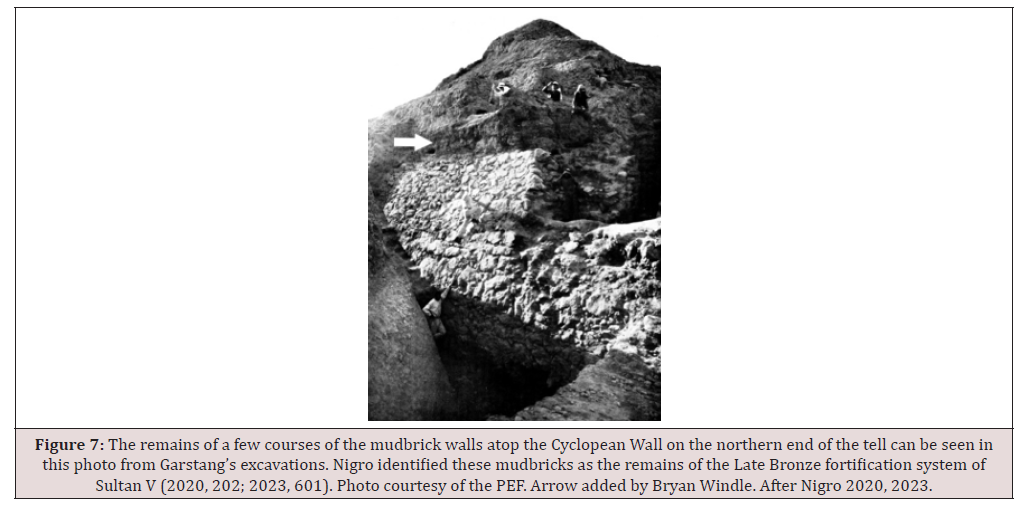
Garstang correctly identified the Late Bronze mudbrick superstructure atop the MB III retaining wall in Trench d-d, Square C6, D6, and E6 (Garstang 1930, Pl. VI) [46], even though he misidentified the double city wall, suggesting it was Late Bronze when it really belonged to the Early Bronze city. In a photo from Garstang’s dig, several remaining courses of mudbricks can be seen atop the Cyclopean Wall on the northern slope of the tell. Nigro has captioned this photo: “LB I–II mudbrick wall on top of Cyclopean Wall” (Nigro 2020, 202) [7]. Kenyon also found remains of the LB Mudbrick Wall in Trench I (west), Trench II (north), and Trench III (south). Photos of the remains of the LB I-II mudbrick walls are included in her plates (Kenyon and Holland 1981, pls 110a, 272c) [29]. While Kenyon identified the remains of this wall as having been part of the Middle Bronze city, Nigro (2023,603, 605) now believes these were the remains of the Late Bronze walls of City V.
The remains of mudbrick walls atop the Middle Bronze Cyclopean Wall discovered by previous excavations resemble the remains discovered by the Italian-Palestinian team in Area A on the southern slope of the tell. Nigro (2023, 605)[2] writes,
“The LB II wall was 2m wide and it was erected moving back 20–30 cm from the front edge of the Cyclopean Wall. The whole extension of the fortification wall should be of ca. 850 m, as suggested by the analysis of the field reports published by the Austro-German and the two British Expeditions; the occupied area of the LB II city, thus, could be around 4.5 hectares .”
Using the well-known 1:3 ratio of estimating an ancient wall’s height given the width of the base, the Late Bronze wall at Jericho stood to a maximum height of 6m (19 ft), taking the fragile nature of mudbricks into consideration (Leen Ritmeyer 2025, Personal Communication).
Evidence for the destruction of City V
Jericho City V was fortified in the LB IB/IIA period, and if Nigro is correct, traces of these fortifications were discovered by each of the previous excavation teams. In describing the Late Bronze fortifications of City V, Nigro (2023, 605) [2] writes, “The LB mudbrick wall was recognized by Kenyon in the trenches she excavated at the western (Trench I), northern (Trench II) and southern (Trench III) sides of the tell.” He footnotes Kenyon’s excavation report as follows: “Kenyon 1981, 110, 169, 219, Pls 109a-110a, 125b, 255b, 272c” (2023, 605) [1,30]. In Trench I, Kenyon noted the revetment wall with mudbrick remains atop in Stage XLIII, Phase lxi and fallen red bricks piling nearly to the top of the revetment in Stage XLIV, Phase lxiv. Her complete description reads as follows:
Above the fill associated with the kerb wall KE, during which the final M.B. bank remained in use, was a series of tip lines against the face of the revetment. The first was a heavy fill of fallen red bricks piling nearly to the top of the revetment. These probably came from the wall on the summit of the bank, of which the foundations were found in Site A (p. 375). If, however, the conclusion that the brickwork above the revetment (see above) was not a facing to the bank but an actual wall, they could have come from this. (Kenyon 1981, 110) [30].
The fallen mudbricks in Trench I from Stage XLIV, Phase lxiv of Trench I can be clearly seen in the cross-section diagram published in Kenyon’s final excavation report (Kenyon 1981, Pl 236; Figure 8) [30]. To be clear, Kenyon dated these walls to the Middle Bronze Age; Nigro (2023, 605) [2] has redated them to the Late Bronze Age, associating them with City V, not City IVc as Kenyon did. More specifically, Nigro (2025, 242) [24] dates the destruction of these walls to the latter half of the fourteenth century.
Figure 8: A cross-section of Trench I on the western side of the tell. It depicts a layer of collapsed mudbricks from Stage XLIV, Phase lxiv, labeled “FALLEN RED MUDBRICKS” (shaded red). These mudbricks would have once stood as a defensive wall atop the MB III Cyclopean Wall. Nigro (2023, 605) [2] identifies these bricks as the collapsed remains of the mudbrick wall from City V. Image: Bryan Windle, after Kenyon 1981, Pl 236 [30].
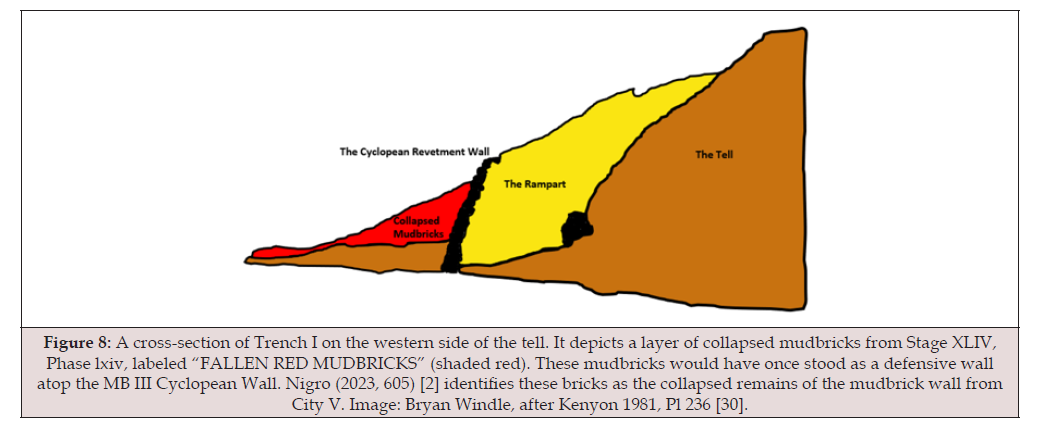
Should this collapsed mudbrick wall be associated with the Middle Bronze City IVc as Kenyon posited or the LB City V, as Nigro argues? As previously stated, the MB III Cyclopean wall was unseen in the Middle Bronze Age, as it was buried, and its purpose was to support the monumental rubble embankment of the rampart and prevent erosion (Fiaccavento and Gallo 2020, 240) [44]. The MB III mudbrick wall was not constructed directly atop the Cyclopean wall, but was located further up the tell at the top of the rampart. In contrast, the Late Bronze fortification wall was placed directly atop the crest of the Cyclopean wall (Figure 9). Kenyon’s excavations revealed that the fallen red mudbricks her team discovered piled to the top of the Cyclopean wall were from a stage (Stage XLIV) that immediately followed the one (Stage XLIII) where the mudbricks were constructed atop the revetment wall (Kenyon and Holland 1981, 110) [30]. While she dated this to the Middle Bronze Age, it matches what is now known about the Late Bronze fortification system, not that of the MB III period. Fiaccavento and Gallo (2020, 241) [44] do note that the MB III Cyclopean wall was “capped with a mudbrick wall…to regularize its top. The Cyclopean Wall was completely buried by the rubble filling of the rampart, so it was clearly not intended to be seen.” However, the few courses of mudbrick used to level the top of the Cyclopean wall before it was covered by the rubble rampart would not have produced the volume of bricks Kenyon discovered at the base of the revetment. Thus, the fallen mudbricks discovered by Kenyon belong to the Late Bronze mudbrick superstructure that once stood atop the Cyclopean wall and should be associated with City V.
Figure 9: A comparison of the fortification system of City IVc (MB III) and City V (LB I–II) based on the latest research from the Italian-Palestinian team. The mudbrick wall that collapsed beneath the Cyclopean Wall belongs to City V, as this was the only time the wall stood atop the Cyclopean Wall. The City IVc fortification system consisted of a mudbrick wall farther up the tell and Cyclopean Wall was buried at that time. Image: Bryan Windle.
If these mudbricks are the remains of the walls that fell in the Late Bronze Age, where are the mudbricks from the earlier Middle Bronze fortification wall? Since Jericho City IVc was abandoned for a period of 100–150 years after its destruction, many of the mudbricks likely disappeared through erosion. It is also possible that the LB inhabitants reused the stable mudbricks and remade new ones from the unstable ones when constructing the fortification wall of City V (Scott Stripling 2024, Personal Communication) [47]. For example, Lorenzon et al. (2023) [48] note the reuse of mudbricks at ancient Artaxata in Armenia where mudbricks were taken from previous structures, “broken down and remixed with additional water and temper to mold new bricks…This type of intensive recycling can still be considered reuse with the caveat that it is incredibly challenging to trace and identify in the archaeological record.” Recycling of old mudbricks leads to consistency in mudbrick composition between time periods (Rosenberg et al. 2020) [49], which can make dating difficult. Further, at Megiddo and Pela, excavators found that mortar was made from recycled occupation material (Homsher 2012) [50]. Thus, the mudbricks from the MB III fortification wall likely disappeared through erosion and/or were recycled for the Late Bronze fortifications.
While the well-known destruction of City IVc dates to the MB III period, evidence of Late Bronze destruction was discovered by Kenyon in a house in Area H on Spring Hill. The final excavation report lists the different phases of stratum as follows: Phase H XIV. liv (new building), liv a (occupation on floor and in bin), livlv (destruction), lv (additional walls in Square H II), lvi (Fill post destruction of lv), lvii (Pits dug into phases liv and lv), (Kenyon 1981, 371) [30]. She found evidence of destruction in phase liv-lv, although she provided no specifics. Kenyon (1957, 262) [31] dated this Late Bronze house and its destruction to the third quarter of the fourteenth century. However, Kenyon later revised her dating of the Late Bronze occupation at Jericho by shifting it half a century earlier, as she did with the Middle Building (Bienkowski 1986, 114) [21]. If this is applied to her dating of the Late Bronze house she excavated on Spring Hill, it means that it was destroyed in the first quarter of the fourteenth century.
There is also evidence of the destruction of City V by fire in the Late Bronze Age. Garstang’s excavations revealed evidence of destruction dating to the Late Bronze Age outside and at the base of the MB III Cyclopean Wall. In his section drawing for the north end of the tell along Line N-X in Squares C6, D6, and E6, he noted an “outer layer of burnt debris” which he earlier described as a destruction layer dating to the middle of the Late Bronze Age (Garstang 1930, 132, Pl VI) [46]. As Nigro (2023, 602) [2] noted, while Garstang misdated the double brick walls further north, which were actually Early Bronze walls, he did correctly note the remains of the Late Bronze mudbrick walls atop the MB III Cyclopean wall. Thus, the burnt destruction layer identified by Garstang at the base of the Cyclopean wall correctly dates to roughly the middle of the Late Bronze Age.
In his 2021 ASOR presentation, Nigro (2021, ASOR Presentation Slide 7) [51] noted further evidence of destruction of the City V by fire: “The Late Bronze ended in some kind of conflagration…The Late Bronze Age ends in a fierce destruction, which is, however, not clearly documented, as it was excavated by the first two excavations in a non-reconstruct able way.” Nigro has not yet definitively offered a date for this destruction. He has acknowledged that a drought of archaeological evidence in the “last century of the Late Bronze Age [ie. the thirteenth century BCE], during the Ramesside reign of Egypt” has been interpreted as abandonment of the site (Nigro 2019, 150) [3]. This implies that the destruction of the Late Bronze Jericho by fire occurred in the fourteenth century BCE. This drought of archaeological evidence at Jericho in the thirteenth century BCE has also been noted by Garstang (Garstang and Garstang 1948, 126–128) and Kenyon (Kenyon 1957, 262–263) [4,31]. While a specific date has not been determined, the destruction by fire of City V likely occurred in the fourteenth century.
Discussion
The evidence presented above indicates that Sultan V, not Sultan IVc represents the final Canaanite city at Jericho. It is natural to ask who or what is responsible for the destruction of Jericho City V in the fourteenth century BCE? Nigro (2025, 242) [24] attributes the destruction of the walls to a powerful earthquake. While this could explain the collapsed mudbrick fortification walls, it would not necessarily explain the destruction by fire near the city walls unearthed by Garstang.
Perhaps the city was destroyed by an enemy. The vassal correspondence in the Amarna archive, which dates to the middle of the fourteenth century BCE contains numerous references to Canaanite city-states attacking each other. Canaan was under Egyptian hegemony during this period, and the rulers of the various city-states wrote letters to the Egyptian king with numerous requests and complaints. For example, in EA 290, ʿAbdi-Ḫeba, the ruler of Jerusalem, informs Pharaoh that Milkilu of Gezer and Shuwardata of Gath “assembled the troops of the city of Gezer, the troops of the city of Gath and the troops of the city of Qilti (and) they seized the town of Rubbôte” (Rainey 2015, 1125) [52]. It is plausible that a rival city-state, or coalition of city-states, similarly attacked Jericho around the same time.
The Amarna archive also contains references to an enigmatic group known as the ʿapîru or ḫa-bi-ru. The ʿapîru/ḫa-bi-ru are mentioned in other ancient texts, from the UR III period to the 20th Egyptian Dynasty (roughly 800 years), and the term is primarily a sociological designation for “marauding nomads” (Collins and Holden, 2019, 126) [53]. While an earlier generation of scholars tried to make an etymological link between the word ḫa-bi-ru and the term Hebrews, the term ʿapîru/ḫa-bi-ru is not usually used as an ethnic designation. Still, there are striking similarities between the ʿapîru/ḫa-bi-ru described in letters from the rulers of city-states in the central highlands, and the biblical conquest narratives which occurred in the same area. For example, letters from Milkilu, the ruler of Gezer (EA 271), ʿAbdi-Ḫeba of Jerusalem (EA 286), Biridiya, the ruler of Megiddo (EA 243), contain details of attacks by the ʿapîru/ḫa-bi-ru, including the coalition of city-states in defense, the loss of territory, the inability of local rulers to maintain control over outlying settlements, and the erosion of Egyptian control. The Israelites of the conquest narratives would almost certainly have been seen as ʿapîru/ḫa-bi-ru by the local rulers of the Canaanite city-states. The Amarna texts provide a valuable contemporary witness to the kinds of social upheaval that led to the emergence of new populations in the highlands during the Late Bronze Age.
Interestingly, the archaeological evidence for the destruction of Jericho aligns with the chronology of the conquest narrative and the dating of the Amarna letters. While many scholars place the composition of the biblical books much later than the events they describe, one cannot ignore the fact that the literal internal chronological data places the destruction of Jericho within the timeframe that the archaeological evidence does, if one adopts and early-date view of the conquest. Scholars generally advocate one of two dates for the Israelite conquest: an early date in the fifteenth– fourteenth centuries BCE or a late date in the thirteenth century BCE, depending largely on whether they interpret the chronological data in passages such as 1 Kings 6:1 literally or symbolically. This present author adopts an early date position, albeit with an important qualification. Unlike typical early-date advocates, the author takes seriously the well-known textual variant in 1 Kgs 6:1, which reads “480th year” in the Masoretic Text (MT), but “440th year” in the Septuagint (LXX). Interpreted literally, these readings place the beginning of the conquest at approximately 1406 BCE and 1366 BCE, respectively. In light of the acknowledged ±20-year margin of error in Egyptian chronology of the Eighteenth Dynasty (Kitchen 1991, 204) [54] to which the different phases of the Late Bronze Age are connected (Amiran 1969, 24; Mullins and Yannai 2019, 151) [34,16], together with the imprecision inherent in current archaeological dating methods such as ceramic typology and carbon dating, this author advocates a chronological-window approach to the textual evidence. Specifically, this author proposes a conquest window of 1426–1346 BCE, representing a ±20-year margin on either side of the MT and LXX dates and corresponding broadly to the LB IB/IIA horizon.
The archaeological evidence for the destruction of Stratum V fits within this chronological window. Nigro dates the destruction of the walls to the second half of the fourteenth century BCE. Similarly, Kenyon dated the destruction of the Canaanite house she excavated to the fourteenth century BCE. Further, she accepted the general historicity of the destruction of Jericho within the context of the conquest narratives, writing “All the canons of historical criticism demand that we accept the main facts of the story of the conquest of Jericho as authentic, for it was obviously an event of great importance in the ultimate dominance of the Israelites in Palestine, and the wealth of detail makes it clear that it was a faithful…record” (Kenyon 1957, 258) [31]7. Jericho City V was destroyed during the mid-to-late fourteenth century BCE, at which time ʿapîru/ḫa-bi-ru are known to have been attacking Canaanite city-states, and close to the time the only ancient text describing the fall of the city places its destruction.
Conclusion
This study uses ceramic typology, comparative assemblages from nearby sites, radiocarbon dating, glyptic evidence, architectural remains, and stratigraphic analysis of the Late Bronze fortifications of Jericho to demonstrate that City V, not City IVc represents the final Canaanite occupation of the site. Moreover, archaeological indicators place the destruction of City V sometime in the fourteenth century BCE; several plausible causes were discussed.
The latest excavations from Nigro’s team shed light on Jericho in the Late Bronze Age. After City IVc was destroyed in the MB III period, the site lay abandoned for close to a century. Sometime late in the fifteenth century BCE, Jericho was rebuilt as a fortified city, reusing the fortifications from the Middle Bronze City IVc. Jericho City V was a modest city of approximately 11 acres (4.5 ha), whose fortification walls stood atop the MB III Cyclopean Wall. The exposed Cyclopean wall stood at least 15 feet tall, with a mudbrick superstructure rising an additional 19 feet above it. According to Nigro (2016, 16) [9], Garstang’s discovery of a cuneiform tablet indicates this city “had a political role, a palace, a ruler, and even an archive.” This is consistent with what is known of other Canaanite city-states during this period from the Amarna archive, as well as with what is known about Jericho from the biblical conquest narratives.
7. The author agrees with this statement.
References
- Kennedy Titus (2023) The Bronze Age Destruction of Jericho, Archaeology, and the Book of Joshua. Religions 14(6): 796.
- Nigro Lorenzo (2023) Tell es-Sultan/Jericho in the Late Bronze Age, in Durch di Zeiten: Through the Ages, eds. Katja Soennecken, Patrick Leiverkus, Jennifer Zimni and Katharina Schmidt. Munich: Gütersloher Verlagshaus 599-614.
- Nigro Lorenzo and Jehad Yasine (2024) Interim Report on the Excavations at Tell es-Sultan, Ancient Jericho (2019-2023): The Bronze and Iron Age Cities. Vicino Oriente 29: 47-96.
- Garstang John and J E B Garstang (1948) The Story of Jericho. London: Marshall, Morgan & Scott, Ltd.
- Kenyon Kathleen M (1952) Early Jericho. Antiquity 26(103): 116-122. Cambridge: Cambridge University Press.
- Kenyon Kathleen M (1967) Jericho. Archaeology 20(4): 268-275.
- Nigro Lorenzo (2020) The Italian-Palestinian Expedition to Tell es-Sultan, Ancient Jericho (1997–2015): Archaeology and Valorisation of Material and Immaterial Heritage, In Digging Up Jericho: Past, Present and Future, eds. Rachael Thyrza Sparks, Bill Finlayson, Bart Wagemakers and Josef Mario Briffa, Oxford: Archaeopress Publishing Ltd.: 175-213.
- Marchetti Nicolo and Lorenzo Nigro, eds (2000) Quaderni di Gerico 2. Rome: Universita Di Roma.
- Nigro Lorenzo (2016) TELL ES-SULTAN 2015: A Pilot Project for Archaeology in Palestine.” Near Eastern Archaeology 79(1): 4-17.
- Wood Bryant G (1990a) Did the Israelites Conquer Jericho? A New Look at the Archaeological Evidence. Biblical Archaeology Review 16(2): 44-57.
- Kenyon K M and T A Holland (1983) Excavations at Jericho, Vol. Five. London: British School of Archaeology in Jerusalem.
- Bowman SGE, Ambers JC, Leese MN (1990) Re-Evaluation of British Museum Radiocarbon Dates Issued Between 1980 and 1984. Radiocarbon 32(1): 59-79.
- Bruins H J and J Van Der Plicht (1995) Tell es-Sultan (Jericho): Radiocarbon Results of Short-Lived Cereal and Multiyear Charcoal Samples from the End of the Middle Bronze Age. Radiocarbon 37(2): 213-220.
- Kutschera Walter, Manfred Bietak, Eva Maria Wild, Christopher Bronk Ramsey, Michael Dee, et al. (2012) The Chronology of Tell el-Dab‘a: A Crucial Meeting Point of 14C Dating, Archaeology, and Egyptology in the 2nd Millennium BCE, Radiocarbon 54(3-4): 407-422.
- Wood Bryant G (1990b) Dating Jericho’s Destruction: Bienkowski Is Wrong on All Counts.” Biblical Archaeology Review 16(5): 45-68.
- Mullins Robert A and Eli Yannai (2019) Late Bronze Age I–II, in The Ancient Pottery of Israel and its Neighbours, Volume 3: from the Middle Bronze Age through the Late Bronze Age, Seymour Gitin. Jerusalem: Israel Exploration Society.
- Kenyon Kathleen M, T A Holland (1982) Excavations at Jericho, Vol. Four. London: British School of Archaeology in Jerusalem.
- Bonfil Ruhama (2019) Middle Bronze Age IIB–C, in The Ancient Pottery of Israel and its Neighbours, Volume 3: from the Middle Bronze Age through the Late Bronze Age, ed. Seymour Gitin. Jerusalem: Israel Exploration Society.
- Mazar Amihai and Robert A Mullins, eds. (2007) Excavations at Tel Beth-Shean 1989–1996, Vol. II: The Middle and Late Bronze Age Strata in Area R. Jerusalem: The Israel Exploration Society.
- Sellin Ernst and Carl Watzinger (1913) Jericho: Die Ergebnisse der Ausgrabungen. Leipzig: J.C. Hinrichs.
- Bienkowski Piotr (1986) Jericho in the Late Bronze Age. Oxford: Aris & Phillips.
- Garstang John (1934) Jericho: City and Necropolis, Fourth Report. University of Liverpool Annals of Archaeology and Anthropology 21: 99-136.
- Bienkowski Piotr (1990) Jericho Was Destroyed in the Middle Bronze Age, Not the Late Bronze Age. Biblical Archaeology Review 16(5): 45-46.
- Nigro Lorenzo (2025) Gerico: La Città Ulrico Hoepli Editore S.P.A.
- Collins S, G Byers, C Kobs, et al. (2016) The Tall el-Hammam Season Eleven, 2016: Excavation, Survey, Interpretations, and Insights, Jordan Department of Antiquities.
- Finkelstein Israel (1993) Shiloh: The Archaeology of a Biblical Site. Tel Aviv: Emery and Claire Yass Publications.
- Moore Jonathan E, Jordan McClinton, and Scott Stripling (2026) The Shiloh Favissa: Israel’s Only Levitically Sanctioned Cultic Deposit. Journal of Anthropological & Archeological Sciences 12(4): 1693-1710.
- Duff Catherine A (2015) Shechem V: The Late Bronze Age Pottery from Field XIII at Shechem/Tell Balatah. The American Schools of Oriental Research.
- Shalvi Golan, Shlomo Shoval, Shay Bar, Ayelet Gilboa (2020) Pigments on Late Bronze Age Painted Canaanite Pottery at Tel Esur: New Insights into Canaanite–Cypriot Technological Interaction. Journal of Archaeological Science: Reports 30(1): 102212.
- Kenyon Kathleen M and Thomas A Holland (1981) Excavations at Jericho, Vol. Three. London: British School of Archaeology in Jerusalem.
- Kenyon Kathleen M (1957) Digging Up Jericho. New York: Frederick A. Praeger, Inc.
- Buhl Marie Louise and Svend Holm Nielsen (1969) Shiloh, the Pre-Hellenistic Remains: The Danish Excavations at Tall Sailun, Palestine in 1926, 1929, 1932 and 1963. Copenhagen: The National Museum of Denmark.
- Panitz Cohen N, Mazar A, et al. (2006) Timnah (Tel Batash) III: the finds from the second millennium BCE. Qedem
- Amiran Ruth (1969) Ancient Pottery of the Holy Land. Israel: Masada Press.
- Artzy Michal (2019) Late Bronze Age I–II Cypriot Imports, in The Ancient Pottery of Israel and its Neighbours, Volume 3: from the Middle Bronze Age through the Late Bronze Age, ed. Seymour Gitin. Jerusalem: Israel Exploration Society.
- Garstang John (1933) Jericho: City and Necropolis. University of Liverpool Annals of Archaeology and Anthropology 20: 3-42.
- Nigro, Lorenzo (2013) Jericho in the Oxford Encyclopedia of the Bible and Archaeology 2, D. Master (ed.), Oxford University Press, New York 1-9.
- Ben Tor Daphna (2011) Political Implications of New Kingdom Scarabs in Palestine during the Reigns of Tuthmosis III and Ramesses II. In Under the Potter’s Tree, edited by David Aston, Bettina Bader, Carla Gallorini, Paul Nicholson and Sarah Buckingham. Leuven: Uitgeverij Peeters en Departement Oosterse Studies.
- Tyldesley Joyce (1996) Hatchepsut: The Female Pharaoh. London: Viking.
- Aling Charles F (2014) Eighteenth Dynasty Chronology. Artifax 14-16.
- Shaw Ian (2003) Oxford History of Ancient Egypt. Oxford: Oxford University Press.
- Horowitz W and Oshima T (2006) Cuneiform in Canaan, Cuneiform Sources from the Land of Israel in Ancient Times. Jerusalem, Israel Exploration Society.
- Burke Aaron A (2008) Walled Up to Heaven: The Evolution of Middle Bronze Age Fortification Strategies in the Levant. Winona Lake: Eisenbrauns.
- Fiaccavento Chiara and Elisabetta Gallo (2020) Protecting the People: The Fortification Systems of Middle Bronze Age Jericho in Light of the Italian-Palestinian Excavations, In Digging Up Jericho: Past, Present and Future, Rachael Thyrza Sparks, Bill Finlayson, Bart Wagemakers and Josef Mario Briffa, Oxford: Archaeopress Publishing Ltd pp. 231-245.
- Yadin Yigael (1982) Israel Comes to Canaan: Is the Biblical Account of the Israelite Conquest Historically Reliable? Biblical Archaeology Review 8(2): 16-23.
- Garstang John (1930) Sir Charles Marston’s Expedition of 1930, Palestine Exploration Quarterly 62(3): 123-132.
- Greenfield Haskel, Scott Stripling, Jordan McClinton, Aharon Tavger, Liora Freud (2024) Forthcoming. Archaeological and Zooarchaeological Research of the Late Bronze Age Favissa at Tel Shiloh: New Perspectives from the Recent Salvage Excavation. Judea and Samaria Research Studies.
- Lorenzon M, B Cutillas Victoria, E Holmqvist, M Gkouma, L Vrydaghs, et al. (2023) Exploring mudbrick architecture and its re-use in Artaxata, Armenia, during the 1st millennium BCE. A multidisciplinary study of earthen architecture in the Armenian Highlands. PLoS One 18(10): e0292361.
- Rosenberg Danny, Serena Love, Emily Hubbard, Florian Klimscha (2020) 7,200 years old constructions and mudbrick technology: The evidence from Tel Tsaf, Jordan Valley, Israel. PLoS One 15(1): e0227288.
- Homsher Robert S (2012) Mud Bricks and the Process of Construction in the Middle Bronze Age Southern Levant. Bulletin of the American Schools of Oriental Research 368(368): 1-27.
- Nigro Lorenzo (2021) Tell es-Sultan/Jericho in the Iron Age. (Conference Presentation). 2021 ASOR Annual Meeting Virtual Component.
- Rainey Anson F (2015) The El-Amarna Correspondence. Brill.
- Collins Steven and Joseph Holden (2019) The Harvest Handbook of Bible Lands. Harvest House Publishers.
- Kitchen K A (1991) The Chronology of Ancient Egypt. In World Archaeology 23(2): 201-208.
- Garstang John (1941) The Story of Jericho: Further Light on the Biblical Narrative. The American Journal of Semitic Languages and Literatures 58(4): 368-372.
- Kenyon Kathleen M (1970) Archaeology in the Holy Land. New York: Praeger Publishers.
- Nigro Lorenzo (2004) In the Shadow of the Bible. Archaeological Investigations by the Deutsches Palästina Vereins before the First World War: Taannek, Megiddo, Jericho, Shechem. In Archéologie dans l’Empire Ottoman Autour de 1900: Entre Politique, Économie et Science, edited by V. Krings and I. Tassignon, 215–29. Bruxelles-Rome: Institut Historique Belge de Rome.
- Sala Maura (2014) The Archaeological Expeditions to Tell es-Sultan (1868-2012). In Archaeology in the Land of Tells and Ruins: A History of Excavations in the Holy Land Inspired by the Photographs and Accounts of Leo Boer. Bart Wagemakers. Oxford: Oxbow Books: pp.117-130.
- Tushingham A D (1953) Excavations at Old Testament Jericho. The Biblical Archaeologist 16(3): 46-67.
Editorial Manager:
Email:
archaeology@lupinepublishers.com
archaeology@lupinepublisher.com

-

Mark E Smith
Bio chemistry
University of Texas Medical Branch, USA -

Lawrence A Presley
Department of Criminal Justice
Liberty University, USA -

Thomas W Miller
Department of Psychiatry
University of Kentucky, USA -

Gjumrakch Aliev
Department of Medicine
Gally International Biomedical Research & Consulting LLC, USA -

Christopher Bryant
Department of Urbanisation and Agricultural
Montreal university, USA -

Robert William Frare
Oral & Maxillofacial Pathology
New York University, USA -

Rudolph Modesto Navari
Gastroenterology and Hepatology
University of Alabama, UK -

Andrew Hague
Department of Medicine
Universities of Bradford, UK -

George Gregory Buttigieg
Maltese College of Obstetrics and Gynaecology, Europe -

Chen-Hsiung Yeh
Oncology
Circulogene Theranostics, England -
.png)
Emilio Bucio-Carrillo
Radiation Chemistry
National University of Mexico, USA -
.jpg)
Casey J Grenier
Analytical Chemistry
Wentworth Institute of Technology, USA -

Hany Atalah
Minimally Invasive Surgery
Mercer University school of Medicine, USA -

Abu-Hussein Muhamad
Pediatric Dentistry
University of Athens , Greece