
 Email Us: info@lupinepublishers.com
 Call Us: +1 (914) 407-6109
57 West 57th Street, 3rd floor, New York - NY 10019, USA
Call Us: +1 (914) 407-6109
57 West 57th Street, 3rd floor, New York - NY 10019, USA


Lupine Publishers Group
Lupine Publishers
ISSN: 2690-5752
Research Article(ISSN: 2690-5752) 
Translation Key to Harapan Script & Why They Ended in 1333BC Volume 10 - Issue 4
Received: February 24, 2025; Published: March 06, 2025
Corresponding author:Katherine New, Department of Medieval and Modern Languages, University of Oxford, UK
DOI: 10.32474/JAAS.2025.10.000342
 Abstract
 PDF
PDFAbstract
This paper explores the visual and literary interpretations of the Classical and Medieval sources of the myth of Ixion in Russian Neoclassical drama. The reverse side of an Etruscan bronze mirror housed in the British Museum provides a unique perspective on the Classical myth of the famed Lapith king. The mirror, which showcases the bound figure of Ixion in an archaic running position, tied to a wheel, stands as one of the rare visual sources, which present the winged instrument of the King’s punishment. The paper attempts to discover why the mythological plotline of Ixion was judged to be a suitable subject to engrave upon a mirror. An undertaking will be made to decipher why the Etruscan artist chose to depict the episode of the king’s punishment upon a female trinket restricted to the boundaries of domestic, secluded space. It is suggested in the paper that both literary and visual sources are united by concepts of deception, illusion and punishment. A mirror reflection is based upon a visual deception of the eye since it offers a reversed image of reality, in much the same manner as Ixion’s literary plotline is based upon a binary concept of delusion, involving both the king, who deceives the gods, and the gods, who retaliate by crafting a deceptive visual illusion. The paper contends that depicting the mythological episode of Ixion’s punishment on the mirror serves to unite the concepts of illusion, deception, and punishment, implying that if illusion is punishable, this mirror will not mislead its user for fear of retribution.
Introduction
Innokenty Fedorovich Annensky, one of the greatest figures of the Russian Silver Age, is best known as an astute literary critic, the translator of Euripides’ seventeen tragedies into Russian and an exceptional lyric poet. Among his notable works are the poetic anthologies ‘Nikto’ and ‘Kiparisovii Laretz’, which are associated with the first wave of Symbolism in Russia. Beyond his well-known scholarly contributions and celebrated poetry, Annensky also created a lesser-known cycle of four mythological tragedies derived from ancient legends, which exist only in incomplete fragments. As a Classical scholar, tutor in ancient languages, and director of the Nikolaevskaya gymnasium in Tsarskoe Selo [1], Annensky aimed to revive the lost tragedies of Euripides, drawing on four obscure myths related to Laodamia, the wife of Protesilaus; Melanippe, the lover of Poseidon; Thamyris, a legendary singer and musician; and Ixion, the mythical king of the Lapiths.
The aim of this article is to focus on the latter of these four mythological plotlines, with the intention of analysing the culmination of Annensky’s play, Tsar Ixion, to uncover the nuances of the Russian poet’s engagement with the Classical donor tradition. The tragedy Tsar Ixion, which revolves around the dual crimes and punishment of the eponymous hero, concludes with a striking, graphic depiction of a torture device on which Ixion is mounted as punishment by the gods. Annensky describes it as follows:
‘The son of Chronos bade Hephaestus make a wheel/ from what I know not/ upon it you with your sprawled frame / will make up both the axes and the hub / not ropes but snakes will bind you to the rim/ on that same magic wheel will you / spin in the aether and in its revolutions / will it become forever hotter [2].’
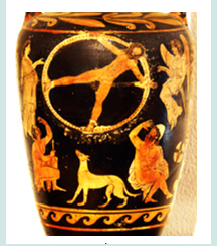
The image Annensky evokes in his audience’s mind is not only violent but also highly pictorial. He draws before his reader a flaming wheel, writhing snakes, animate spokes, and the tormented body of the spinning Ixion. The three-dimensional scene the Russian poet constructs appears more akin to a visual tableau than to a poetic image, which could be expected in a 20th-century verse play. The only clue to the mystery of Annensky’s departure from his customary lyrical mode of versification and his adoption of a graphic narrative style is found in his preface to the play, where the poet summarises the mythological plotline. Before addressing the literary sources for his play (Aeschylus, ‘ Sophocles,’ and Euripides’ fragmentary tragedies), Annensky mentions a Greek red-figure Campanian neck-amphora, now preserved in Berlin, which depicts the punishment of Ixion (Figure 1). The Russian poet describes the manner of Ixion’s bondage (‘Иксион привязан змеями к спицам огненного колеса’, ‘Ixion is bound with snakes to the axes of the fiery wheel’), the location of the wheel (‘колес[o] представлено колеблющимся в воздухе’, ‘the wheel is depicted as hovering in the air’), and the audience witnessing the torture (‘Около колеса изображен с одной стороны Гермес в островерхом шлеме, с другой - Гефест с клещами, а снизу Эринния с горящим факелом’, ‘On one side of the wheel, Hermes is depicted in a pointed helmet, on the other side Hephaestus, who holds tongs, and at the bottom, Erinys with a burning torch’). As can be seen from the image below, Annensky’s description of the vase is thorough, as every mythological figure is detailed. Ixion is depicted in rotation with ‘wild hair and a fierce or terrified expression [3]’ denoting his physical suffering, while two gods, Hermes and Hephaistos, admire their handiwork from below.
Figure 1: A red-figure Campanian neck-amphora depicting the punishment of Ixion. 4th century BC. Berlin [4].Different conceptions of human.
However, despite Annensky’s exhaustive commentary on the red-figure Cumae vessel, he does not explicitly convey his own interpretation of the vase, only hinting at a very implicit connection with the Classical visual tradition as a potential source of artistic inspiration. Although the poet cites only one Classical artifact in his introduction, several other visual representations of the legend of Ixion are evident across various media, including marble reliefs, sarcophagi, Greek vases, and Etruscan bronze mirrors, which deploy the spinning wheel not only as a pars pro toto for the whole mythological plotline, but as an illustrative example of divine vengeance [5]. A red-figure kantharos, dated to the mid-fifth century, by the Amphitrite painter, depicts the moment of Ixion’s punishment, as he is conveyed by Hermes and Ares, while Athena carries the winged wheel behind them:
A shared iconographic pattern ties together each representation of the Ixion legend, with the spinning wheel and the hero’s prostrate body serving as the dominant themes of the composition Figure 2. Secondary motifs, such as the audience witnessing the torture or the nature of Ixion’s bondage, seem to be essential to the iconography of the legend, although specific details may vary. Thus, it can be suggested that the visual representation of the mythological narrative was fundamentally stable and aimed to convey a single message to its audience: the horror of divine vengeance.
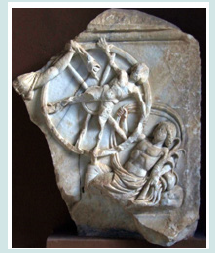
Archaeological and sculptural evidence suggests that the mythological plotline was primarily associated and defined by Ixion’s physical torture on the wheel. A marble relief, depicting Ixion’s torture, shows the wheel in mid-spin, with Ixion’s spreadeagled figure carved at a slight angle:
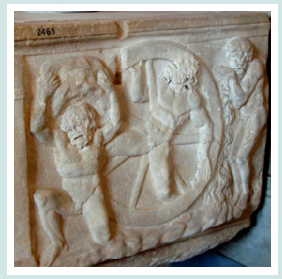
A Roman sarcophagus, depicting Ixion, Sisyphus, and Tantalus with their respective punishments, indicates that the Roman visual tradition used the figure of Ixion to evoke scenes from the underworld Figure 3. The contorted mouth of Sisyphus and the twisted, straining figure of Ixion illustrate the horrors of Hades and the punishment resulting from hubris against the gods.
Figure 2: A Red-figure Kantharos, Amphitrite Painter. London E155. Mid 5th century BC [6].
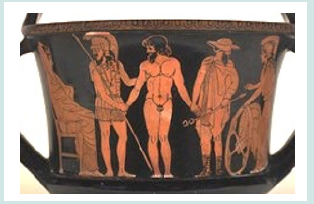
Figure 3: Relief with the punishment of Ixion. Side Archaeological Museum, Turkey. 2nd century BC [7].
The crucial role of the wheel in antiquity, not only as an emblem of the mythological plotline but also as an equalising element, which restores the balance of justice (Euripides’ reassures his audience that Ixion’s arrogance was duly punished at the end of his play, Plutarch’s Moralia 19 d-e), is completely transformed in Annensky’s rendition of the mythological plotline, where Ixion’s physical punishment is displaced outside the narrative framework (‘Иксиона заковывают и уводят’). In contrast to Euripides, who clearly states that the wheel was brought out on stage (‘οὐ μέντοι πρότερον αὐτὸν ἐκ τῆς σκηνῆς ἐξήγαγον ἢ τῷ τροχῷ προσηλῶσαι’) [9] and displayed to the audience, Annensky only describes the nature of the king’s punishment. The emphasis is thus shifted from the physical to the psychological, with Ixion’s inner torment becoming the driving force of the last scene Figure 4. Free from physical pain, Ixion is able to give a final insight into his relationship with the gods.
Figure 4: Sarcophagus with punishment of Sisyphus, Ixion and Tantalus in Hades; side panel depicts the myth of Laodamia and Protesilaus; Marble. 170 AD. Musei Vaticani. Roma [8].
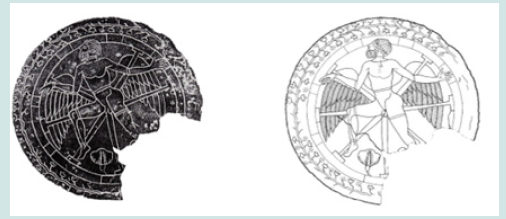
However, one of the visual representations of the legend of Ixion, an Etruscan bronze mirror from the 3rd century BC, presents a seemingly insoluble mystery to its audience. While it depicts the hero’s punishment on the wheel, the mirror not only lacks the same iconographic motifs as other Classical artifacts but also seems an unsuitable object to bear such a gruesome subject. Modern scholarship offers no solution to this mystery regarding Etruscan bronze mirrors, despite numerous studies on the depiction of mythological narratives on the reverse side of such artefacts [10]. Therefore, the aim of this paper is to provide a rational explanation for the presence of the scene of physical torture on a domestic tool and to suggest points of convergence between the Etruscan bronze mirror and Annensky’s graphic portrayal of Ixion’s punishment. Before analysing the Etruscan mirror in question and its unique iconographic features, it is necessary to place the artifact within a broader cultural context to understand the artistic choices behind its imagery.
Although the Etruscans are familiar to many by name and artifacts dating to the Etruscan period (circa 8th to 3rd century BC) can be found in almost every archaeological museum, the ancient civilisation, which once inhabited Tuscany, Umbria and Lazio [11], remains largely shrouded in mystery: little is known of Etruscan architecture, only a small number of Etruscan sources have survived, which could shed light on the culture and literature of the period [12], and even the Etruscan system of writing has not been fully deciphered to this day [13]. The cause of this virtual disappearance of the Etruscan civilisation has been ascribed to a nexus of military invasions: the victory of the Sicilian Greeks at Cumae in 474 BC, which broke the Etruscans’ naval hegemony [14], the invasion of the Gauls from the North [15] and most importantly the Roman rebellion of 510 BC, which saw Rome break free from the rule of Etruscan kings [16]. In 273 BC the last Etruscan city of Cerveteri fell and by the end of the 3rd century BC Etruria had completely submitted to the dominion of Rome. Rome’s successful conquest brought on what has been termed an ‘obliteration’ of Etruscan culture: Rome took over city administration, commerce and trade, and adopted Etruscan art and architecture, gradually transforming and assimilating it into its own [17]. A notable example is the first building of the Roman temple of Jupiter Optimus Maximus, dedicated to the greatest Olympian god, which was constructed by Etruscan masters in close adherence to Etruscan architectural canons [18].
Despite this systematic Romanisation of the Etruscan civilisation, art appears to have suffered the least. Four distinctive visual traditions can be determined in surviving artefacts: ornate vase painting, in particular Bucchero pottery [19], terracotta panel [20] and figurative sculpture [21]; tomb wall and domestic frescoes [22]; and most importantly for the present paper, metal craftsmanship, notably bronze mirrors, otherwise known as malena or malstria by the Etruscans. It is estimated that around three thousand Etruscan mirrors, dated between c. 540 and 100 BC, survive to this day [23], which are attributed to three distinct categories: grip mirrors, covered mirrors, and covered mirrors in wooden, hinged boxes. Covered mirrors, produced from the end of the fourth century, and later covered mirrors in boxes, produced in the late third century, resembled modern-day compacts, with a protective lid attached by hinges to the outer side of the mirror [24]. This lid appears to have served the dual purpose of protecting the mirror’s surface and acting as an illuminating device that reflected light onto the user’s face [25]. The outer surfaces of the compact would have been ornate, with floral motifs and concentric designs being popular options. Often, the lid was adorned with a more specific figurative design. However, the first category, grip mirrors, forged in one piece or with a separate welded handle, were the most common style produced from 530 BC-520 BC.
Four categories of ornamentation can be distinguished in relation to grip mirrors in particular (these categories are likewise applicable to the other two types of Etruscan mirror but are more vividly represented by the numerous grip mirrors that survive to this day): daily life, Etruscan mythological figures, floral and animal image, and Greek gods and heroes, which were by far the most popular theme [26] The last of these four categories can be distinguished with the help of two diverse identifications: either by characteristic iconographical conventions (for example a female figure clad in a helmet, an aegis, and bearing a spear is likely to be Athena) or by inscription. Certain mythological figures, such as Athena and Zeus, or even Herakles, prevalent in all forms of Classical iconography (vase painting, marble reliefs, and freestanding sculpture, etc.), are also recurrent on Etruscan bronze mirrors, and thus cannot, due to their popularity, provide an original insight into Classical mythology and its representation. In contrast to frequently depicted subject matters, a number of mythological characters, scarcely represented in Classical art, are shown on one or two individual Etruscan mirror surfaces, offering us a rare insight into the ancient understanding of Greek mythology. To this category belongs an Etruscan bronze mirror of the 3rd century BC, representing the lonely figure of Ixion, the legendary king of the Lapiths. The back of this bronze mirror, now preserved in the British Museum, provides a rare glimpse not only into the Classical myth of Ixion but also, as shall be demonstrated later in the paper, into Annensky’s treatment of the punishment scene.
As can be seen from the image above, the reverse of the Etruscan bronze mirror presents the bare figure of Ixion tied to a huge spinning wheel Figure 5. The wheel takes up most of the surface area of the mirror’s reverse, with Ixion affixed to it by his limbs and torso in a dynamic pose, indicating that the wheel is in motion. The spaces between the wheel’s axes are shown with the help of natural imagery (flowers and an ivy garland around the outer edge of the wheel), which, considering the function of the mirror, most likely had an ornamental role. The tautness of the restraints which bind Ixion emphasise the physical pain inflicted by the wheel, reasserting its role as a corporal punishment. As can be seen from the reverse of the mirror in question, Etruscan iconography appears to have endowed Ixion’s wheel primarily with an emblematic role of mortal punishment.
Figure 5: Etruscan engraved bronze mirror of the legend of Ixion. British Museum, London. 3rd century BC [27].
Consequently, a question inevitably arises regarding why the writhing figure of a tormented sinner adorns the reverse side of an Etruscan bronze mirror, a decidedly domestic item. The assumed ownership of the mirror does not provide an answer. While a scene of physical violence would have been socially more acceptable and even desirable to a male audience, and men certainly must have relied on mirrors for personal grooming and possibly shaving, historical and archaeological evidence indicates that mirrors were primarily female trinkets. Otto Brendel asserts that ‘the customers for these objects were women’ and points to a substantial body of evidence suggesting that mirrors were created for female consumers. Eight mirrors engraved with their owners’ names have been discovered, all of which are female. It has been hypothesised that mirrors were presented as bridal or marital gifts, given to girls entering into womanhood or presented to female relatives, most notably mothers. An example of this would be a fourth-century mirror depicting Venus and Adonis, with an inscription reading ‘tite cale:atial:turce malstria:cver’, ‘Titus Calus gave this mirror to his mother as a gift’ [28]. Such intended ownership makes it all the more of a mystery as to why the myth of Ixion would be depicted on a mirror. Indeed, at first glance it hardly seems a suitable subject to present to a mother, daughter or bride.
Several explanations have been proposed to clarify the presence of gruesome scenes on mirrors. For instance, Nancy de Grummond suggests that a depiction of battle or wrestling may have been engraved on a woman’s mirror to ‘please the men who might attend them in an intimate setting. ‘ Another theory is that violent scenes, such as Achilles murdering Troilus, ‘were chosen especially for funerary purposes,’ given that many mirrors have been found in burials. However, none of these explanations align with the iconography of the bronze mirror in question, as the sprawled figure of Ixion is hardly a heroic battle or wrestling scene, nor does it represent a bloody sacrifice suited to a funerary context. Instead, three different potential explanations can be proposed. The first of these explanations and the simplest, is that a round mirror invites a round subject matter. Engraving a wheel on a round reverse side of a mirror seems logical in terms of craftsmanship. This explanation must, however, be dismissed as banal and pedestrian for the simple reason that many other iconographic motifs are spherical in shape. Obvious examples would be lunar or solar imagery, yet they are not routinely depicted upon round mirrors. Furthermore, it is apparent from other extant mirrors that Etruscan bronze-cutters did not lack technical skill and so were not confined to simplistic designs. Therefore, other explanations must be sought. The myth of Ixion is esoteric and fairly marginal to Greek mythology (unlike the myths of Heracles which attracted great iconographic attention), so its use in this instance is remarkable and unusual to say the least.
Two other explanations based on the semantics and symbolism of the myth seem more promising. However, to explore them, it is first necessary to examine the literary renditions of the plotline. The legend of Ixion survives in numerous Classical and early and late Medieval oral and literary sources, including The Iliad, Pindar’s Pythian Ode II, Ovid’s Metamorphoses, Propertius’ Elegies, Horace’s Odes, Virgil’s Aeneid and Georgics, Boethius’ De Consolatione Philosophiae III, xxiv, and Tzetzes’ Chiliades 9.273, to name just a few. A cumulative study of these sources reveals the general outline of the mythological plotline: Ixion slays the sire of his wife, Dia, who comes to him to receive the dowry from her sonin- law; Ixion is stricken by insanity; Zeus cleanses him of the stain of his crime and invites him to live among the deities of Olympus; Ixion lusts after the divine wife of Zeus, Hera, and wishes to unite with her; Zeus creates a cloud effigy of Hera to trick Ixion, who falls into the trap and unites with the effigy; dreadful progeny is born as a result of this union; finally, Ixion is affixed to a revolving wheel as punishment for his hubris. The fullest account of the legend can be found in an early Greek poetic source, Pindar’s Pythian Ode II, commonly dated to the 5th century BC.
From Pindar’s rendition of the plotline, it becomes clear that the mythological narrative of Ixion is based on two distinct elements that drive the plot: infidelity and deception. As will be shown later in the paper, both elements are crucial to the representation of Ixion on the Etruscan bronze mirror. The first element, infidelity, is closely tied not only to Ixion, who attempts to seduce Hera, the wife of Zeus, but also to Zeus himself. In the Iliad, where Ixion’s name is first mentioned, Zeus, confessing his love for Hera, compares his passion for her to the feelings he had for his other paramours (‘οὐδ᾽ ὁπότ᾽ ἠρασάμην Ἰξιονίης ἀλόχοιο, / ἣ τέκε Πειρίθοον θεόφιν μήστωρ᾽ ἀτάλαντον’, 317-18), including Ixion’s wife Dia (‘Ἰξιονίης ἀλόχοιο’) and other figures like Demeter, Danaë, Alcmene, Pasiphaë, Semele, and Leto. According to the mythological storyline, Ixion not only crosses marital boundaries by desiring the wife of Zeus, but Zeus also acts unfaithfully by lusting after his wife and fathering a son with her, named Peirithous in the Iliad (317-18).
Thus, a second explanation for the presence of Ixion’s wheel on the back of our mirror becomes apparent. Since mirrors were often given as bridal gifts, depicting a mythological figure punished with eternal torment for infidelity makes sense. A young bride only has to glance at the back of her mirror to see the consequences of attempting to cross marital boundaries. With Ixion’s contorted figure emphasized in punishment, his limbs spread wide and bound tightly by fetters, the warning is unmistakable. However, a further and more obscure, almost allegorical explanation for the depiction of Ixion’s wheel on the Etruscan mirror can also be posited, based upon the main semantic centre of the plot: deception. Ixion’s first crime, the murder of his father-in-law is committed by means of deception, since he sets him a trap, in the form of a disguised pit, into which the unfortunate man falls and burns alive. Secondly, the mythological plot of Ixion rests upon a crucial concept in Antiquity, xenia or more in this instance theoxenia, the observance of a proper host-guest relationship. On Zeus’ side of the relationship, all requirements of theoxenia are adhered to completely: [29] Ixion is endowed with the highest honour of living among the gods of Olympus: ‘εὐμενέσσι γὰρ παρὰ Κρονίδαις γλυκὺν ἑλὼν βίοτον, μακρὸν οὐχ ὑπέμεινεν ὄλβον’ (25-6) [30]. Furthermore, Ixion is allowed entrance to Zeus’ own palace, granting him open access to the most secluded locations of the dwelling (‘μεγαλοκευθέεσσιν ἔν ποτε θαλάμοις’, 34) [31]. However, in contrast to Zeus’ observance of xenia, Ixion breaches every duty of a proper guest: he wishes to possess the property of his host and he endeavors to perpetrate theft by desiring to rape Hera. By his actions Ixion dishonours Zeus’s household and so ends the special connection between his divine host and himself as guest.
In response to Ixion’s deceit, Zeus retaliates with his own form of deception, manifesting in the creation of a cloud effigy designed to deceive Ixion into believing he is entering into a relationship with Hera: ‘ἅντε δόλον αὐτῷ θέσαν Ζηνὸς παλάμαι… ἀθανάτῃς δὲ θεῇς εἰς ὦπα ἐίσκειν παρθενικῆς καλὸν εἶδος ἐπήρατον’ (39- 40). Like Pandora, a similarly deceptive female figure created at Zeus’s behest, the effigy acts as ‘a snare’ (‘δόλον’): both artificially manufactured females are deceptive in appearance, designed to seem like what they are not (the effigy tricks Ixion into believing he is lying with Hera; Pandora is made to resemble an innocent virgin). The motif of Zeus’s deception is reinforced throughout five consecutive lines of poetic text, with terms such as ‘ψεῦδος’ (‘trick’, 37), ‘εἶδος’ (‘a semblance’, 38), ‘δόλον’ (‘a trap’, 39), and ‘παλάμαι’ (‘wily’, 40), emphasising the god’s role in fashioning the false creature. Thus, both sides of Ixion’s and Zeus’s bond, central to the mythological plot, are undermined by deception: Ixion deceives his host, and Zeus in turn tricks his guest.
It can be suggested that this inherent duplicity is the missing link between the mirror’s iconography and Ixion’s myth, as a common concept of deception and illusion unites the two. Just as a mirror reflection relies on a visual deception of the eye by offering a reversed image of reality, Ixion’s myth is grounded in a binary delusion, affecting both the hero, who deceives the gods, and the gods themselves, who respond by creating a deceptive visual illusion. Consequently, Ixion’s wheel is a fitting subject to depict on a mirror, as it symbolizes the intertwined concepts of deception and punishment. It can thus be suggested that the scene depicted on the Etruscan mirror serves a dual function. First, it is admonitory, acting as a warning to its user about the repercussions of deception, particularly marital infidelity. Second, and importantly, the wheel of Ixion embodies the idea that if illusion is punishable, the present mirror will not deceive its mistress for fear of retribution. The image on the reverse of the mirror effectively speaks to its owner, reassuring her that what she sees is the truth. The iconography of the Etruscan mirror, which depicts the punishment of Ixion and may initially seem incongruous with a female trinket, is both fitting and eloquent: it not only warns its mistress but also reassures her, integrating a heroic myth into the domestic sphere.
Thus, a solution to the seemingly insoluble mystery of why a torture device and the contorted body of a mortal criminala murderer and sacrilegious rapist- would be carved onto a female domestic implement has been proposed. The image of the wheel on the Etruscan bronze mirror can be seen as having an almost allegorical function, since it both warns, reassures, and perhaps even teases the mirror’s mistress. However, the mystery remains as to why Innokenty Annensky favoured a graphic, pictorial description of Ixion’s torture over a more covert, lyrical representation of divine punishment, as present in the other three mythological tragedies of the Russian poet. An example of such a conclusion can be found in the tragedy Famira-Kifared, where the eponymous hero blinds himself offstage, and the details of his physical suffering remain shrouded from the audience. This second mystery can likewise be solved by referring to the Classical donor tradition. As shown in the paper, only scant evidence of the literary treatment of the legend survives from Antiquity; thus, the visual tradition can be proposed as a potential source for the Russian poet. Specific iconographic details, such as the nature of Ixion’s bondage (snakes), the fiery essence of the wheel (flames radiating from the rim), clearly defined spokes (Ixion’s limbs in Annensky; Ixion’s limbs bound to actual spokes in Classical art), the divine audience of the punishment (e.g., Hermes), the presence of Hephaestus as a smithy, as well as the wheel’s ability to revolve and its location (in the aether as opposed to Hades), are all shared among extant visual representations of Ixion’s torture and the conclusion of Annensky’s mythological tragedy.
However, a more intricate point of correspondence can be presented, connecting Annensky’s rendition of Ixion’s punishment with the Classical visual tradition as exemplified by the Etruscan bronze mirror, not only in terms of iconographic detail but, more significantly, in terms of secondary semantic function. In contrast to the Classical tradition where the wheel breaks both the body and mind of the punished hero, Annensky’s interpretation reveals the spiritual strength of his Ixion, distinguishing it from his frail, mortal body. Ixion’s parting words as he faces his torment are not curses or screams (‘You’re waiting for my curses… / people say / that when a man goes to his death or torture / he bids farewell and curses / No’), but rather expressions of forgiveness and calm endurance toward the gods who have deceived and tortured him: ‘And you, nymphs, may you blossom, and not forget to say my final pardon to Hera. ‘ Similar to the creator of the Etruscan bronze mirror, Annensky imbues Ixion’s wheel with a new, extended function, separate from its primary role as a torture device and aimed at conveying an additional layer of meaning to the audience, who are capable of discerning the allegory.
Thus, to conclude, the striking graphic representation of Ixion on the wheel in Annensky’s drama can be said to shed new light on Classical sources, which have not been analysed or interpreted before. The mystery of the bronze mirror which was brought to light due to Annensky’s unusual mode of narration in his mythological tragedy, serves as the crucial missing link not only for the interpretation of the visual representation of Ixion in Antiquity in synchrony, but also in diachrony, between Classical and 20th century Russian Neoclassical traditions.
References
- Nikolaev, P. 590.
- The original text is quoted from Annensky (2000) and translations of Russian and Classical texts are mine.
- Boyce J p.93.
- Image taken from Nava M L pp.48-49.
- Sixteen visual representations of the mythological plotline of Ixion survive. Boyce J L p.84.
- Image taken from British Museum Images: https://www.bmimages.com/
- Image taken from World History Encyclopedia: https://www.worldhistory.org/Ixion/
- Image taken from World History Encyclopedia: https://www.worldhistory.org/Ixion/
- I did not however take him off the stage before I had nailed him to the wheel. Moralia 19 d-e
- To name but a few: De Puma R D pp. 290-302; Jennifer R M pp. 144-145; De Puma R and Guthrie W pp. 19-29; Izzet V E pp.1–22; Carpino A A 2003.
- For more on the territorial range of the Etruria see Camporeale G pp. 18-21.
- Wallace R 2008.
- Rix H, Gerhard M, 1991; Bonfante G and Bonfante L 2002.
- Astour M pp. 33-34.
- See more in Harris W V pp. 356-8.
- Bloch R P.88.
- McCartney E S pp. 121-167.
- Warren L B p.54.
- Haynes S pp.56-57; Ramage N H pp. 1–61.
- Del Chiaro, M. A. pp. 119–122.
- Berge L pp. 2–5.
- Brendel O, Brendel O J, Ridgway F R, P.43-49; Holloway R R pp. 341–347; Riis P J pp.104-118; Brilliant R (1984).
- Van der Meer L B, p.5.
- De Grummond N T, p.8.
- Haynes S p.242.
- De Grummond N T, p.89.
- Images taken from https://www.britishmuseum.org/research/collection.
- Haynes S., p.239.
- Park A P.84.
- For although he acquired a blissful life among the sons of Chronus, he was not able to keep hold of his great gift.
- A spacious bed-chamber.
Editorial Manager:
Email:
archaeology@lupinepublishers.com
archaeology@lupinepublisher.com

-

Mark E Smith
Bio chemistry
University of Texas Medical Branch, USA -

Lawrence A Presley
Department of Criminal Justice
Liberty University, USA -

Thomas W Miller
Department of Psychiatry
University of Kentucky, USA -

Gjumrakch Aliev
Department of Medicine
Gally International Biomedical Research & Consulting LLC, USA -

Christopher Bryant
Department of Urbanisation and Agricultural
Montreal university, USA -

Robert William Frare
Oral & Maxillofacial Pathology
New York University, USA -

Rudolph Modesto Navari
Gastroenterology and Hepatology
University of Alabama, UK -

Andrew Hague
Department of Medicine
Universities of Bradford, UK -

George Gregory Buttigieg
Maltese College of Obstetrics and Gynaecology, Europe -

Chen-Hsiung Yeh
Oncology
Circulogene Theranostics, England -
.png)
Emilio Bucio-Carrillo
Radiation Chemistry
National University of Mexico, USA -
.jpg)
Casey J Grenier
Analytical Chemistry
Wentworth Institute of Technology, USA -

Hany Atalah
Minimally Invasive Surgery
Mercer University school of Medicine, USA -

Abu-Hussein Muhamad
Pediatric Dentistry
University of Athens , Greece