
 Email Us: info@lupinepublishers.com
 Call Us: +1 (914) 407-6109
57 West 57th Street, 3rd floor, New York - NY 10019, USA
Call Us: +1 (914) 407-6109
57 West 57th Street, 3rd floor, New York - NY 10019, USA


Lupine Publishers Group
Lupine Publishers
ISSN: 2690-5752
Short Communication(ISSN: 2690-5752) 
A Few Words about Chile Volume 8 - Issue 4
Received:August 22, 2023; Published: August 28, 2023
Corresponding author:João Vicente Ganzarolli de Oliveira, Professor and Researcher of the Tércio Pacitti Institute of the Federal University of Rio de Janeiro, Cidade Universitária, Rio de Janeiro (RJ, 21941-901), Brazil
DOI: 10.32474/JAAS.2023.08.000292
 Abstract
 PDF
PDFAbstract
The following lines are focused on Chile, a country I had the privilege of visiting many times, and which became one of the countries I love most. Rough edges, inadequacies and errors in general that remain are mine.
Figure 1: Chilean Patagonia (Photo taken by the Author in 1995).

Keywords:Chile; South America; Spanish Language; Politics; Catholic Church
El que lee mucho y anda mucho, ve mucho y sabe mucho.
Miguel de Cervantes Saavedra
Love beauty: it is the shadow of God on the universe.
Gabriela Mistral
Introduction
Among the mosaic of countries that are encompassed by the southern part of the so-called New World (America), only Equator, Paraguay, Uruguay, and the Guianas are smaller than Chile. One of the factors that gives Chile’s less than 800,000 square kilometers of land area such a wide range of climates and landscapes is its being one of the longest North-South countries of the world, since the climate, as we know, varies according to the latitude; however, considering only its mainland surface, Chile reveals itself as distinctive due to its narrowness from East to West. Also very important for the variety of microclimates and the geological composition of what we today call “Chile” is the fact that Chilean eastern frontier (in the North with Peru and Bolivia and in the rest of its length with Argentina) is settled along the Cordillera de los Andes, which is the longest and one of the tallest mountain range in our entire planet; endowed with nearly 900 peaks over 5.000 meters, the Andes diminish in heigh from Santiago southwards to the southern seas, where the Strait of Magellan lies, connecting the Pacific and the Atlantic oceans1.
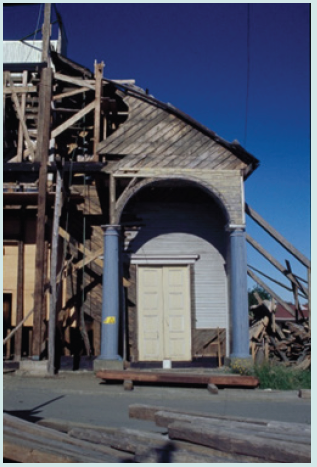
Figure 2: Chilean church being repaired (Photo taken by the author in the Chilean island of Chiloé, in 2004).
Body
Inhabited by humans since the last 18,500 years or more, judging by stone tools evidence2, the Chilean lands are now home to circa 18 million people, ethnically distributed as follows: 59% white, 25% mestizo (mixed indigenous and white), 8% indigenous, 8% unspecified3. In what concerns religion and statistically speaking, what we can say is that circa 63% of nowadays Chileans are Christians (45% Catholics, 15% Protestants, 3% other Christian denominations); 1% is classified as having “other” religion, whereas 36% have no religion at all4. Just like the great majority of Latin American countries, Chile has Spanish as official language, with a strong Chilean flavour, by the way. Indeed, the kind of Spanish used in Chile is quite distinctive in terms of accent and musicality; one example among many others is this: within Chilean national frontiers (and this holds also for Easter Island [which is geologically located in Polynesia] and the Austral Zone [which is part of Antarctica], Chilean main overseas territories), the final syllables of the words of Miguel de Cervantes’ and Gabriela Mistral’s language are often dropped, and some of its consonants are spoken with a particularly soft pronunciation.
Back to the mainland – or conti, as the inhabitants of Easter Island sometimes call it – and still in the field of the “Chilean Spanish”, one notices that the accent is more or less the same from North to South. Variations in accent do exist, but they have little or nothing to do with the latitude; instead, they relate to social standing and the dichotomy between urban and rural areas – always bearing in mind that “the Chilean population was largely formed in a small section at the centre of the country, and then migrated in modest numbers to the North and South, a fact that helps explaining this relative lack of differentiation in terms of language, which was maintained by the national reach of radio, and now television, which also helps to diffuse and homogenize colloquial expressions5.” On the other hand, one should not forget that several autochthonous languages are still utilized in Chile; we are talking about the Mapudungun, the Aymara, the Rapa Nui, the Chilean Sign Language and (barely surviving) the Qawasqar and the Yaghan – all of them along with non-indigenous German, Italian, English, Greek and Quechua. In the aftermath of the Spanish Conquest, Spanish took over as lingua franca, a situation that remains until our days.
Foot Notes
1 See Ben Box, Sebastian Ballard et alii. South American Handbook, 72nd edition, Bath, Trade & Travel, 1995, p. 610.
2 Cf. Bruce Bower. “People roamed tip of South America 18,500 years ago. Stone tools and charred animal bones from Monte Verde help to rewrite human history in the New World”, in https://www.sciencenews.org/article/people-roamed-tip-south-america-18500-years-ago, November 30, 2015.
3 Cf. Informe Latinobarómetro, 2011.
4 Cf. https://www.cadem.cl/wp-content/uploads/2020/10/Post-Plebiscito-VF.pdf.
5 https://en.wikipedia.org/wiki/Chile.
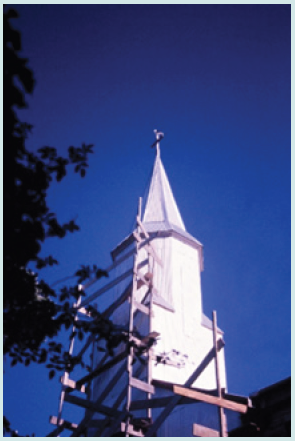
Figure 3: Chilean church being repaired (Photo taken by the author in the Chilean island of Chiloé, in 2004).
Conclusion
Chile is very rich in terms of natural resources (consider copper, whose mining makes up 20% of Chilean GDP and 60% of exports, always remembering that the Chilean copper mine of Escondida is the largest one in the entire world, producing over 5% of global supplies, and that, overall, a third of the world’s copper production is of Chilean origin), an advantage that could grant each of its citizens a good standard of living. Such was the goal of the Chilean central government during most of the 1970s and throughout the 1980s. Subjected to the backs-and-fourths of economics and politics in general (as is the case of every single country on earth: suffice to remember Babylon, ex-centre of an empire, nowadays an abandoned archaeological site inside a ruined country), Chile has been experiencing a growing instability since the end of the 1990s, which has escalated in this already tragic 21st century. Infiltrated by communists and leftists in general, Chile has become a theatre of a real ideological war in the last four years or so; churches have been burnt, the hammer & the sickle have been praised, and the fact that Chile is the cradle of saints like Alberto Hurtado (1901-1952) and Teresa of Jesus of Los Andes (1900-1920) has been forgotten. Hopefully, as Jesus Christ himself made it clear, the Church He founded is an institution against which the gates of hell shall not prevail (cf. Mt 16,18).
Editorial Manager:
Email:
archaeology@lupinepublishers.com
archaeology@lupinepublisher.com

-
Mark E Smith
Bio chemistry
University of Texas Medical Branch, USA -
Lawrence A Presley
Department of Criminal Justice
Liberty University, USA -
Thomas W Miller
Department of Psychiatry
University of Kentucky, USA -
Gjumrakch Aliev
Department of Medicine
Gally International Biomedical Research & Consulting LLC, USA -
Christopher Bryant
Department of Urbanisation and Agricultural
Montreal university, USA -
Robert William Frare
Oral & Maxillofacial Pathology
New York University, USA -

Rudolph Modesto Navari
Gastroenterology and Hepatology
University of Alabama, UK -
Andrew Hague
Department of Medicine
Universities of Bradford, UK -
George Gregory Buttigieg
Maltese College of Obstetrics and Gynaecology, Europe -
Chen-Hsiung Yeh
Oncology
Circulogene Theranostics, England -
.png)
Emilio Bucio-Carrillo
Radiation Chemistry
National University of Mexico, USA -
.jpg)
Casey J Grenier
Analytical Chemistry
Wentworth Institute of Technology, USA -
Hany Atalah
Minimally Invasive Surgery
Mercer University school of Medicine, USA -
Abu-Hussein Muhamad
Pediatric Dentistry
University of Athens , Greece