
 Email Us: info@lupinepublishers.com
 Call Us: +1 (914) 407-6109
57 West 57th Street, 3rd floor, New York - NY 10019, USA
Call Us: +1 (914) 407-6109
57 West 57th Street, 3rd floor, New York - NY 10019, USA


Lupine Publishers Group
Lupine Publishers
ISSN: 2690-5752
Short Communication(ISSN: 2690-5752) 
Study on the Co-Management Model of Serial World Natural Heritage Sites and the Practice in China Volume 8 - Issue 4
Received:October 17, 2023; Published: October 30, 2023
Corresponding author:Xiao Shizhen, School of Karst Science, Guizhou Normal University/State Engineering Technology Institute for Karst Desertification Control, Guiyang, Guizhou, 550001, China
DOI: 10.32474/JAAS.2023.10.000299
 Abstract
 PDF
PDFAbstract
World heritage is the common wealth of all mankind. World Natural Heritage is the most important and unique natural landscape in the world. There are many serial world heritage sites and its coordinated protection and management is very important. In this study, the South China Karst World Natural Heritage and the China Danxia World Natural Heritage in China were selected as the empirical study areas to explore the collaborative co-management model of serial World natural heritage sites. Two models were figured out including National Administration - Transprovince Coordination Committee-Site management Model and National Administration - Transsite Coordination Committee-Site management Model, which have been playing significant roles in co-management of serial world natural heritage properties. This study provides an important reference for the effective comanagement of serial World natural heritage sites.
Keywords:Serial World Natural Heritage; co-management model; South China Karst; China Danxia
Introduction
World Heritage is our common world level legacy, with outstanding universal value, from the past, what we live with today, and what we pass on to future generations. Our world cultural and natural heritage are both irreplaceable sources of life and inspiration. World Heritage sites belong to all the peoples of the world, irrespective of the territory on which they are located. World heritages are identified under in an international treaty called the Convention concerning the Protection of the World Cultural and Natural Heritage, adopted by UNESCO in 1972, through a universal and strict application process. Till now, there are 1199 properties in total located in 168 States Parties out of 195. Among the properties, some are called serial properties because they have two or more component parts, reflecting cultural, social or functional links over time that provide, where relevant, landscape, ecological, evolutionary or habitat connectivity, and contributing to the Outstanding Universal Value of the whole property. A serial property may occur on the territory of a single State Party, which is called serial national property, or within the territory of different States Parties, which is called serial transnational property or transboundary property. There are currently 48 transboundary properties in the world located in 72 state parties. The number of serial national property is deficient but can be expected for more than that of transboundary properties.
Protection and management of World Heritage properties should ensure that their Outstanding Universal Value, including the conditions of integrity and/or authenticity at the time of inscription, are sustained or enhanced over time. The protection and management of serial World Heritage properties are facing more challenges as it across different administrative units. World Heritage sites that cross national borders add to the difficulties of heritage conservation and management. Conflicts over the development and management of heritage resources in heritage sites across administrative areas in the same contracting party are relatively prominent, mainly due to the competition for heritage tourism resources [1]. It is required in the Operational Guidelines for the Implementation of the World Heritage Convention that (UNESCO WORLD HERITAGE CENTRE, 2021): in the case of serial properties, whether national or transnational, a management system or mechanisms for ensuring the coordinated management of the separate components are essential and should be documented in the nomination. The States Parties concerned shall establish a joint management committee or similar body to oversee the management of the whole of a nominated serial transnational property.
Figure 1: The Collaborative co-management of the South China Karst.
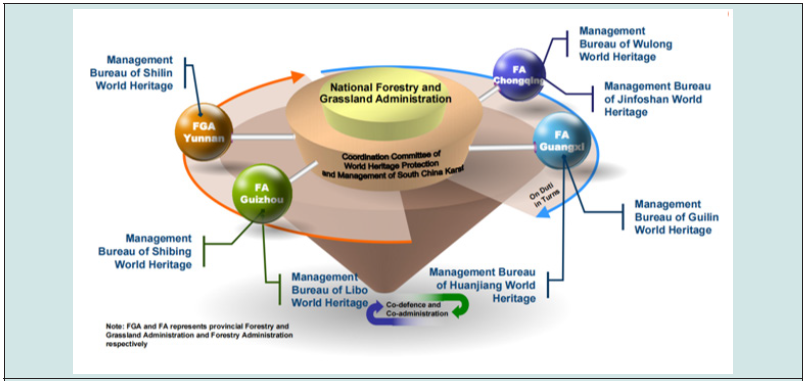
Figure 2: The Collaborative co-management of the China Danxia.

Qualitative research methods are often used to carry out comparative analysis on serial world heritage sites, to explore the similarities and differences in conservation management between different boundary management subjects [2], and to make up for the differences in conservation management through crossnational learning based on different management experiences [3]. A series of inheritance management models and management mechanisms have also been the focus of scholars’ discussions [4,5], and on this basis, put forward the localization research of heritage management. However, at present, the research on the comanagement model of serial World natural heritage is insufficient. Therefore, in this study, South China Karst, China Danxia World Natural Heritage in China were chosen as the empirical research areas to explore the collaborative co-management model of serial world heritage properties.
Table 1. The basic information of the South China Karst WNH property.
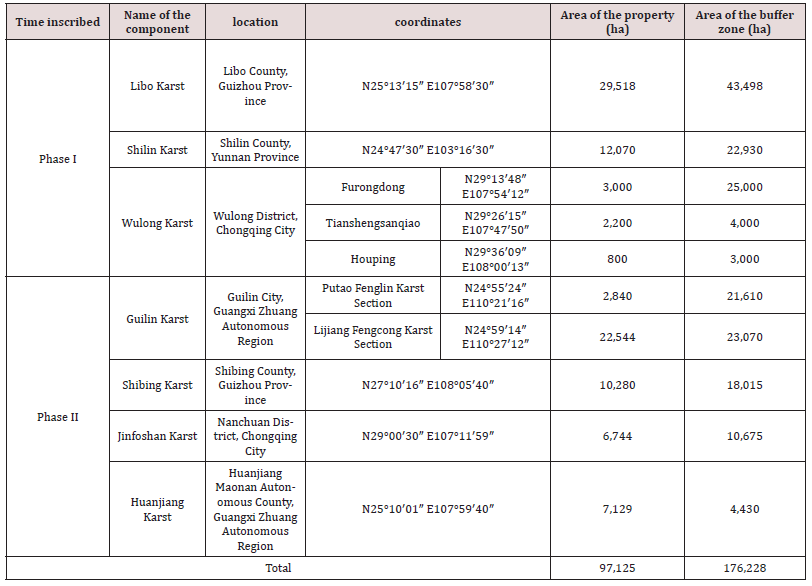
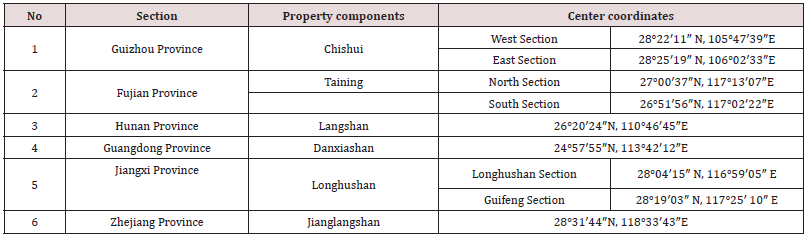
Table 2.The basic information of the China Danxia WNH property.
Study Areas
The South China Karst
The South China Karst is a serial world natural heritage that was submitted in two phases by China to the World Heritage Committee of UNESCO. Phase I properties were inscribed on the World Heritage List in 2007, comprising three components: Shilin Karst (Yunnan), Libo Karst (Guizhou) and Wulong Karst (Chongqing). The Phase II comprises four components: Guilin Karst (Guangxi), Shibing Karst (Guizhou), Huanjiang Karst (Guangxi), and Jinfoshan Karst (Chongqing). The World Heritage Property is a serial property that includes seven karst clusters in four Provinces. The total area is 97,125 hectares, with a buffer zone of 176,228 hectares. The property contains the most spectacular, scientifically significant and representative series of karst landforms and landscapes of South China from interior high plateau to lowland plains.
The China Danxia
China Danxia is a serial world natural heritage property comprising six components found in six provinces of China including Chishui Danxia in Guizhou Province, Taining Danxia in Fujian Province, Langshan Danxia in Hunan Province, Danxiashan in Guangdong Province, Longhushan in Jiangxi Province and Jianglangshan in Zhejiang Province. China Danxia is unrivaled in its rich warm and humid climate red-beds sandstone landform geomorphologic features characterized by spectacular red cliffs and a range of erosional landforms, including dramatic natural pillars, towers, ravines, valleys and waterfalls. China Danxia is also noted as a natural aesthetic landscape comprising red rocks, green vegetation, blue water and white clouds [6,7].
Collaborative co-management of serial and transboundary World Natural Heritage sites
National Administration - Transprovince Coordination Committee-Site management Model
The South China Karst World Natural Heritage is serial world heritage crossing four provinces of China, and the effective coordination has been attached great importance by the international society. It was required in 2007 by the World Heritage Committee that “Potential for further extension of the property requires development of a management framework for effective coordination between the different clusters” [8]. In 2014, the World Heritage Committee stated again that “Long term protection and management requirements for the component parts of the South China Karst include the need to ensure coordination throughout the serial site as a whole, through the establishment of a Protection and Management Coordination Committee for the South China Karst World Heritage” [9].
The South China Karst set up a good example of collaborative co-management, representing National Administration - Transprovince Coordination Committee-Site management Model. The national department responsible for the World Natural Heritage is the National Forestry and Grassland Administration, which is mainly responsible for guiding the draft laws, regulations and departmental rules of the South China Karst World Natural Heritage, formulating relevant policies, plans and standards and organizing their implementation, organizing and carrying out resources survey, protection and construction, ecological restoration, monitoring and evaluation. Coordination Committee of World Heritage Protection and Management of the South China Karst was set up to coordinate the protection and management of seven sites [10]. The Chinese Academy of Forestry, a comprehensive, multidisciplinary and public welfare national research institution directly under the State Forestry and Grassland Administration, assists in the protection and management of heritage sites. The secretariat of the Coordination Committee of World Heritage Protection and Management of the South China Karst is set in the Ecology and Nature Conservation Institute of the Chinese Academy of Forestry, and is responsible for coordination and management. Each provincial Forestry and Grassland Administration, including Phase I and Phase II, together coordinates and an on duties in turn mechanism. These authorities in turns (every four years) organize evaluation and provides suggestions on implementation of protection and management. They meet at least once a year. Management Bureau of each component of the South China Karst World Natural Heritage was set in in the City (County) where the property is located to manage the Properties directly. Since Libo Karst and Huanjiang Karst are completely contiguous, a joint Codefence and Co-administration mechanism has been set up within Libo Karst and Huanjiang Karst for coordinated management.
National Administration - Transsite Coordination Committee-Site management Model
The China Danxia is currently the serial world natural heritage involving the most provinces in China, hence of high pressure and difficulty in its coordinated protection management. The situation is the same as that of the South China Karst, the National Forestry and Grassland Administration is responsible for the overall supervision and management guidance of the China Danxia.
However, the coordination management mechanism is a little different. After the successful inscription of China Danxia, the “China Danxia World Natural Heritage Protection Committee” was established by the six provinces, with the head of the Forestry Administration of Hunan Province as the chair, the head of Forestry Administrations of the other five provinces as the deputy chairs, and six heritage sites as members, with the collaboration of scientific committee. The committee has formulated working rules, established a rotating system for the China Danxia Annual Conference, held a theme event every year, and held a working meeting to jointly study and solve the main problems in the protection and development of the heritage sites. China Danxia World Natural Heritage Protection Committee led scientific research, strengthened monitoring of heritage resources, and organized the compilation of the third Periodic Reporting on China Danxia World Natural Heritage, providing scientific support for deepening coordinated conservation. Guide each component to vigorously promote the legislative work, through the formulation and implementation of local regulations, to provide legal guarantee for collaborative protection. China Danxia World Natural Heritage Professional Conservation Committee held various training courses to improve the level of coordinated conservation and management of various heritage sites, and promote the organic integration of coordinated conservation and sustainable development. From 2010 till now, the China Danxia World Natural Heritage Protection Committee has held 12 consecutive working meetings. The China Danxia set up a good example of collaborative co-management, representing National Administration - Transsite Coordination Committee-Site management Model.
Discussion and Conclusion
The coordinated conservation and management among the various components of a serial world heritage sites is an important measure to ensure that each part of the heritage can be fully and effectively protected and managed. The establishment of coordinated management mechanism, the construction of coordinated protection planning system, the coordination of legislation and law enforcement, the coordination of monitoring and research, and the coordination of sustainable development are all effective ways to achieve good coordination. Good examples happen also in other countries. Strong transboundary collaboration between the States Parties of Italy and Switzerland is in place, including mechanisms that are agreed by all of the local municipalities in both countries, through common signed accords and declarations; A strategic transnational board (Cross-border board of the Monte San Giorgio municipalities), composed by the plenary assemblies of the two Foundations (Swiss and Italian), by the 2 site managers and by the scientific manager (these latter with advisory role, without right to vote) was set up [6,7].
Both the South China Karst and the China Danxia set good examples in co-management of serial world natural heritage sites. The co-management model of the two serial world natural heritage sites are similar but a little bit different. Two models can be referenced including National Administration - Transprovince Coordination Committee-Site management Model and National Administration - Transsite Coordination Committee-Site management Model. It has formed a unified and interconnected management system, strengthened the protection of the South China Karst World Natural Heritage, which covers four provinces, and the China Danxia World Natural Heritage, which covers six provinces, and established a protection and management model with Chinese characteristics, which has been appraised by the World Heritage Committee. The most important is to establish a cooperative co-management model suitable for different serial heritage sites. In the future, we need to continue to carry out cross-administrative regional collaborative heritage protection exploration, strengthen collaborative protection efforts, strengthen publicity and exchanges and cooperation.
Acknowledgments
The research was supported by Guizhou Provincial Key Technology R&D Program: A study on the conservation model with technology and sustainable development demonstration of the World Natural Heritages in Guizhou (No. 220 2023 QKHZC).
References
- Yang Xiaoshuang (2022) Establishment of the management effectiveness assessment system of cross-county world natural heritage and empirical analysis——a case study of Fanjingshan. Guizhou Normal University, China.
- Makuvaza S (2012) Who Owns the Special Area at Victoria Falls World Heritage Site? Political, Organizational and Governmental Interests. The Historic Environment: Policy & Practice 3(1): 42-63.
- Svels K, Sande A (2016) Solving landscape-related conflicts through transnational learning? The case of transboundary Nordic World Heritage sites. Landscape Research 41(5): 524-537.
- Liang Mingzhu, Wang Wei (2011) Study on trans-regional serial World Heritage management mechanism. Economic Geography 31(07): 1202-1206.
- Xu Xiaoqian (2009) Research on the management Model of Serial World Heritage projects in China [D]. Jinan University, China.
- (2010) UNESCO World Heritage Committee, Decision 34 COM 8B.1, Natural properties - China Danxia.
- (2010) UNESCO World Heritage Committee. Decision 34 COM 8B.6, Natural Properties- Monte San Giorgio.
- (2007) UNESCO World Heritage Committee, Decision 31 COM 8B.11, Nomination of natural, mixed and cultural properties to the world heritage list-South China Karst.
- (2014) UNESCO World Heritage Committee. Decision 38 COM 8B.9, South China Karst (China) (extension).
- Adie B A, Amore A (2019) Transnational World Heritage, (meta)governance and implications for tourism: An Italian case. Annals of Tourism Research 80(1): 102844-102848.
Editorial Manager:
Email:
archaeology@lupinepublishers.com
archaeology@lupinepublisher.com

-

Mark E Smith
Bio chemistry
University of Texas Medical Branch, USA -

Lawrence A Presley
Department of Criminal Justice
Liberty University, USA -

Thomas W Miller
Department of Psychiatry
University of Kentucky, USA -

Gjumrakch Aliev
Department of Medicine
Gally International Biomedical Research & Consulting LLC, USA -

Christopher Bryant
Department of Urbanisation and Agricultural
Montreal university, USA -

Robert William Frare
Oral & Maxillofacial Pathology
New York University, USA -

Rudolph Modesto Navari
Gastroenterology and Hepatology
University of Alabama, UK -

Andrew Hague
Department of Medicine
Universities of Bradford, UK -

George Gregory Buttigieg
Maltese College of Obstetrics and Gynaecology, Europe -

Chen-Hsiung Yeh
Oncology
Circulogene Theranostics, England -
.png)
Emilio Bucio-Carrillo
Radiation Chemistry
National University of Mexico, USA -
.jpg)
Casey J Grenier
Analytical Chemistry
Wentworth Institute of Technology, USA -

Hany Atalah
Minimally Invasive Surgery
Mercer University school of Medicine, USA -

Abu-Hussein Muhamad
Pediatric Dentistry
University of Athens , Greece